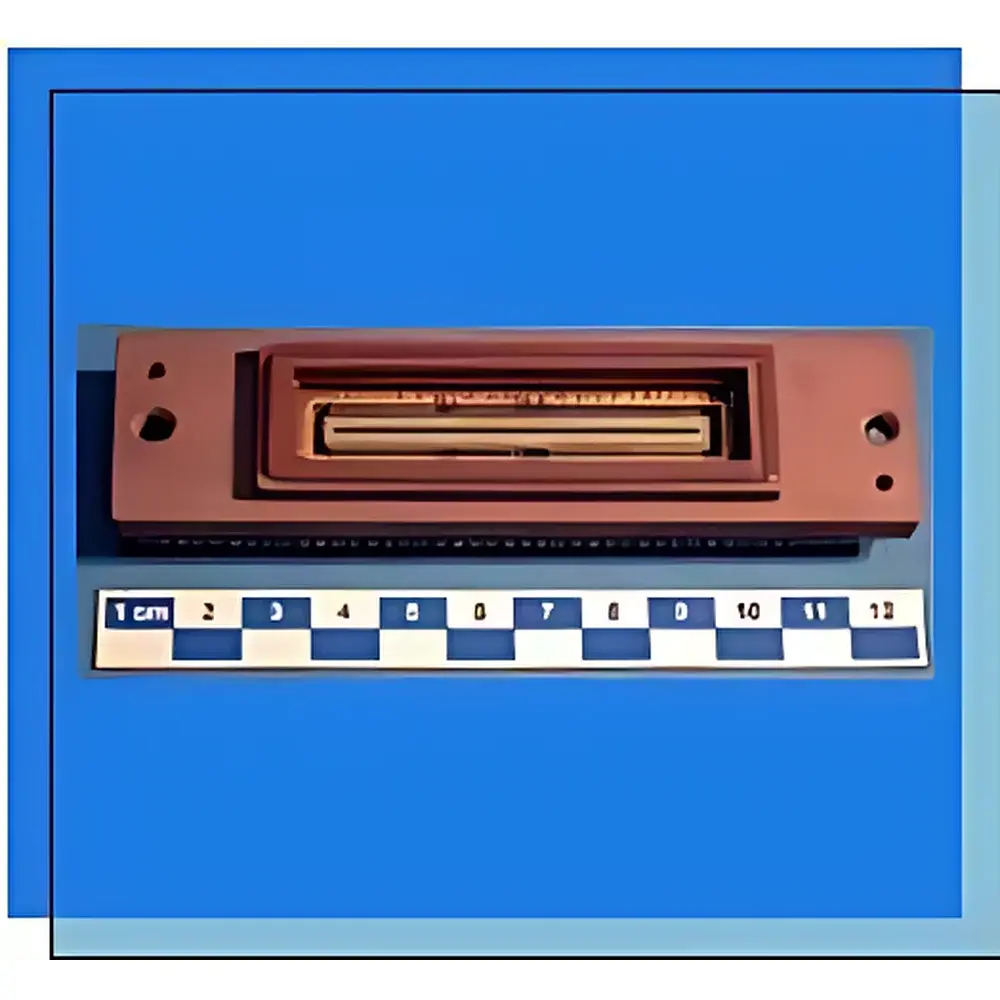
TDI CCD Image Sensor Series – Fairchild Semiconductor (now ON Semiconductor) CCD296 / CCD525 / CCD5061 / CCD8091 / CCD10121
| Origin | USA |
|---|---|
| Manufacturer Type | Authorized Distributor |
| Origin Category | Imported |
| Model Numbers | CCD296, CCD525, CCD5061, CCD8091, CCD10121 |
| Pricing | Available upon Request |
Overview
The TDI CCD Image Sensor Series — comprising the CCD296, CCD525, CCD5061, CCD8091, and CCD10121 — represents a family of high-performance, time-delay integration (TDI) charge-coupled device sensors engineered for precision line-scan imaging under low-light or high-speed motion conditions. Unlike conventional area-scan or single-line CCDs, TDI sensors accumulate signal charge synchronously with object motion across multiple rows of pixels, delivering significant signal-to-noise ratio (SNR) enhancement without mechanical scanning or frame averaging. This architecture is especially critical in applications requiring continuous, distortion-free imaging of moving objects — such as conveyor-based X-ray inspection, postal sorting, PCB automated optical inspection (AOI), and high-resolution dental panoramic radiography.
Key Features
- Time-Delay Integration (TDI) architecture enabling high-sensitivity, motion-synchronized imaging with up to 128-stage charge transfer;
- Multi-output parallel readout architecture (4–8 ports) supporting aggregate data rates from 80 MHz to 160 MHz;
- Pixel pitch options: 45 µm (CCD296), 13 µm (CCD525), and 8.75 µm (CCD5061/CCD8091/CCD10121) for application-specific resolution and field-of-view trade-offs;
- Fiber-optic faceplate + scintillator integration (CCD296) optimized for direct X-ray-to-visible-light conversion in medical and industrial radiography;
- Bi-directional TDI line shifting capability (CCD5061, CCD8091, CCD10121) supporting flexible scan directionality and dynamic speed adaptation;
- On-chip anti-blooming (CCD525), multi-pinned phase (MPP) technology, and four-phase buried-channel NMOS design for low dark current and high quantum efficiency;
- RoHS-compliant ceramic PGA packaging (e.g., 176-pin for CCD8091) with AR-coated optical window for enhanced transmission and thermal stability;
- Configurable TDI stage selection (e.g., 4–128 stages) allowing real-time optimization of integration gain versus line rate.
Sample Compatibility & Compliance
These sensors are designed for integration into OEM imaging subsystems operating in regulated environments. The CCD296 is routinely deployed in Class II medical X-ray devices compliant with IEC 62464-1 (medical electrical equipment — X-ray image receptors) and FDA 21 CFR Part 1020.30 (diagnostic x-ray systems). All models meet RoHS Directive 2011/65/EU for hazardous substance restrictions. While not standalone instruments, their electrical and optical interfaces align with industry-standard LVDS or CMOS-compatible clocking and timing protocols, facilitating integration into systems certified to ISO 13849 (functional safety of machinery) or IEC 61508 (industrial safety integrity levels). No built-in software or firmware; full control and calibration reside at the system level per user-defined architecture.
Software & Data Management
As bare-die or module-level semiconductor components, these TDI CCDs do not include embedded firmware or proprietary drivers. They operate under external timing generators and analog signal processing chains (e.g., correlated double sampling, programmable gain amplifiers). Integration requires custom FPGA- or ASIC-based controller design supporting precise phase clock sequencing, TDI stage configuration, and pixel clock synchronization. Reference timing diagrams and register maps are provided in the official ON Semiconductor datasheets (e.g., DS10121A, DS8091B). For traceability in GxP environments, system integrators implement audit trails at the host controller layer — consistent with FDA 21 CFR Part 11 requirements for electronic records and signatures when used in pharmaceutical or medical device manufacturing inspection systems.
Applications
- Medical Imaging: Panoramic dental X-ray systems (CCD296), digital mammography pre-processing modules;
- Industrial Inspection: Real-time PCB solder-joint verification, IC wafer defect mapping, printed electronics AOI;
- Logistics Automation: High-speed parcel sorting (CCD525), baggage CT pre-scan line arrays;
- Food & Beverage: Fill-level detection in transparent containers, label integrity verification on high-speed bottling lines;
- Materials Analysis: Wood grain characterization, composite laminate delamination screening, metal surface crack detection;
- Scientific Instrumentation: Synchrotron beamline line-scan detectors, laser Doppler velocimetry signal acquisition.
FAQ
Are these sensors supplied with evaluation boards or reference designs?
Yes — standard evaluation platforms (e.g., Osprey 2K for CCD525) are available through authorized distributors, including timing controllers, power regulation, and analog front-end circuitry.
What is the maximum operational temperature range?
Specified for continuous operation from –20 °C to +60 °C ambient; extended-range variants support –40 °C to +70 °C with appropriate thermal management.
Do these sensors support binning modes?
CCD10121 includes on-chip horizontal binning capability; other models require external digital binning in the host processor or FPGA.
Is radiation hardening available?
Standard versions are not radiation-hardened; however, ON Semiconductor offers custom radiation-tolerant derivatives upon request for aerospace and nuclear applications.
Can these be integrated into FDA-cleared medical devices?
Yes — numerous OEMs have incorporated these sensors into 510(k)-cleared or De Novo-classified imaging systems; full system validation remains the responsibility of the medical device manufacturer.