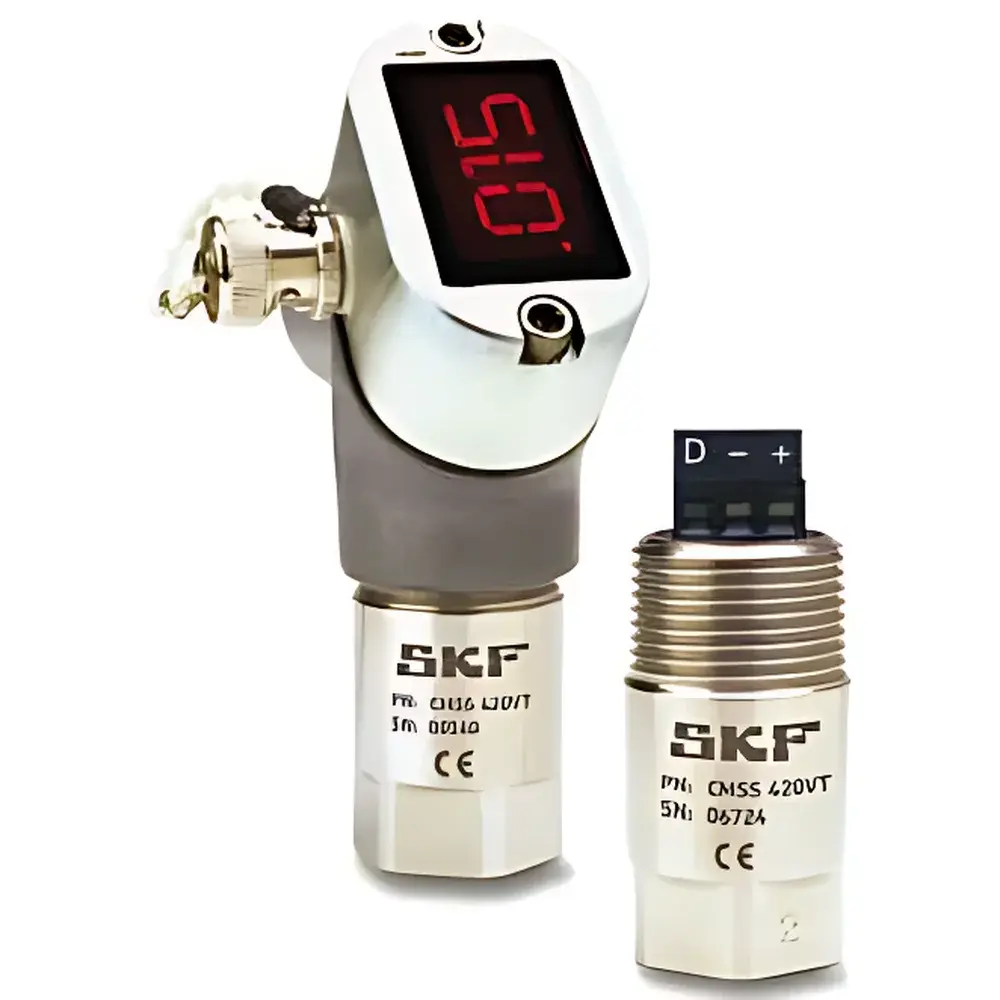
CMSS 420VT Vibration Transmitter
| Output | 4–20 mA (proportional to selected velocity range) |
|---|---|
| Accuracy | ±5% of full-scale output |
| Frequency Response | 2 Hz – 2 kHz (−3 dB) |
| Flatness | ±10% from 10 Hz – 1 kHz |
| Buffered Output | 100 mV/g (acceleration sensitivity) |
| Power Supply | 22–36 VDC via dual-conductor cable |
| Operating Temperature | −20 °C to +80 °C |
| Mounting | 1/4-28 UNC or M8 threaded stud |
| Weight (transmitter only) | 227 g |
| Compliance | Designed for industrial condition monitoring per IEC 61266-1 and ISO 10816-3 guidelines |
| Optional Accessories | CMSS 420LCD (local LCD display), CMSS 420LED (local LED display), CMSS 420BNC (buffered BNC output module) |
Overview
The CMSS 420VT Vibration Transmitter is an industrial-grade, two-wire loop-powered vibration sensing device engineered for continuous, real-time monitoring of machine health in rotating equipment. It operates on the principle of piezoelectric acceleration sensing, with internal signal conditioning that converts raw acceleration data into a linear 4–20 mA analog output proportional to root-mean-square (RMS) velocity — the industry-standard metric for machinery condition assessment per ISO 10816-3 and API RP 670. The transmitter’s wide frequency response (2 Hz – 2 kHz at −3 dB) enables reliable detection of both low-frequency imbalances and high-frequency bearing defects. Its robust stainless-steel housing and sealed design ensure stable performance in harsh environments typical of power generation, oil & gas, pulp & paper, and heavy manufacturing facilities.
Key Features
- True RMS velocity output (25.4 mm/s or 50.8 mm/s full-scale ranges) compliant with ISO 20816-1 for machinery vibration severity evaluation
- High-stability piezoelectric sensing element with integrated charge amplifier and temperature-compensated signal conditioning
- Two-wire 4–20 mA output compatible with standard PLC, DCS, and SCADA analog input modules — no external power supply required beyond loop voltage
- Dual mechanical mounting options: 1/4-28 UNC and M8 threaded studs for flexible integration onto bearing housings, gearboxes, and motor frames
- Integrated buffered BNC output (100 mV/g) providing unfiltered acceleration waveform for portable data acquisition and spectral analysis
- Wide operating temperature range (−20 °C to +80 °C) and IP67-rated enclosure for deployment in humid, dusty, or thermally variable industrial zones
Sample Compatibility & Compliance
The CMSS 420VT is optimized for rigidly mounted rotating machinery including induction motors, centrifugal pumps, compressors, fans, and gearmotors. It meets electromagnetic compatibility requirements per IEC 61000-6-2 (immunity) and IEC 61000-6-4 (emissions). Its measurement methodology aligns with ISO 10816-3 for non-process machines and supports predictive maintenance workflows under ISO 18436-2 Category II certification standards. While not intrinsically safe, it is suitable for Zone 2 / Class I, Division 2 hazardous locations when installed with appropriate barrier systems. Documentation includes traceable calibration certificates per ISO/IEC 17025-accredited procedures.
Software & Data Management
As a hardware-only analog transmitter, the CMSS 420VT does not include embedded firmware or network connectivity. However, its 4–20 mA output integrates natively into any control system supporting 4–20 mA analog inputs — including Siemens PCS7, Emerson DeltaV, Honeywell Experion, and Rockwell Automation Logix platforms. When paired with optional CMSS 420LCD or CMSS 420LED local displays, operators gain immediate field-readout capability without requiring HMI access. The BNC buffered output enables direct connection to portable analyzers (e.g., SKF Microlog, CSI 2140, or Dewesoft X) for time-domain waveform capture, FFT spectral analysis, and envelope demodulation — essential for early-stage bearing fault identification. All analog signals are compatible with audit-trail-enabled data historians supporting FDA 21 CFR Part 11 compliance when deployed in regulated pharmaceutical or food processing environments.
Applications
- Continuous vibration surveillance of critical assets in asset-intensive industries
- Trend-based alarm generation for velocity amplitude thresholds (e.g., warning at 7.1 mm/s, alert at 11.2 mm/s per ISO 20816-1)
- Integration into automated shutdown logic for exceedance of pre-defined RMS velocity limits
- Baseline reference for periodic portable vibration surveys and route-based data collection
- Supplemental input channel for AI-driven prognostics platforms performing anomaly detection and remaining useful life estimation
- Commissioning verification and post-maintenance validation of mechanical alignment and balancing quality
FAQ
What is the difference between CMSS 420VT-1 and CMSS 420VT-2?
CMSS 420VT-1 is calibrated for a full-scale velocity range of 25.4 mm/s RMS, while CMSS 420VT-2 covers 50.8 mm/s RMS — enabling selection based on expected operational vibration severity.
Can the CMSS 420VT be used for bearing fault detection?
Yes — its buffered BNC output delivers unprocessed acceleration waveforms suitable for high-frequency envelope analysis, a proven method for detecting incipient rolling element bearing faults.
Is the 4–20 mA output isolated?
The output is non-isolated but designed for common-mode noise rejection in industrial 24 VDC loops; galvanic isolation is recommended when interfacing with sensitive control systems or across ground-potential differences.
Does the transmitter require recalibration after installation?
No — factory-calibrated units maintain accuracy over their specified temperature and shock/vibration profile; periodic verification per ISO 17025 is advised annually in mission-critical applications.
Are the optional displays (CMSS 420LCD/LED) powered by the 4–20 mA loop?
Yes — both displays draw power directly from the same two-wire loop, requiring no auxiliary power source and preserving intrinsic simplicity and reliability.
Related Products