
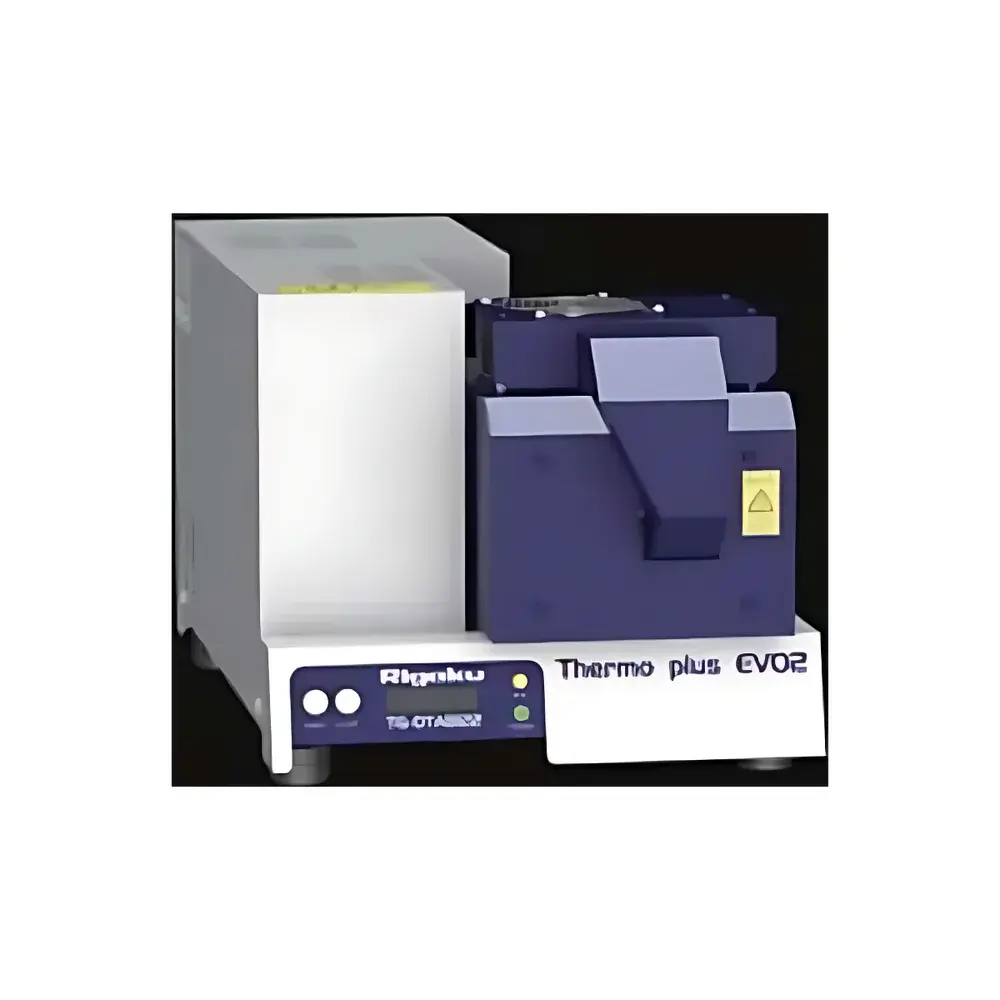
Rigaku TG-DTA8122 Horizontal Triple-Coil Simultaneous Thermogravimetric and Differential Thermal Analyzer
| Brand | Rigaku |
|---|---|
| Origin | Japan |
| Model | TG-DTA8122 |
| Temperature Range | Ambient to 1100 °C (standard), up to 1500 °C (high-temperature option) |
| Heating Rate | Up to 100 °C/min |
| Balance System | Horizontal differential triple-coil design |
| Max. Sample Mass | 1 g |
| TG Full Scale | ±250 mg (500 mg FS) |
| TG Sensitivity | 0.01 µg |
| DTA Full Scale | ±1000 µV (2000 µV FS) |
| Atmosphere Options | Air, inert gas, vacuum, steam, controlled flow |
| Optional Autosampler | 24 sample positions + 3 reference + 5 calibration positions |
| Standard Operating Modes | Constant Reaction Control (CRC), Step Isothermal Analysis (SIA), Dynamic Rate Control (DRC) |
Overview
The Rigaku TG-DTA8122 is a high-precision simultaneous thermogravimetric and differential thermal analyzer engineered for rigorous materials characterization under controlled thermal environments. It integrates thermogravimetry (TG) and differential thermal analysis (DTA) within a single, coaxially aligned measurement platform—ensuring identical thermal history, gas atmosphere, heating rate, and mechanical contact conditions for both signals. This architectural symmetry eliminates inter-signal artifacts arising from thermal lag or differential convection, enabling true correlation between mass change (e.g., decomposition, oxidation, desorption) and endo-/exothermic events (e.g., phase transitions, crystallization, solid-state reactions). The instrument employs Rigaku’s proprietary horizontal differential triple-coil balance system, which actively compensates for thermal drift induced by furnace temperature ramping and sample mass variation—reducing baseline instability to sub-microgram levels across the full operating range. Designed for laboratory-based R&D, quality control, and regulatory-compliant testing, the TG-DTA8122 supports both static and dynamic thermal protocols, including sample-controlled thermogravimetry (SCTG), where mass-loss rate—not time or temperature—is the primary feedback variable for furnace control.
Key Features
- Horizontal differential triple-coil balance architecture delivering <0.01 µg mass resolution and exceptional long-term baseline stability
- Simultaneous, co-located TG and DTA measurement with identical thermal and gas-path conditions for direct signal correlation
- Programmable heating rates up to 100 °C/min over ambient–1100 °C (standard) or ambient–1500 °C (optional high-temp furnace)
- Three advanced thermal control modes: Constant Reaction Control (CRC), Step Isothermal Analysis (SIA), and Dynamic Rate Control (DRC)
- Multi-atmosphere compatibility—including air, N₂, Ar, He, O₂, vacuum, and saturated water vapor—with mass-flow controllers and pressure monitoring
- Modular autosampler option supporting 24 samples, 3 reference crucibles, and 5 calibration standards for unattended, GLP-compliant operation
Sample Compatibility & Compliance
The TG-DTA8122 accommodates a broad spectrum of solid and powdered materials—including polymers, pharmaceuticals, catalysts, ceramics, metals, battery electrode materials, and geological samples—in standard alumina, platinum, or graphite crucibles (up to 1 g loading). Its horizontal geometry ensures uniform gas exposure and minimizes buoyancy effects compared to vertical designs. The system complies with key international thermal analysis standards, including ASTM E1131 (TG), ASTM E793 (DTA), ISO 11358 (polymer thermal degradation), and USP <1231> (thermal characterization of drug substances). When configured with audit-trail-enabled software and electronic signatures, it meets FDA 21 CFR Part 11 requirements for regulated environments. All calibration procedures follow ISO/IEC 17025 traceability guidelines using certified reference materials (e.g., Ni, In, Al₂O₃, CaC₂O₄·H₂O).
Software & Data Management
ThermoPlus EVO2 software provides integrated instrument control, real-time data acquisition, and advanced post-processing. It supports multi-channel visualization (TG, DTA, derivative TG, temperature, gas flow), automatic peak detection with onset/midpoint/endpoint assignment, and quantitative deconvolution of overlapping events via curve-fitting algorithms. Data export is compatible with ASTM E1641-compliant formats (.csv, .txt, .tdf) and third-party analysis platforms (OriginLab, MATLAB, Thermo-Calc). For regulated labs, optional 21 CFR Part 11 modules provide role-based access control, electronic signatures, full audit trails, and secure data archiving. All raw and processed data are timestamped and checksum-verified to ensure integrity throughout the analytical lifecycle.
Applications
- Decomposition kinetics and activation energy determination of polymers and composites (ASTM E1641)
- Hydration/dehydration behavior and stoichiometric water loss in pharmaceutical hydrates
- Oxidation stability assessment of lubricants, fuels, and metal powders
- Thermal stability screening of battery cathode/anode materials under inert and oxidative atmospheres
- Phase transition analysis (e.g., glass transition, melting, crystallization) in amorphous and semi-crystalline systems
- Residue quantification and ash content validation per ISO 1171 and ASTM D3174
- In-situ catalytic reaction monitoring under controlled gas mixtures and dynamic temperature programs
FAQ
What distinguishes simultaneous TG-DTA from sequential TG + DSC measurements?
Simultaneous TG-DTA uses a single furnace and co-located sensors, ensuring identical thermal and environmental conditions for both signals—critical for kinetic modeling and event correlation. Sequential instruments introduce temporal and thermal hysteresis, limiting interpretability.
Can the TG-DTA8122 perform sample-controlled thermogravimetry (SCTG)?
Yes—the instrument natively supports SCTG via Dynamic Rate Control (DRC) mode, enabling closed-loop temperature regulation based on real-time mass-loss rate, essential for studying slow decomposition or equilibrium-driven processes.
Is the autosampler validated for GMP environments?
When deployed with ThermoPlus EVO2’s 21 CFR Part 11 package, the autosampler’s positioning accuracy, sample identification, and sequence execution are fully auditable and support IQ/OQ/PQ documentation per GAMP 5 guidelines.
How is baseline drift minimized during high-temperature ramps?
The horizontal triple-coil balance dynamically compensates for thermal expansion and electromagnetic interference; combined with active furnace shielding and symmetric sensor geometry, it achieves <±0.1 µg baseline deviation over 1000 °C ramps.
What calibration standards are recommended for routine verification?
Certified reference materials include nickel (Curie point at 354 °C), indium (melting at 156.6 °C), aluminum oxide (phase transition at ~1200 °C), and calcium oxalate monohydrate (three-step decomposition) — all traceable to NIST or BAM.



