
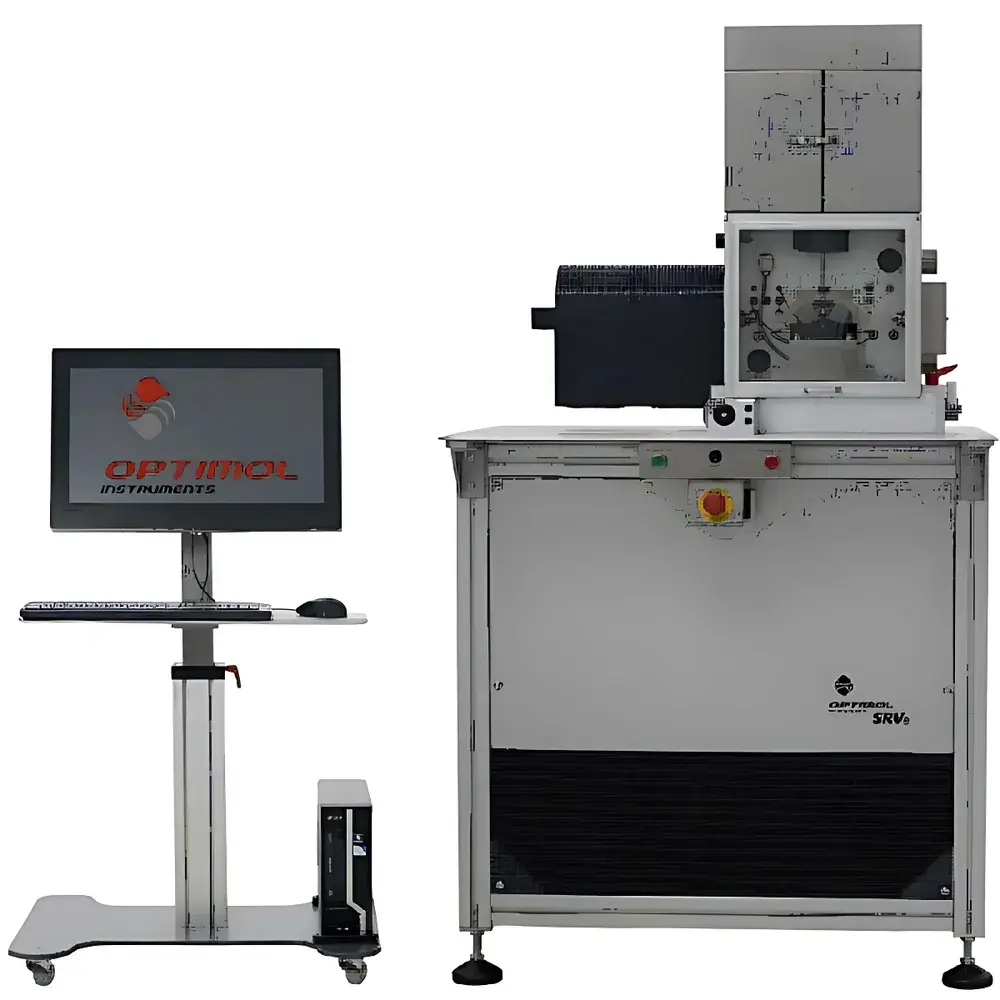
Optimol SRV®5 Multifunctional Tribological Tester
| Brand | Optimol |
|---|---|
| Origin | Germany |
| Model | SRV®5 |
| Instrument Type | Reciprocating Tribometer |
| Maximum Friction Force | 2500 N |
| Friction Force Resolution | 1 N |
| Operating Temperature Range | −35 °C to 1000 °C |
| Motion Modes | Reciprocating, Rotational, Tilted (0°–90°), Oscillatory, Non-Continuous Transition |
| Optional Modules | FSA (Friction Signal Analysis), Vacuum Chamber (High Vacuum), Nanopositioning Stage, Electrical Resistance Monitoring, Custom Fixture Integration |
Overview
The Optimol SRV®5 Multifunctional Tribological Tester is a fifth-generation, high-precision reciprocating tribometer engineered for industrial-scale simulation of real-world friction and wear phenomena. Based on over 50 years of continuous development and validation across automotive OEMs, lubricant formulators, aerospace material suppliers, and national metrology institutes, the SRV®5 implements Couette-type reciprocating motion combined with torque-sensing rotational capability—enabling quantitative measurement of friction coefficient, wear volume, and interfacial energy dissipation under rigorously controlled mechanical, thermal, and environmental conditions. Its core architecture adheres to fundamental tribological principles: direct force transduction via dual piezoelectric sensors mounted beneath the lower specimen, eliminating mechanical linkage artifacts; electromagnetic linear actuation ensuring constant power delivery across full stroke without harmonic distortion; and thermally stable furnace design certified for sustained operation at 1000 °C with ±1 °C uniformity over the test zone. This system serves not only as a research platform but also as a reference-grade instrument referenced in ISO 20808, ASTM D5707, DIN 51834, NB/SH/T 0765, and GB/T 33541 standards.
Key Features
- Electromagnetic linear drive system: Two synchronized voice-coil actuators deliver true sinusoidal, triangular, rectangular, or trapezoidal displacement profiles (0.001–500 Hz, stroke 0.1–5 mm) without mechanical eccentricity, backlash, or lubrication requirements—ensuring zero-maintenance operation for >40 years’ service life.
- Dual-axis piezoelectric force sensing: High-stiffness, wide-bandwidth (≥100 kHz) sensors measure instantaneous friction force and normal load directly at the interface, delivering linearity <±0.1% FS and hysteresis <0.05% FS.
- Tilt-adjustable test geometry: Motorized inclination stage enables precise angular alignment from horizontal (0°) to vertical (90°), replicating contact kinematics found in piston ring/cylinder liner, valve stem/guide, gear tooth flank, and bearing cage interfaces.
- Integrated high-temperature furnace: Graphite-heated chamber with multi-zone PID control maintains ±1 °C stability from −35 °C to 1000 °C for extended duration (>100 h at 1000 °C), validated per ASTM E220 calibration protocols.
- Modular motion configuration: Rapid conversion (<5 min) between reciprocating, rotational, oscillatory, and non-continuous (static-to-sliding transition) modes using standardized tooling interfaces.
- Optional FSA module: Full-cycle friction signal acquisition synchronized with position and time data enables decomposition into static, mixed, and hydrodynamic regimes—critical for mechanism-level tribology studies.
Sample Compatibility & Compliance
The SRV®5 accommodates flat, cylindrical, spherical, and custom-profiled specimens up to Ø25 mm × 10 mm height (reciprocating) or Ø50 mm diameter (rotational). It supports metallic alloys (steel, Ti-6Al-4V, Inconel), ceramics (Al₂O₃, Si₃N₄, WC-Co), polymer composites, DLC and MoS₂ coatings, greases, oils, and solid lubricants. All hardware and firmware comply with IEC 61000-6-2/6-4 EMC standards and CE Machinery Directive 2006/42/EC. Software audit trails, electronic signatures, and configurable user roles meet FDA 21 CFR Part 11 and EU Annex 11 requirements for GLP/GMP environments. Calibration certificates traceable to PTB (Physikalisch-Technische Bundesanstalt) and NIST are provided with each system.
Software & Data Management
The proprietary SRV-Control v6.x software provides real-time visualization of friction force, normal load, temperature, displacement, and velocity. Raw data (16-bit, 1 MHz sampling) is stored in HDF5 format with embedded metadata (test parameters, calibration IDs, operator, timestamp). Automated report generation includes ISO-standard wear rate calculation (mm³/N·m), COF histograms, Stribeck curve plotting, and statistical process control (SPC) charts. Data export supports ASTM E1447-compliant CSV, MATLAB .mat, and Python-compatible netCDF formats. Remote monitoring, scheduled calibration reminders, and firmware update notifications are enabled via secure TLS 1.3 connection.
Applications
- Automotive R&D: EP/AW additive screening per ASTM D2782; piston ring–liner scuffing resistance; brake pad–rotor cold-fusion mapping.
- Aerospace materials: Thermal barrier coating adhesion under cyclic thermal stress; titanium alloy fretting wear at 600 °C.
- Energy sector: Gear oil film breakdown analysis; wind turbine bearing grease lifetime prediction under variable load spectra.
- Biomedical tribology: UHMWPE-on-ceramic joint simulator validation; hydrogel lubricity assessment under physiological saline flow.
- Advanced manufacturing: Laser-clad layer integrity evaluation; PVD/CVD coating delamination onset detection via electrical resistance monitoring option.
- Standards development: Primary reference instrument for round-robin interlaboratory studies coordinated annually by Optimol’s Global Proficiency Testing Program.
FAQ
What standards does the SRV®5 support out-of-the-box?
ASTM D5707, ISO 20808, DIN 51834, NB/SH/T 0765, GB/T 33541, and JIS K 7218—all implemented via preconfigured test methods with auto-generated compliance reports.
Can the SRV®5 operate under vacuum or inert atmosphere?
Yes—optional high-vacuum chamber (10⁻⁶ mbar base pressure) with feedthroughs for temperature, force, and electrical monitoring is available.
Is remote diagnostics and calibration support available?
All systems include embedded Ethernet diagnostics and optional annual remote calibration verification via Optimol’s certified metrology team.
How is traceability maintained for long-term data integrity?
Each measurement chain is calibrated against PTB-traceable references; software enforces version-controlled method files with SHA-256 checksums and immutable audit logs compliant with ISO/IEC 17025.
What is the expected service life of an SRV®5 system?
Based on field data from >1,200 installed units worldwide, mean time between unscheduled maintenance exceeds 15 years; all electronics and firmware are backward-compatible across SRV® generations.



