
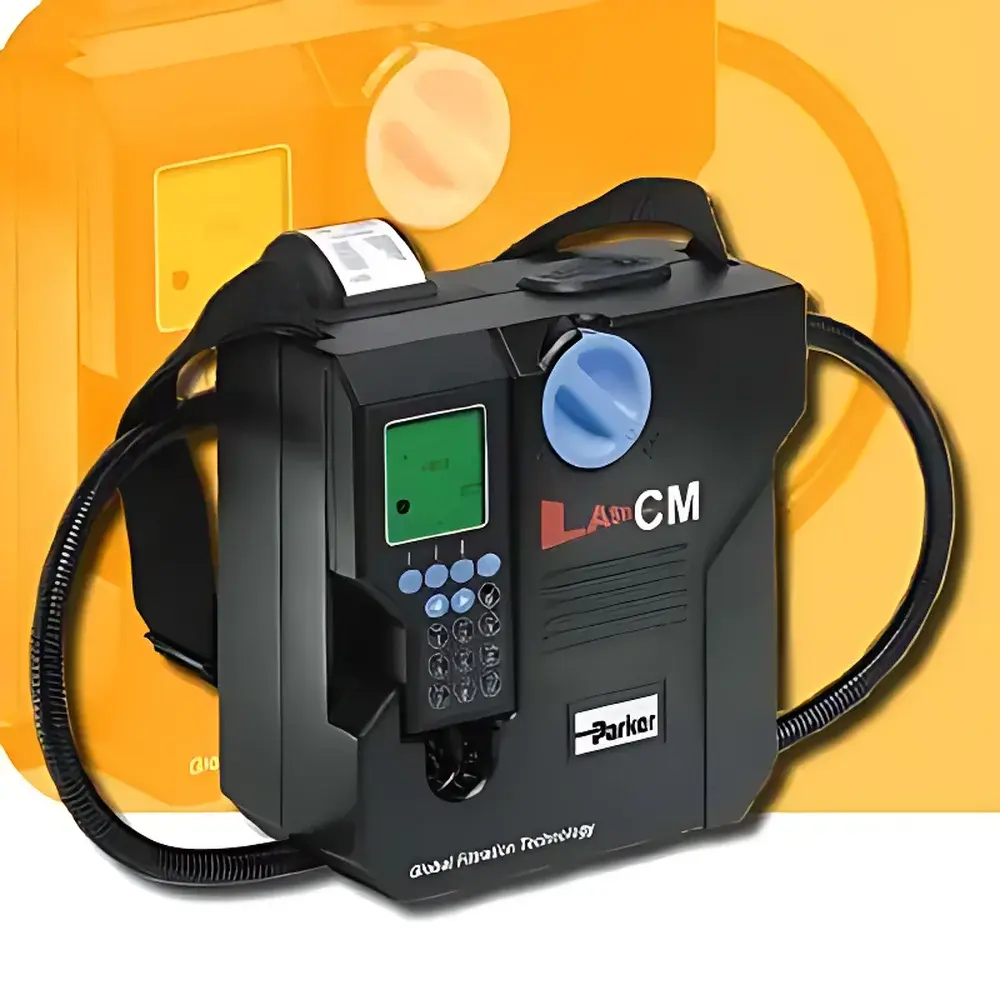
Parker LaserCM LCM20 Portable Particle Counter
| Brand | Parker |
|---|---|
| Origin | United Kingdom |
| Model | LCM20 |
| Calibration Standards | ACFTD & MTD |
| Channel Count | 6 |
| Detection Principle | Single-Point Source Laser (SPSL) Light Scattering |
| Display | Integrated LCD Handheld Unit |
| Data Storage | 300 Test Records |
| Pressure Rating | Up to 420 bar |
| Flow Compatibility | Up to 400 L/min (with system integration) |
| Communication | RS232 @ 9600 baud |
| Compliance | ISO 4406, ISO 11171, NAS 1638, ASTM D6786 |
| Software | DAT μm Trend Analysis Suite (free firmware updates included) |
| Optional Accessories | Barcode Scanner, Built-in Thermal Printer, Relay Output for External Equipment Control |
| Service | Annual calibration support via Parker Authorized Service Centers |
Overview
The Parker LaserCM LCM20 Portable Particle Counter is an engineered solution for real-time, in-line fluid contamination monitoring in hydraulic, lubrication, and turbine oil systems. Operating on the principle of single-point source laser (SPSL) light scattering, the LCM20 detects and sizes suspended particulate matter as fluid passes through a precision optical sensing chamber. Each particle crossing the laser beam generates a scattered light pulse proportional to its cross-sectional area; signal processing algorithms classify these pulses into six discrete size channels, enabling compliance-grade reporting per ISO 4406, ISO 11171, and NAS 1638 standards. Designed for industrial reliability, the LCM20 delivers quantitative contamination data without interrupting system operation—making it integral to predictive maintenance programs where unscheduled downtime correlates strongly with particulate-induced wear and valve stiction.
Key Features
- 6-channel particle counting architecture with dual calibration traceability: ACFTD (2+, 5+, 15+, 25+, 50+, 100+ µm) and MTD (4+, 6+, 14+, 21+, 38+, 70+ µm)
- Integrated microprocessor controller with self-diagnostic routines, automatic calibration alerts, and firmware-upgradable architecture
- Real-time in-line measurement capability at pressures up to 420 bar and flow rates up to 400 L/min (system-integrated mode); compatible with high-flow SPS adapters for extended operational envelopes
- Backlit LCD handheld interface supporting on-device data review, storage of up to 300 test records, and direct parameter configuration
- Built-in thermal printer for immediate hard-copy documentation of ISO/NAS-coded results
- RS232 serial interface (9600 baud) for bidirectional communication with laboratory PCs or SCADA systems
- Programmable relay output for automated response actions—e.g., triggering offline filtration units upon threshold exceedance
- Optional barcode scanner for rapid sample ID logging and traceability in multi-point monitoring workflows
Sample Compatibility & Compliance
The LCM20 is validated for use with mineral oils, synthetic lubricants, phosphate esters, and other non-corrosive hydraulic fluids meeting ISO 32–68 viscosity grades. Its optical path design minimizes bubble interference and accommodates moderate water content (<0.1% v/v). All measurement protocols adhere to ISO 11171:2010 (calibration standard), ISO 4406:2021 (contamination code reporting), and NAS 1638 Class Code definitions. The instrument supports GLP/GMP-aligned data integrity through audit-trail-capable DAT μm software, which logs operator ID, timestamp, calibration status, and environmental metadata per test record. Parker-certified annual recalibration services ensure continued metrological traceability to NIST-traceable reference materials.
Software & Data Management
The DAT μm desktop application provides comprehensive post-acquisition analysis, including time-series trending, statistical process control (SPC) charting, deviation mapping against historical baselines, and automated report generation compliant with internal QA templates or external regulatory submissions. Firmware updates are delivered free-of-charge and installed via RS232 connection, preserving long-term instrument functionality across evolving industry requirements. Data export supports CSV, PDF, and XML formats—enabling seamless integration into enterprise CMMS, LIMS, or SAP EAM platforms. All stored test records include embedded digital signatures and tamper-evident checksums to satisfy FDA 21 CFR Part 11 electronic record requirements when configured with user authentication.
Applications
- Condition-based monitoring of critical hydraulic circuits in power generation, marine propulsion, and aerospace ground support equipment
- Acceptance testing of new oil batches prior to system commissioning or after bulk replenishment
- Verification of filter performance efficiency during service life validation studies
- Root-cause analysis of component wear failures using longitudinal particle morphology correlation
- Supporting ISO 14644 cleanroom fluid handling protocols in semiconductor manufacturing tooling
- Field-deployed diagnostics for mobile equipment fleets operating under variable environmental stressors
FAQ
Is the LCM20 suitable for use with fire-resistant hydraulic fluids such as phosphate esters?
Yes—the optical wetted path materials (316 stainless steel, fused silica, and fluoropolymer seals) are chemically compatible with phosphate ester, polyol ester, and water-glycol formulations.
Does the device require periodic recalibration by the end user?
No—recalibration is performed annually by Parker-authorized service centers using certified ACFTD/MTD reference suspensions; field users receive automated prompts prior to due date.
Can the LCM20 operate continuously in pressurized loop configurations?
Yes—it is rated for continuous in-line operation at up to 420 bar and integrates directly with Parker’s modular sampling manifolds for permanent installation.
What data security features does the DAT μm software provide?
Role-based access control, electronic signature capture, immutable audit trails, and encrypted local database storage—all configurable to align with ISO/IEC 27001 information security policies.
Is training provided for instrument operation and data interpretation?
Parker offers certified instructor-led courses covering method validation, troubleshooting, and ISO 4406 coding conventions—available globally through regional technical support hubs.



