
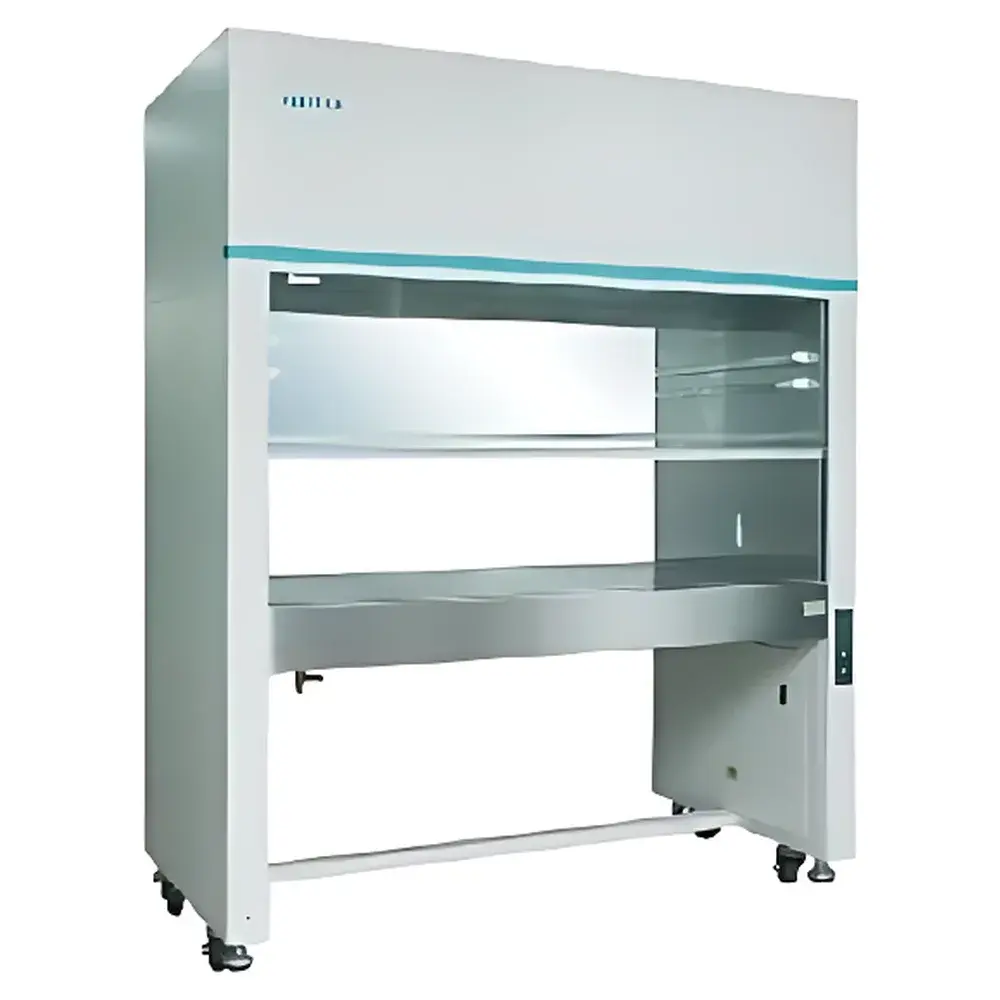
AnTai BCM-1000A Vertical Laminar Flow Biological Safety Clean Bench
| Brand | AnTai |
|---|---|
| Origin | Jiangsu, China |
| Model | BCM-1000A |
| Instrument Category | Vertical Flow Clean Bench |
| Cleanliness Class | ISO Class 5 (equivalent to US FED-STD-209E Class 100) |
| Noise Level | ≤62 dB(A) |
| User Configuration | Single-operator, dual-front access |
| Airflow Pattern | Vertical downward laminar flow |
| Average Air Velocity | 0.25–0.45 m/s (adjustable) |
| Exhaust Air Volume | 2 m³/min |
| Vibration (Half-Peak) | ≤5 µm |
| Illuminance | ≥300 lx |
| Power Supply | AC 220 V, 50 Hz |
| Max. Power Consumption | 0.8 kW |
| Net Weight | 300 kg |
| Work Area Dimensions (W×D×H) | 1000 × 700 × 620 mm |
| Overall Dimensions (W×D×H) | 1160 × 760 × 1780 mm |
| Supply HEPA Filter | 915 × 610 × 50 mm (1 unit) |
| Exhaust HEPA Filter | 480 × 90 × 50 mm (1 unit) |
| Fluorescent Lamp | 20 W × 2 |
| UV Lamp | 20 W × 2 |
| Optional Outlets | 2 kW rated socket |
Overview
The AnTai BCM-1000A is a vertically oriented laminar flow clean bench engineered for routine aseptic operations in biological and pharmaceutical laboratories. It operates on the principle of unidirectional, HEPA-filtered vertical airflow—delivering ISO Class 5 (FED-STD-209E Class 100) air quality across the work surface. Unlike biosafety cabinets, the BCM-1000A does not provide personnel protection against hazardous aerosols; rather, it safeguards samples and processes from environmental particulate contamination. Its design integrates an aerodynamic air curtain at the front opening, generated by precisely balanced intake and exhaust dynamics, minimizing cross-contamination between the workspace and ambient lab air. The unit complies with fundamental engineering requirements for laminar flow devices per ISO 14644-1 and supports GLP-aligned workflows where sample integrity—not operator containment—is the primary objective.
Key Features
- Vertical laminar airflow system with adjustable velocity (0.25–0.45 m/s), ensuring consistent particle-free coverage across the full 1000 × 700 mm work area.
- Dual HEPA filtration architecture: one 915 × 610 × 50 mm supply filter for incoming air and a dedicated 480 × 90 × 50 mm exhaust filter for recirculated or expelled air—both certified to ≥99.99% efficiency at 0.3 µm.
- Air curtain isolation barrier at the sash opening, formed by controlled inflow velocity and negative-pressure suction near the base, reducing lateral ingress of room air.
- Spring-assisted, counterbalanced vertical sliding sashes (front and rear) enabling precise, tool-free positioning and stable ergonomic operation.
- Integrated dual lighting system: two 20 W fluorescent lamps for general illumination (≥300 lx at work surface) and two 20 W UV-C lamps (254 nm) for pre-use decontamination—interlocked with sash position to prevent UV exposure during operation.
- Dedicated 2 kW grounded outlet mounted within the work chamber, supporting auxiliary equipment such as centrifuges, pipette controllers, or small incubators without external power extension.
- Stainless steel work surface and rounded internal corners facilitate cleaning and meet basic hygiene standards for repeated disinfection cycles.
Sample Compatibility & Compliance
The BCM-1000A is validated for use in non-hazardous microbiological procedures—including cell culture passaging, media preparation, sterile sampling, and reagent handling—where maintaining product sterility is critical. It is routinely deployed in hospital pharmacies (USP compliant environments), academic life science labs, and biomanufacturing QC areas. While not certified to NSF/ANSI 49 or EN 12469 for biohazard containment, its construction and airflow performance align with ISO 14644-1 (Class 5), ISO 14644-3 (testing protocols), and JIS B 9920 for clean bench verification. All electrical components conform to IEC 61010-1 safety standards. Documentation includes factory-assembled airflow uniformity reports and filter integrity test records.
Software & Data Management
The BCM-1000A is a standalone mechanical system with no embedded microprocessor or digital interface. Operational parameters—including fan speed, lighting, and UV activation—are controlled via tactile push-button switches with LED status indicators. No firmware, data logging, or network connectivity is provided. This analog architecture ensures long-term reliability, eliminates cybersecurity concerns, and simplifies qualification (IQ/OQ) under GMP or GLP frameworks where deterministic behavior and auditability are prioritized over automation. Users maintain manual logbooks for UV usage duration, filter replacement dates, and periodic airflow verification—consistent with FDA 21 CFR Part 11 expectations for paper-based records in low-risk environments.
Applications
- Aseptic preparation of cell culture media, buffers, and reagents in academic and industrial research labs.
- Pharmaceutical compounding in hospital pharmacy cleanrooms adhering to USP environmental monitoring guidelines.
- Microbial inoculation and colony isolation in diagnostic microbiology workflows.
- Handling of non-pathogenic plant or animal tissue explants during primary culture establishment.
- Quality control testing of sterile medical devices and packaging materials.
- Supporting ISO 13485-certified production environments where background bioburden control is required but biological agent risk is absent.
FAQ
Does the BCM-1000A provide protection against biological hazards for the operator?
No. It is a clean bench—not a biosafety cabinet—and offers no personnel or environmental protection from viable aerosols or toxins.
What is the recommended HEPA filter replacement interval?
Under continuous operation in typical laboratory conditions, supply and exhaust filters should be replaced every 12–18 months or after 7,500–10,000 operational hours, verified by in-situ airflow and pressure drop measurements.
Can this unit be integrated into a larger HVAC-controlled cleanroom?
Yes. Its vertical airflow design and low heat dissipation (0.8 kW max.) make it compatible with ISO Class 7 or Class 8 cleanroom infrastructure when installed with appropriate ceiling cutouts and exhaust ducting.
Is UV irradiation dose validated per ISO 15714?
UV lamp output is specified at 254 nm with nominal intensity; users must perform in-house validation using calibrated radiometers to confirm ≥40 mJ/cm² surface dose for microbial reduction per ISO 15714 Annex A.
Does the unit comply with energy efficiency regulations such as EU ErP Directive?
As a Class III laboratory device under EU Regulation (EU) 2019/2021, its power consumption (0.8 kW) falls below mandatory labeling thresholds; however, no ErP-specific certification is issued for this model.



