
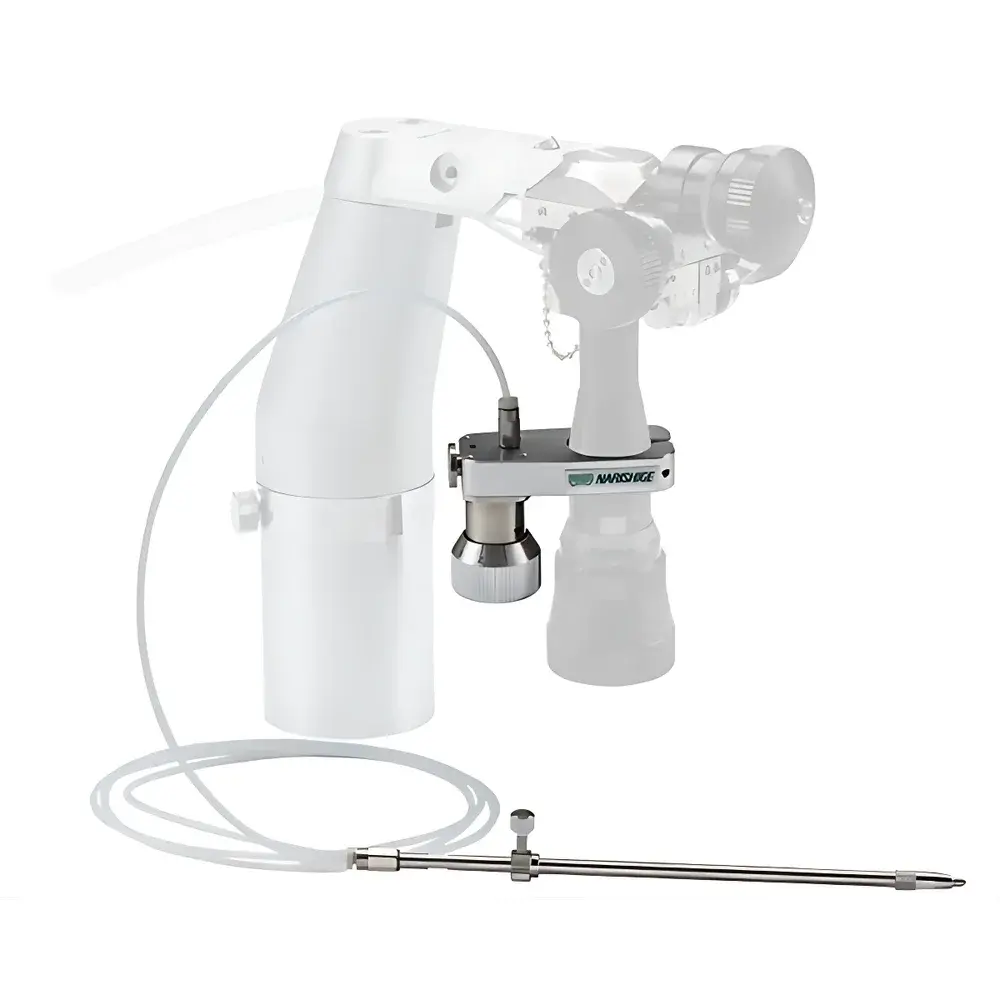
Narishige IM-HD1 Pneumatic Microinjector
| Brand | Narishige |
|---|---|
| Origin | Japan |
| Model | IM-HD1 |
| Dimensions | 24 × 55 × 54 mm |
| Weight | 58 g |
| Compatible Pipettes | CT-4 (inner diameter 0.4 mm), CT-1-1.5 (inner diameter 1.5 mm) |
| Actuation | Pneumatic (foot or finger-controlled via manipulator linkage) |
| Includes | HI-9 Injector Holder, Cleaning Rod, HIO1PKO1 Silicone Gasket, Hex Wrench |
Overview
The Narishige IM-HD1 Pneumatic Microinjector is a precision-engineered tool designed for controlled, low-force liquid handling in microscale biological manipulation—particularly in single-cell injection, intracytoplasmic sperm injection (ICSI), oocyte enucleation, and embryonic microinjection workflows. Unlike motorized or syringe-pump-based systems, the IM-HD1 operates on regulated pneumatic pressure, delivering consistent, repeatable actuation without mechanical backlash or thermal drift. Its compact form factor (24 × 55 × 54 mm, 58 g) enables seamless integration with Narishige micromanipulators (e.g., MO-202, MN-4) and standard inverted microscope stages. The device functions as a passive, analog pressure transducer: input air pressure (typically 0.01–0.3 MPa) is converted into linear displacement of the plunger via a sealed diaphragm assembly, enabling direct correlation between input pressure and delivered volume—ideal for applications requiring sub-microliter reproducibility under real-time manual control.
Key Features
- Compact, lightweight design optimized for ergonomic integration with mechanical micromanipulators and stereomicroscopes.
- Dual-pipette compatibility: supports CT-4 capillaries (0.4 mm ID) for high-resolution, low-volume delivery and CT-1-1.5 capillaries (1.5 mm ID) for rapid fluid exchange or viscous medium handling.
- Pneumatic actuation eliminates electrical noise, electromagnetic interference, and heat generation—critical for live-cell imaging and electrophysiology-compatible environments.
- Modular construction with replaceable silicone gasket (HIO1PKO1) and stainless-steel internal components ensures long-term chemical resistance to common solvents, saline buffers, and mild acids/bases.
- Tool-free pipette loading/unloading via HI-9 injector holder; integrated cleaning rod facilitates routine maintenance without disassembly.
- No embedded electronics or firmware—fully compliant with ISO 13485 cleanroom handling protocols and compatible with Class II biosafety cabinets.
Sample Compatibility & Compliance
The IM-HD1 is routinely deployed in GLP-compliant cell line development labs, IVF clinics certified under CAP/CLIA standards, and academic core facilities performing CRISPR-Cas9 ribonucleoprotein (RNP) delivery. It accommodates aqueous solutions (PBS, HBSS), glycerol-supplemented media (up to 30% v/v), and low-viscosity polymer solutions (e.g., 0.5% agarose, <5 cP). While not rated for sterilization by autoclaving, all contact surfaces are compatible with 70% ethanol, isopropanol, and hydrogen peroxide vapor (HPV) decontamination. The device itself carries no CE marking or FDA 510(k) clearance, as it is classified as a Class I laboratory accessory under IEC 61010-1:2010 (Safety Requirements for Electrical Equipment for Measurement, Control, and Laboratory Use)—consistent with its non-powered, pneumatically actuated architecture.
Software & Data Management
The IM-HD1 operates independently of software control; it is an analog, operator-mediated instrument. However, when paired with Narishige’s digital pressure regulators (e.g., PR-100) or third-party pressure controllers (e.g., Elveflow OB1), it supports traceable pressure logging via analog voltage output (0–5 V) or digital I/O (RS-232/USB). In regulated environments, users may document injection parameters—including applied pressure, duration, and pipette type—in electronic lab notebooks (ELNs) aligned with 21 CFR Part 11 requirements. Audit trails for calibration of external pressure sources must be maintained separately per institutional SOPs.
Applications
- Single-cell microinjection in zebrafish, Xenopus, and mouse embryos.
- Cytoplasmic transfer and nuclear transplantation in somatic cell nuclear transfer (SCNT).
- Delivery of dyes (e.g., Calcein AM), tracers (e.g., Lucifer Yellow), or functional RNAs into adherent or suspension mammalian cells.
- Microfluidic chip priming and channel filling where backpressure-sensitive valves require gentle, pulse-free flow initiation.
- Preparation of calibrated microdroplets for droplet-based PCR or digital ELISA assays.
FAQ
Is the IM-HD1 compatible with non-Narishige micromanipulators?
Yes—provided the manipulator offers a standardized 3/8″-24 threaded interface or accepts the HI-9 holder via custom adapter plates.
Can it be used for vacuum aspiration?
No—the IM-HD1 is unidirectional and designed exclusively for positive-pressure ejection; aspiration requires a separate vacuum source and valve manifold.
What is the minimum resolvable injection volume?
Volume resolution depends on pipette geometry and pressure stability; with CT-4 capillaries and regulated 0.02 MPa input, typical dispense increments range from 10–50 nL under skilled manual control.
Does Narishige provide calibration certificates?
No—calibration is user-performed using gravimetric or fluorometric methods per ISO/IEC 17025 guidelines; Narishige supplies dimensional drawings and pressure-response curves in the technical manual.
Is the device suitable for sterile tissue culture work?
Yes—when assembled with sterile-filtered capillaries and operated inside a laminar flow hood using aseptic technique, the IM-HD1 introduces no inherent contamination risk due to its absence of moving seals or lubricants in the fluid path.



