
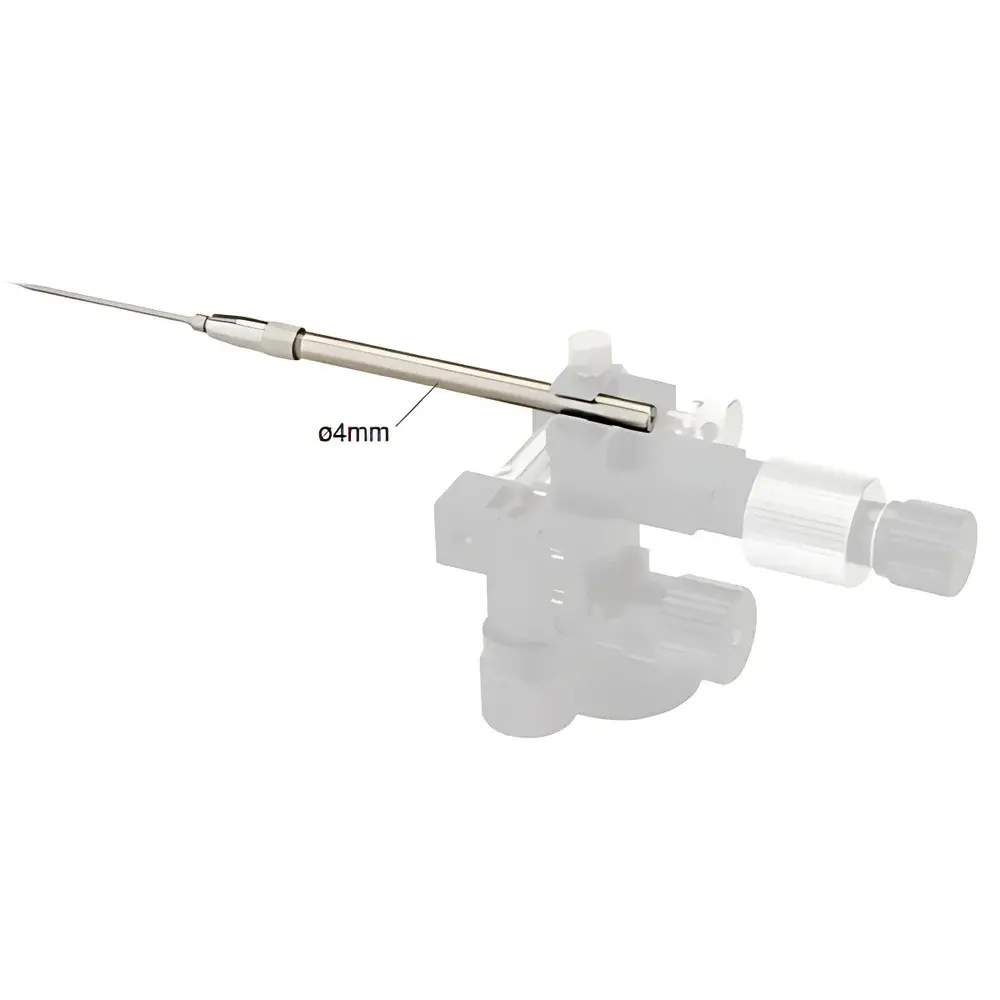
NARISHIGE UPN-C Adjustable Pipette Holder
| Brand | NARISHIGE |
|---|---|
| Origin | Japan |
| Model | UPN-C |
| Material | Corrosion-resistant polymer housing with stainless steel actuation mechanism |
| Weight | 8 g |
| Dimensions (L × H) | 80 mm × 12 mm |
| Pipette bar diameter compatibility | 4 mm |
| Adjustment | Manual angular tilt support |
| Compliance | Designed for ISO/IEC 17025-aligned laboratory workflows |
Overview
The NARISHIGE UPN-C Adjustable Pipette Holder is an ergonomically engineered laboratory accessory designed to secure and position standard 4 mm-diameter glass or plastic volumetric pipettes during routine liquid handling, titration, or calibration procedures. Unlike passive static clamps, the UPN-C employs a dual-mode mechanical actuation system—offering both press-to-release and rotational engagement—to enable rapid, one-handed pipette insertion and removal without compromising positional stability. Its operational principle relies on controlled elastic deformation of a polymer-based jaw assembly, coupled with precision-machined stainless steel pivot components, ensuring consistent clamping force across repeated cycles. This design minimizes mechanical stress on pipette stems while maintaining alignment within ±0.5° of vertical orientation—a critical factor in gravimetric and photometric applications where meniscus reading accuracy is paramount.
Key Features
- Two-action actuation: Integrated lever-and-rotary mechanism allows intuitive pipette loading/unloading via either downward pressure or 90° clockwise rotation—optimized for glove-compatible operation in biosafety cabinets and fume hoods.
- Chemical-resistant construction: Housing fabricated from high-performance polyoxymethylene (POM) with UV-stabilized additives; resistant to common solvents including ethanol, acetone, dilute acids (≤1 M HCl), and alkaline solutions (≤1 M NaOH).
- Anti-slip internal geometry: Micro-textured inner jaw surfaces combined with replaceable silicone-coated contact pads provide coefficient of friction ≥0.7 against borosilicate glass (e.g., Class A volumetric pipettes), preventing axial slippage under static load up to 500 g.
- Precision angular adjustability: Integrated tilt hinge permits continuous adjustment from −15° to +30° relative to base plane, facilitating optimal meniscus viewing angles for manual reading or digital imaging systems.
- Modular mounting compatibility: Standard 8 mm diameter base hole enables secure attachment to universal lab stands (e.g., Thorlabs, Fisher Scientific) using M4–0.7 threaded rods or magnetic bases.
Sample Compatibility & Compliance
The UPN-C accommodates all ISO 648-compliant volumetric pipettes with nominal stem diameters of 4.0 ± 0.1 mm—including 1 mL, 2 mL, 5 mL, 10 mL, and 25 mL capacities. It is validated for use with Class A and Class B borosilicate glass pipettes (DIN EN ISO 1042) as well as autoclavable polypropylene alternatives. The device itself carries no CE marking but conforms to general laboratory equipment safety requirements per IEC 61010-1:2010 (Edition 3.1) for non-electrical instruments. Its material composition meets USP specifications for polymeric components in contact with pharmaceutical preparations, supporting GLP-compliant documentation workflows.
Software & Data Management
As a purely mechanical holding device, the UPN-C requires no firmware, drivers, or software integration. However, its angular repeatability (±0.3° over 10,000 cycles) and stable positioning make it suitable for integration into automated image-based pipette calibration systems. When used alongside digital meniscus detection platforms (e.g., METTLER TOLEDO SmartCal, Sartorius Picus EVO), the UPN-C’s fixed reference geometry supports traceable angle registration and reduces inter-operator variability in visual endpoint determination—contributing to audit-ready records compliant with FDA 21 CFR Part 11 when paired with validated electronic lab notebooks (ELNs).
Applications
- Volumetric calibration laboratories performing ISO/IEC 17025-accredited verification of pipettes per ISO 8655-2.
- Pharmaceutical QC labs conducting USP assay preparation requiring precise pipette stabilization during solution transfer.
- Academic teaching labs where student handling frequency demands robust, low-maintenance fixtures resistant to accidental impact or chemical splash exposure.
- Environmental testing facilities processing aqueous samples with aggressive preservatives (e.g., HgCl₂, azide buffers), where metal-free contact surfaces are preferred.
- Reference material producers requiring repeatable pipette orientation for certified reference solution dispensing under ISO Guide 34 conditions.
FAQ
Does the UPN-C accommodate pipettes larger than 4 mm in diameter?
No—the jaw geometry is specifically optimized for 4.0 ± 0.1 mm stem diameters. For 6 mm or tapered pipettes, NARISHIGE recommends the UPN-10 or UPN-20 variants.
Can the UPN-C be sterilized in an autoclave?
The polymer housing is rated for dry-heat sterilization at 121°C for ≤20 minutes; however, steam autoclaving is not recommended due to potential hinge lubricant migration and dimensional drift.
Is angular position locking achieved mechanically or digitally?
Position retention is fully mechanical via a spring-loaded detent pin engaging indexed grooves on the tilt axis—no batteries or electronics required.
What maintenance is required to ensure long-term performance?
Annual inspection of jaw pad integrity and hinge smoothness is advised; replacement silicone pads (NARISHIGE P/N UPN-PAD-4) are available separately.
How does the UPN-C compare to the UPN-1 model?
The UPN-C adds angular adjustability and enhanced chemical resistance versus the fixed-angle UPN-1; both share identical weight, footprint, and clamping force specifications.



