
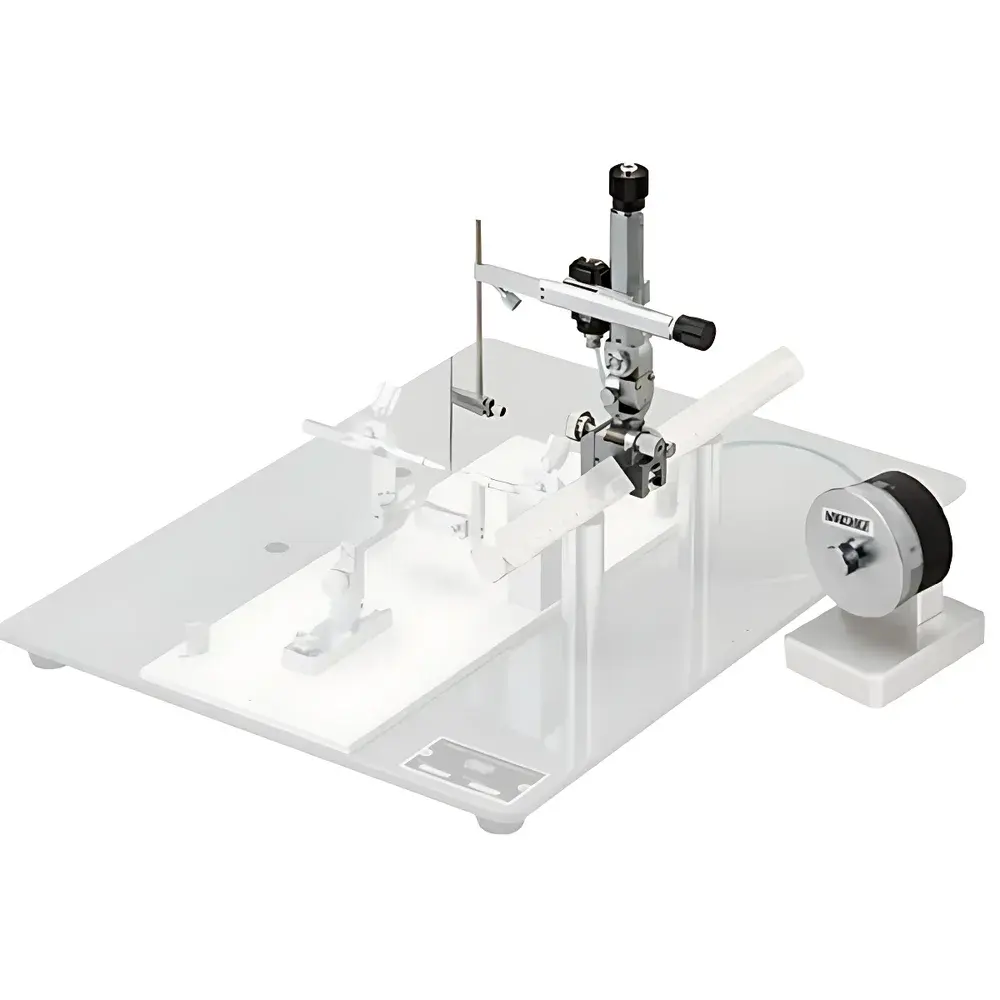
Narishige SM-25C Stereotactic Microcontroller
| Brand | Narishige |
|---|---|
| Origin | Japan |
| Model | SM-25C |
| Drive Type | Hydraulic Micromanipulator with Precision Mechanical Adjustment |
| X-Axis Travel | 40 mm |
| Z-Axis Travel | 40 mm |
| Fine Z-Adjustment (Oil-Damped) | 10 mm |
| Full Knob Rotation Displacement | 250 µm |
| Minimum Graduation | 1 µm |
| Pivot Angle Adjustment | Yes |
| Manipulator Dimensions (W×D×H) | 125 × 28 × 157 mm |
| Manipulator Weight | 380 g |
| Control Unit Dimensions (W×D×H) | 65 × 88 × 93 mm |
| Control Unit Weight | 630 g |
| Hydraulic Tubing Length | 900 mm |
| Included Accessory | Dedicated 1 mm Diameter Soldering Clamp |
Overview
The Narishige SM-25C Stereotactic Microcontroller is a high-precision hydraulic micromanipulator engineered for reproducible, sub-micrometer spatial positioning in stereotaxic neuroscientific procedures. Unlike motorized or piezoelectric alternatives, the SM-25C employs a dual-stage mechanical-hydraulic architecture: coarse positioning via calibrated rack-and-pinion translation and fine axial control through oil-damped micrometer-driven displacement. This hybrid design eliminates electronic drift, ensures passive stability during long-duration recordings or injections, and delivers deterministic mechanical resolution without reliance on closed-loop feedback electronics. Its primary application domain spans in vivo rodent and non-human primate stereotaxic surgery—including intracranial electrode implantation, viral vector microinjection, optogenetic fiber placement, and targeted electrophysiology probe insertion—where thermal drift, vibration sensitivity, and operator-induced tremor must be minimized.
Key Features
- Hydraulic fine-adjustment mechanism with 10 mm oil-damped Z-axis travel, enabling smooth, backlash-free movement and intrinsic damping against micro-tremor.
- Mechanical micrometer scale with 1 µm minimum graduation and 250 µm linear displacement per full knob rotation—calibrated and traceable to JIS B 7502 standards.
- Three-axis manual positioning (X, Y, Z) with orthogonal locking levers; coarse travel ranges of ±20 mm (X) and ±20 mm (Z), supporting standard stereotaxic frame integration (e.g., David Kopf Instruments models).
- Pivot-angle adjustment capability for oblique trajectory alignment—critical for targeting deep midline structures (e.g., habenula, ventral tegmental area) while avoiding cortical vasculature.
- Modular manipulator head compatible with standard 1 mm diameter electrodes, optical fibers, glass pipettes, and custom-fabricated tools via integrated clamp interface.
- Compact, low-mass manipulator body (380 g) minimizes cantilever deflection and inertial loading on stereotaxic frames; control unit (630 g) features tactile rotary knobs and unambiguous scale visibility under surgical lighting.
Sample Compatibility & Compliance
The SM-25C is designed for use with common preclinical animal models, including mice (C57BL/6, BALB/c), rats (Sprague-Dawley, Wistar), and ferrets. It interfaces directly with stereotaxic frames conforming to ISO 13485-aligned manufacturing practices and supports mounting on both horizontal and angled base plates. All metallic components are passivated stainless steel (AISI 316L), compliant with ISO 10993-5 for short-term tissue contact. The hydraulic system uses medical-grade silicone oil (ISO 8536-4), fully sealed and maintenance-free over >10,000 operational cycles. While the device itself does not require FDA 510(k) clearance (classified as a laboratory research tool under 21 CFR §866.2900), its design aligns with GLP principles for instrument qualification—traceable calibration records, defined operational limits, and documented mechanical hysteresis profiles are available upon request.
Software & Data Management
The SM-25C operates as a purely manual, analog positioning system—no embedded firmware, no USB connectivity, and no software dependency. This architecture eliminates electromagnetic interference (EMI) risks near sensitive electrophysiology rigs (e.g., patch-clamp amplifiers, neural data acquisition systems) and ensures deterministic response latency (<1 ms mechanical settling time). Positional metadata (e.g., coordinates, angle settings, injection depth) must be recorded externally using lab information management systems (LIMS) or ELN platforms compliant with 21 CFR Part 11 (e.g., LabArchives, Benchling). Narishige provides a standardized coordinate log template aligned with Paxinos & Franklin mouse/rat brain atlases, supporting structured annotation of surgical trajectories and histological verification workflows.
Applications
- High-fidelity intracerebral microinjection of AAV vectors, CRISPR-Cas9 ribonucleoproteins, or pharmacologic agents with volumetric precision down to 10 nL.
- Chronic implantation of silicon-based neuropixel probes or tungsten microelectrodes with <50 µm target deviation across repeated sessions.
- Simultaneous multi-site targeting using paired SM-25C units mounted on bilateral stereotaxic arms—enabling bilateral optogenetic inhibition or dual-hemisphere LFP recording.
- Ex vivo slice electrophysiology: precise positioning of stimulation electrodes or drug-application pipettes within hippocampal or cortical slices mounted on submerged-style recording chambers.
- Developmental neuroscience: stereotaxic targeting of embryonic or neonatal brain regions using customized angled adapters and reduced-force clamping fixtures.
FAQ
Does the SM-25C support motorized or programmable automation?
No. The SM-25C is a manually operated, non-electronic micromanipulator. Automation requires external motorized stages (e.g., Narishige MMO-202ND) interfaced via third-party motion controllers.
Is the hydraulic oil serviceable or replaceable by the user?
No. The oil chamber is hermetically sealed at the factory and not field-serviceable. Leakage or stiffness indicates mechanical damage and requires return to Narishige-authorized service centers.
Can the SM-25C be sterilized for repeated surgical use?
The manipulator body may be wiped with 70% ethanol or isopropyl alcohol. Autoclaving, gamma irradiation, or ethylene oxide exposure is not permitted and will compromise seal integrity and hydraulic performance.
What is the maximum recommended load capacity for the 1 mm clamp?
The clamp is rated for static loads ≤200 g. Dynamic loads (e.g., rapid insertion into tissue) must remain below 50 g to prevent slippage or micrometer gear wear.
How does the SM-25C compare to the MO-10 or MP-285 models?
Unlike the MO-10 (motorized, open-loop) or MP-285 (closed-loop piezoelectric), the SM-25C prioritizes mechanical stability and EMI immunity over speed or digital repeatability—making it optimal for long-duration in vivo experiments where positional fidelity outweighs throughput.



