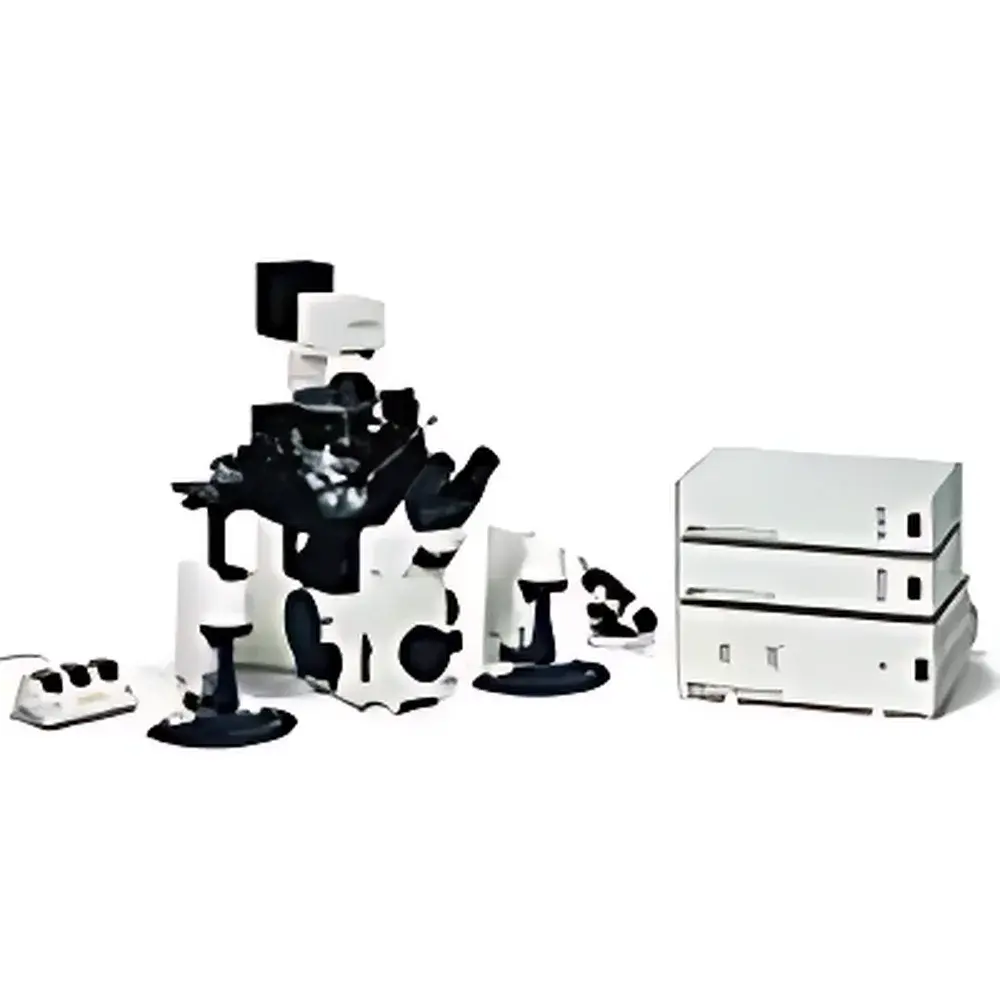
NARISHIGE XenWorks Microinjection System
| Brand | NARISHIGE |
|---|---|
| Origin | Japan |
| Model | XenWorks |
| Type | Motorized Micromanipulator and Digital/Analog Microinjector System for Intracellular and Embryonic Applications |
| Power Supply | 110–230 V AC, 50/60 Hz |
| Compliance | Designed for research use only |
Overview
The NARISHIGE XenWorks Microinjection System is a modular, high-precision platform engineered for reproducible intracellular, embryonic, and nuclear microinjection tasks in developmental biology, transgenic model generation, and assisted reproductive technology (ART) laboratories. Built upon decades of Japanese precision engineering, the system integrates three core subsystems: the XenWorks micromanipulator (motorized inverted joystick), the XenWorks Digital Microinjector (dual-channel pressure-controlled unit), and the XenWorks Analog Microinjector (hydraulic-based coarse/fine actuation). Its operational principle relies on closed-loop stepper motor control for positional stability, coupled with digitally regulated pneumatic pressure delivery (vacuum extraction + positive/negative pressure injection) to achieve sub-micron spatial resolution and millisecond-level temporal control over fluid displacement. The system is designed for integration with inverted and upright research-grade microscopes—including Nikon, Zeiss, Leica, Olympus, and Sutter platforms—and supports standard 1.0 mm O.D. glass capillaries and custom-tapered pipettes.
Key Features
- Motorized micromanipulator with inverted ergonomic joystick design: six selectable rotational ranges (12 mm, 3.3 mm, 880 µm, 400 µm, 200 µm, 100 µm) and user-defined “Work” and “Floor” Z-axis limits
- Three-axis travel range up to 25 mm (X/Y/Z) with maximum speed of 5.5 mm/s and positional repeatability ≤ ±0.5 µm
- Digital Microinjector featuring dual independent pressure channels: one for gentle aspiration (–350 to +350 Pa, 7 Pa step resolution), one for high-precision injection/transplantation (0–5600 Pa, 7 Pa step resolution)
- Adjustable injection duration from 0.01 s to 10.00 s in 0.1 s increments, triggered manually or via footswitch
- Integrated low-noise compressor eliminates need for external compressed air sources
- Analog Microinjector with 10:1 coarse-to-fine adjustment ratio, interchangeable syringe barrels (100 µL, 500 µL, 1000 µL), and fluid displacement calibration traceable to ISO 8596
- Remote control keypad with high-contrast LCD display for real-time parameter monitoring and adjustment
- Modular mounting architecture compatible with standard microscope stage adapters (Nikon TE200/300/2000, Zeiss Axiovert 100/135/200, Leica DM IL/IRB/IRE2, Olympus IX51/71/81)
Sample Compatibility & Compliance
The XenWorks system is validated for handling delicate biological specimens including mouse zygotes, blastocysts, embryonic stem cells (ESCs), somatic cell nuclei, and human spermatozoa. It supports both passive capillary loading and active pressure-driven delivery across suspension and adherent cell types. All components comply with IEC 61000-6-3 (EMC emissions) and IEC 61000-6-2 (immunity) standards. As a research-only instrument, it is not certified for clinical use under FDA 21 CFR Part 820, ISO 13485, or EU MDR Annex I. However, its digital logging capabilities—time-stamped pressure events, duration settings, and actuation triggers—support GLP-compliant experimental documentation when integrated with laboratory information management systems (LIMS). No internal data storage or electronic signature functionality is provided; users must implement external audit-trail solutions per 21 CFR Part 11 requirements.
Software & Data Management
The XenWorks platform operates without proprietary software or driver dependencies. All parameter configuration and real-time control are executed via the front-panel keypad and physical rotary dials. Pressure profiles, timing sequences, and actuation modes are stored in volatile memory only during operation and are not retained after power-down. For traceability, users may log settings manually or interface the footswitch trigger output (TTL-compatible) with third-party acquisition systems (e.g., NIS-Elements, MetaMorph, or custom Python/Matlab scripts) to synchronize injection events with time-lapse imaging or electrophysiological recordings. No cloud connectivity, firmware update mechanism, or remote diagnostics are implemented—ensuring full local control and data sovereignty.
Applications
- Pro-nuclear DNA microinjection into murine fertilized oocytes for transgenic line establishment
- Embryonic stem cell (ESC) injection into host blastocysts for chimeric embryo production
- Somatic cell nuclear transfer (SCNT) in mammalian cloning workflows
- Intracytoplasmic sperm injection (ICSI) for infertility research and gamete manipulation
- Piezo-assisted sperm-mediated gene transfer and nuclear transplantation
- Cytoplasmic transfer, organelle injection, and targeted reagent delivery into single cells or early embryos
- High-throughput microinjection assay development using standardized capillary arrays
FAQ
Is the XenWorks system compatible with upright microscopes?
Yes—adapter kits are available for Zeiss Axiovert and Olympus IX-series upright configurations; however, optimal ergonomics and visual access are achieved on inverted platforms.
Can the Digital Microinjector be used for long-duration continuous pressure application?
No—it is designed for discrete, time-gated pulses (0.01–10.00 s); sustained pressure requires external regulators or analog systems.
What capillary specifications are supported?
Standard 1.0 mm outer diameter borosilicate glass capillaries; tapered or coated variants require verification of tip geometry compatibility with the holder clamping mechanism.
Does the system support automated protocol sequencing?
Not natively—the XenWorks lacks programmable script execution; automation requires external TTL-triggered integration with motion controllers or image analysis software.
Is service and calibration available outside Japan?
Yes—authorized NARISHIGE service centers operate in North America, Europe, and Asia-Pacific regions; annual calibration is recommended for pressure channel accuracy verification per ISO/IEC 17025 guidelines.
Related Products