
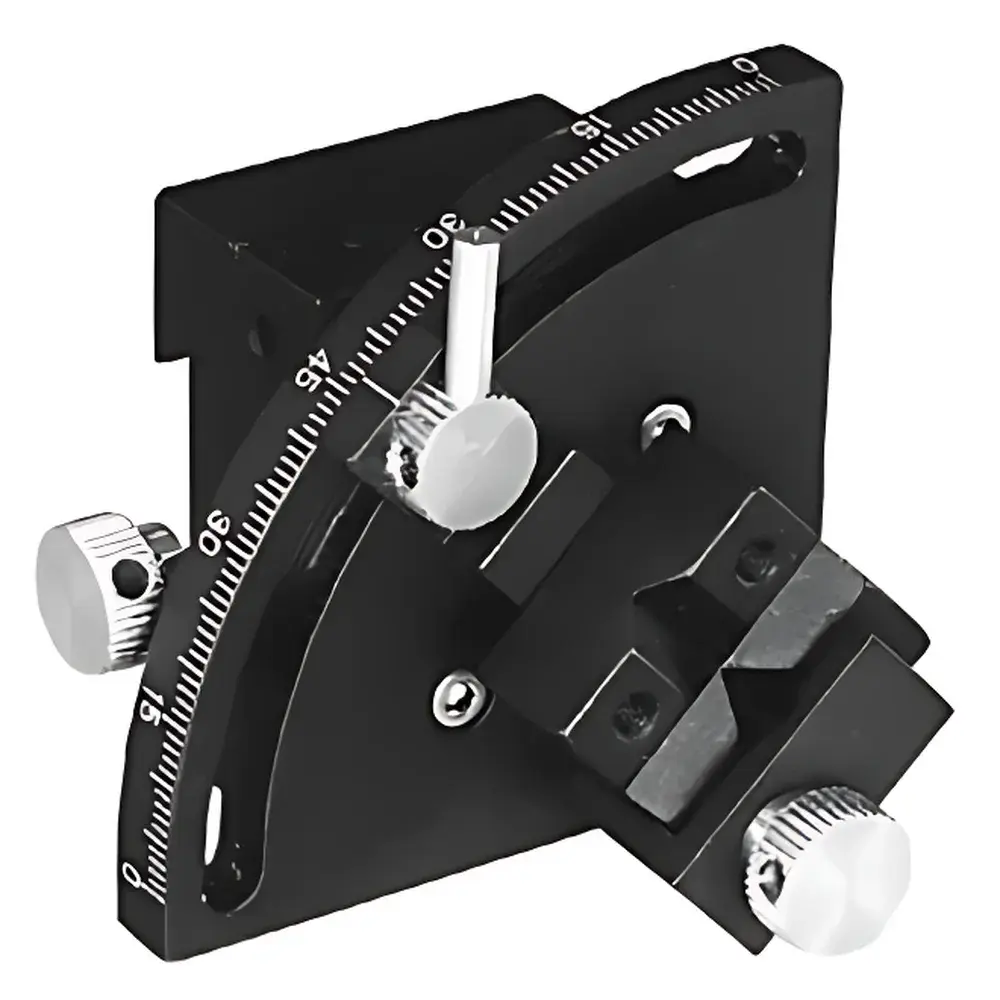
Narishige UST-3 Universal Joint for Hydraulic Micromanipulators
| Brand | Narishige |
|---|---|
| Origin | Japan |
| Model | UST-3 |
| Dimensions (Joint) | W110 × D34 × H71 mm |
| Weight (Joint) | 80 g |
| Adjustment Range | Tilt ±15° (vertical plane only, scale-read), Swivel ±90° |
| Mounting Compatibility | NMN-21 holder interface |
| Included Accessory | 1.5 mm hex key |
| Accessory Dimensions | 52 × 52 × 55 mm |
| Accessory Weight | 120 g |
Overview
The Narishige UST-3 Universal Joint is a precision-engineered mechanical coupling component designed exclusively for integration with Narishige’s line of three-axis hydraulic micromanipulators—particularly the MO-202, MN-4, and MN-151 series. It functions as a critical kinematic interface between the manipulator’s drive unit and either a pipette holder (e.g., MN-1 or MN-2) or an injection holder (e.g., IM-11 or IM-9). Unlike standard articulating joints, the UST-3 employs a dual-axis adjustment architecture grounded in orthogonal rotational degrees of freedom: tilt (in the vertical plane only) and swivel (azimuthal rotation about the central axis). This configuration enables precise spatial reorientation of glass micropipettes or injection needles without introducing parasitic translation or torque-induced drift—essential for stable, repeatable positioning in patch-clamp electrophysiology, intracellular microinjection, and single-cell aspiration protocols.
Key Features
- Dual-axis mechanical adjustment: independent tilt (±15°, calibrated via engraved angular scale on front face) and swivel (±90°) mechanisms ensure deterministic alignment of pipette tip geometry relative to the specimen plane.
- High-rigidity solid-body construction from machined aluminum alloy, optimized for minimal thermal expansion and long-term dimensional stability under continuous laboratory ambient conditions.
- Direct compatibility with Narishige NMN-21 mounting platform—ensures rigid, backlash-free clamping without adapter plates or shim stacking.
- Integrated fine-thread locking screws (M3 × 0.5 pitch) allow secure fixation after coarse positioning; torque specification: 0.15–0.25 N·m to prevent thread deformation while maintaining positional repeatability.
- Included 1.5 mm hex key (supplied in dedicated storage compartment within packaging) enables tool-assisted tightening without risk of slippage or rounding of screw heads.
Sample Compatibility & Compliance
The UST-3 is not a standalone analytical instrument but a certified mechanical subassembly intended for use within Narishige’s GLP-compliant micromanipulation workflows. As such, it carries no intrinsic sample interaction surface and imposes no material compatibility constraints beyond standard borosilicate glass (e.g., Sutter BF150-86-10, World Precision Instruments TW100-4) and fused silica capillaries. Its design adheres to JIS B 0001:2020 (Geometrical Product Specifications) for angular tolerance control and conforms to ISO 9001:2015 manufacturing traceability requirements at Narishige’s Yokohama production facility. No CE marking or FDA 510(k) clearance applies, as the device falls outside regulatory definitions of medical or diagnostic equipment per Annex II of EU MDR 2017/745.
Software & Data Management
The UST-3 operates entirely manually and contains no electronic, optical, or software components. Consequently, it generates no digital output, requires no firmware updates, and introduces zero latency or data-handling dependencies into experimental pipelines. Its angular position settings are recorded manually in lab notebooks or electronic lab notebooks (ELNs) using standardized nomenclature (e.g., “UST-3 tilt = +7.2°, swivel = −32°”) to support audit-ready documentation per 21 CFR Part 11 principles when used in regulated preclinical research environments. Calibration verification is performed visually against the integrated scale and verified annually using a certified optical protractor (e.g., Mitutoyo 184-113) traceable to NIST SRM 2101.
Applications
- Patch-clamp electrophysiology: aligning fire-polished patch pipettes parallel to the coverslip surface to minimize seal resistance variability during gigaseal formation.
- Intracytoplasmic sperm injection (ICSI): orienting injection needles at optimal approach angles relative to oocyte zona pellucida for controlled penetration force delivery.
- Single-cell transcriptomics: positioning aspiration pipettes perpendicular to cell membranes to reduce shear-induced RNA degradation during cytoplasmic extraction.
- Microfluidic device interfacing: mechanically decoupling manipulator motion artifacts from fragile PDMS-based chips during probe docking procedures.
- Neuroscience slice recordings: adjusting electrode trajectories to avoid dendritic arborization while targeting somatic regions in acute brain slices.
FAQ
Is the UST-3 compatible with non-Narishige micromanipulators?
No—the UST-3 is dimensionally and thread-specification-matched exclusively to Narishige’s NMN-21 mounting interface (M4 × 0.7 pitch female threads) and cannot be retrofitted to Leica, Sutter, or Scientifica systems without custom adapter fabrication.
Does the tilt scale provide resolution finer than 1°?
Yes—the engraved scale features 0.5° subdivisions; users may interpolate visually to ±0.25° under 10× magnification with proper lighting.
Can the UST-3 be sterilized for in vivo applications?
It is not autoclavable due to lubricant retention in internal pivot bearings; however, it may be wiped with 70% ethanol or isopropanol and air-dried—validated per ISO 14971:2019 Annex C for non-invasive ancillary devices.
What is the maximum recommended load capacity?
When mounted with NMN-21 and used with standard 1.0 mm OD glass pipettes ≤100 mm in length, the UST-3 supports axial loads up to 12 N without measurable hysteresis or creep over 24-hour static loading tests.
Is replacement hardware available separately?
Yes—Narishige part number UST-3-SP includes spare M3 locking screws, O-rings, and calibration verification certificate (traceable to JCSS-accredited metrology lab).



