
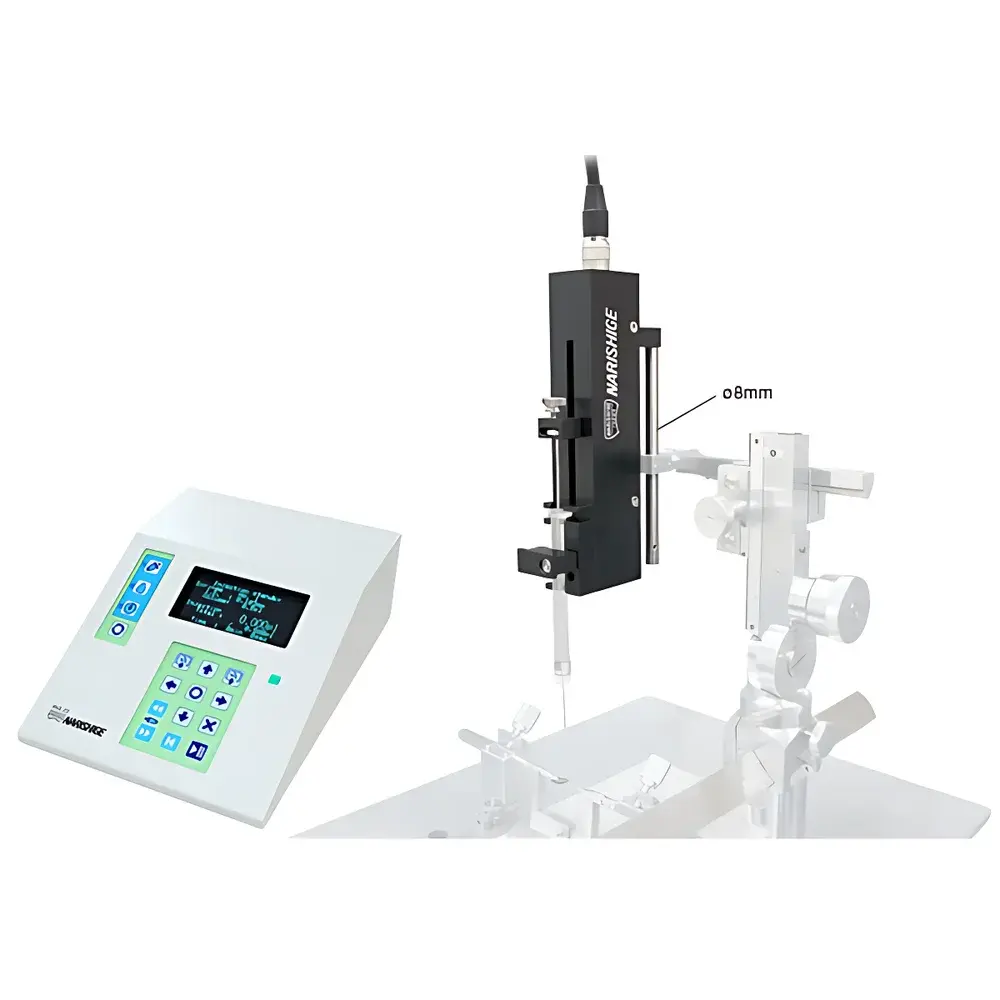
NARISHIGE IMS-30 Electric Stereotactic Microinjector
| Brand | NARISHIGE |
|---|---|
| Origin | Japan |
| Model | IMS-30 |
| Drive Motor | 5-phase stepper motor |
| Stroke Range | 60 mm |
| Operating Voltage | AC 100–240 V, 50/60 Hz |
| Power Consumption | 15 W |
| Dimensions (Driver Unit) | 47.5 × 82.5 × 156.5 mm, 456 g |
| Dimensions (Control Unit) | 180 × 260 × 95 mm, 2.5 kg |
| Included Accessories | 1.5-m power cord, 1.5-m connection cable, dedicated mounting screws, two hex wrenches, spare fuses (installed in fuse holder) |
| Syringe Compatibility | Pre-programmed Hamilton syringe codes (e.g., 7001/7101 for 1 µL, 7002/7102 for 2 µL, 702/1702 for 25 µL, etc.), inner diameter range: 0.103–2.304 mm, volume range: 0.5–250 µL |
| Mounting Options | Direct screw-in or bracket-mounted integration with stereotactic micromanipulators |
Overview
The NARISHIGE IMS-30 Electric Stereotactic Microinjector is a precision-engineered instrument designed for controlled, repeatable microvolume delivery in neuroscience, developmental biology, and preclinical research settings. It operates on a closed-loop 5-phase stepper motor system, enabling high-resolution linear displacement (60 mm total stroke) with exceptional positional reproducibility and minimal mechanical backlash. Unlike manual or pneumatic injectors, the IMS-30 calculates and maintains constant flow rates based on user-defined injection volume and time—eliminating operator-dependent variability in bolus delivery. Its core function relies on precise actuation of the syringe plunger via a rigid, low-compliance drive mechanism, ensuring accurate volumetric dispensing across a wide range of capillary geometries—from ultra-fine 0.103 mm ID (0.5 µL) to robust 2.304 mm ID (250 µL) Hamilton-compatible glass or metal syringes. The device is purpose-built for integration into stereotactic workflows, supporting both acute intracranial, intraocular, and embryonic injections under visual guidance (e.g., with DIC or fluorescence microscopy).
Key Features
- Pre-loaded Hamilton syringe database covering 11 standard configurations (0.5–250 µL), with automatic flow rate calculation upon selection of volume and duration
- Dual-mounting architecture: supports direct screw-in attachment or bracket-based alignment with NARISHIGE MO-10, MN-151, or other third-party stereotactic manipulators
- Ergonomic control unit with icon-driven interface and large backlit LCD display showing real-time status (plunger position, elapsed time, remaining volume, flow rate)
- Universal syringe holder featuring dual-mode fixation—large-diameter clamping surface for thin-wall plungers and reversible adapter for secure retention of diverse syringe barrel profiles
- Wide-input universal power supply (100–240 V AC, 50/60 Hz) with low thermal signature (15 W max), suitable for laminar flow hoods and vibration-isolated rigs
- Modular hardware design: driver unit (456 g) decoupled from control electronics (2.5 kg), minimizing inertial coupling during fine positioning
Sample Compatibility & Compliance
The IMS-30 accommodates all standard Hamilton glass syringes (models 700x, 710x, 170x series) and compatible alternatives from SGE, Ito, or Nanomite. Inner diameters from 0.103 mm to 2.304 mm are supported, enabling calibrated delivery across viscous solutions (e.g., viral vectors, dyes, hydrogels, or cell suspensions) without recalibration. While the IMS-30 itself is not FDA-cleared or CE-marked as an IVD device, its operational parameters align with GLP-compliant microinjection protocols used in academic and contract research organizations. Data logging (via optional RS-232 or TTL trigger output) supports traceability in studies adhering to NIH, EMBO, or FELASA guidelines for animal experimentation.
Software & Data Management
The IMS-30 operates autonomously via its embedded firmware—no host PC or proprietary software is required for basic operation. However, it features TTL-compatible trigger inputs and analog/digital status outputs (plunger position, injection start/stop signals), enabling synchronization with electrophysiology rigs (e.g., Axon Digidata), imaging systems (e.g., Zeiss LSM, Nikon A1R), or behavioral platforms (e.g., Med Associates). For audit-ready environments, external data acquisition systems can record timestamps, motor step counts, and event markers—facilitating compliance with 21 CFR Part 11 requirements when paired with validated third-party DAQ software (e.g., LabChart, Spike2, or custom Python/NI LabVIEW implementations).
Applications
- Stereotactic intracerebral injection of AAV, lentivirus, or CRISPR-Cas9 constructs in rodent models
- Embryonic microinjection in zebrafish, chick, or mouse embryos (E0.5–E3.5)
- Intraocular delivery of neurotrophic factors or optogenetic agents in retinal explants
- Microfluidic interfacing: precise priming and calibration of nanoliter-scale channels
- Calibration reference for gravimetric or fluorometric validation of microdispensing accuracy
- Teaching labs: demonstration of volumetric precision, fluid dynamics at low Reynolds numbers (<1), and motor control fundamentals
FAQ
Can the IMS-30 be used with non-Hamilton syringes?
Yes—users may manually enter inner diameter and nominal volume for any syringe; flow rate calculations remain valid provided the plunger seal integrity and linearity are verified.
Is the IMS-30 compatible with cryogenic or humidified chambers?
The driver unit is rated for ambient operation (15–35°C, <80% RH non-condensing); extended use below 10°C or above 40°C requires environmental enclosure validation.
Does the IMS-30 support programmable multi-step injection sequences?
No—the device executes single-step volume/time commands only; sequential protocols require external TTL triggering or integration with motion controllers.
What maintenance is required for long-term accuracy?
Annual verification of plunger travel linearity using calibrated gauge blocks or laser interferometry is recommended; stepper motor and lead screw require no lubrication.
How is sterility maintained during in vivo use?
The IMS-30 is not autoclavable; sterilization is achieved via ethanol wipe-down and UV exposure—syringe barrels and needles must be separately sterilized per institutional biosafety protocols.





