
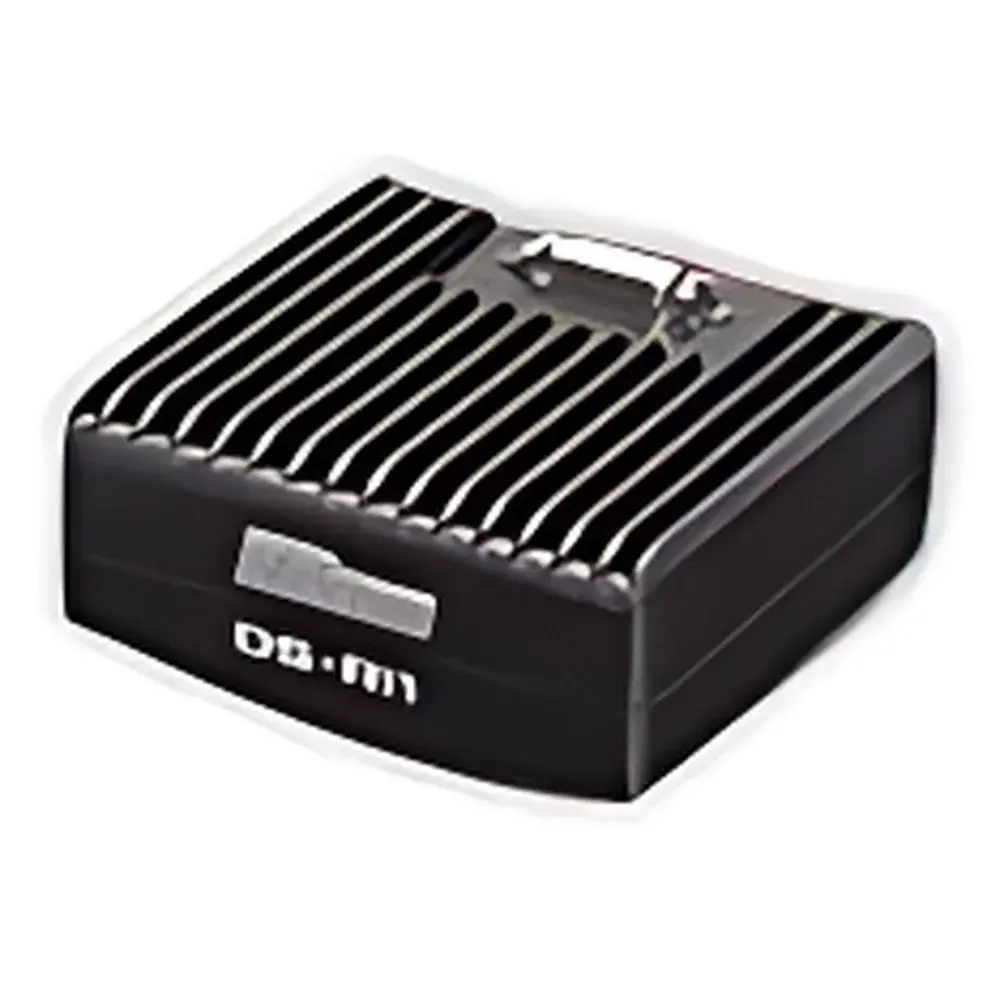
Narishige DS-Ri1 High-Resolution Microscopy CCD Camera
| Brand | Narishige |
|---|---|
| Origin | Japan |
| Model | DS-Ri1 |
| Sensor Type | Interline Transfer CCD |
| Resolution | 4080 × 3072 (12.5 MP) |
| Pixel Size | 7.4 µm × 7.4 µm |
| Cooling | Peltier-cooled to −10°C below ambient |
| Interface | USB 2.0 via DS-L2 or DS-U2 controller |
| Frame Rate | up to 19 fps (full resolution), higher in ROI or binning modes |
| Bit Depth | 12-bit per channel (36-bit RGB raw) |
| Optical Compatibility | Supports 14 Nikon digital imaging interfaces |
| Software Control | Fully integrated with NIS-Elements v5.x or later |
| Compliance | Designed for GLP/GMP-aligned laboratory documentation workflows, supports audit-trail-capable acquisition metadata logging per FDA 21 CFR Part 11 guidelines where configured with validated NIS-Elements deployment |
Overview
The Narishige DS-Ri1 is a high-performance, interline transfer CCD camera engineered specifically for demanding optical microscopy applications requiring exceptional spatial fidelity, color accuracy, and low-noise performance. Built upon the proven architecture of the Nikon DXM1200 series and refined through Narishige’s expertise in precision optical instrumentation, the DS-Ri1 delivers 12.5 megapixel resolution (4080 × 3072) with a native pixel pitch of 7.4 µm — optimized for diffraction-limited imaging across visible wavelengths. Its core measurement principle relies on photon-to-electron conversion within a thermoelectrically stabilized silicon photodiode array, followed by correlated double sampling (CDS) readout to suppress reset noise and fixed-pattern noise. This enables quantitative brightfield, phase contrast, and fluorescence imaging with high dynamic range and minimal thermal drift — critical for longitudinal studies, comparative histopathology, and industrial surface inspection where pixel-level reproducibility is mandatory.
Key Features
- 12.5 MP interline CCD sensor with 7.4 µm square pixels, delivering >2200 TV lines of horizontal resolution under Köhler illumination
- Peltier-based active cooling system stabilizing sensor temperature to 10°C below ambient, reducing dark current by up to 50% compared to uncooled operation
- USB 2.0 interface with dedicated DS-L2 standalone preview mode and DS-U2 controller compatibility for seamless integration into existing Nikon imaging ecosystems
- Real-time preview at 19 fps (1.4 MP subsampled) or 7.5 fps (full-frame), enabling intuitive manual focusing and live exposure optimization
- Advanced color science pipeline incorporating Nikon-developed spectral matching algorithms calibrated against CIE 1931 XYZ tristimulus values for accurate dye-specific hue preservation
- 12-bit per channel (36-bit RGB) raw output format supporting linear intensity response and post-acquisition gamma/white balance correction without quantization loss
Sample Compatibility & Compliance
The DS-Ri1 is compatible with all standard Nikon microscope photoports and supports 14 distinct mechanical and electrical interface configurations — including C-mount, F-mount, and proprietary Nikon DXM couplers — ensuring interoperability with upright, inverted, and stereo platforms. It meets ISO 10934-1 (Medical endoscopes — Vocabulary) and JIS Z 8110 (Imaging systems — Terminology and definitions) requirements for optical imaging instrumentation. When deployed with NIS-Elements in validated environments, the system supports ALCOA+ data integrity principles: attributable, legible, contemporaneous, original, accurate, complete, consistent, enduring, and available. Audit trails, electronic signatures, and instrument calibration metadata are preserved in accordance with FDA 21 CFR Part 11 and EU Annex 11 expectations for regulated life science laboratories.
Software & Data Management
The DS-Ri1 operates natively within the NIS-Elements software platform (v5.20 or later), which provides unified control over acquisition parameters, multi-dimensional time-lapse sequencing, hardware synchronization (shutter, filter wheels, stage), and quantitative image analysis modules including particle counting, intensity profiling, and colocalization metrics. All acquired images embed EXIF-compliant metadata — including exposure time, gain, binning mode, objective magnification, and environmental temperature — enabling traceable reconstruction of experimental conditions. Raw data is stored in lossless TIFF or vendor-neutral ND2 formats; batch export supports DICOM-SR for PACS integration in clinical pathology settings.
Applications
- Brightfield and phase contrast documentation in academic histology and veterinary diagnostics
- Fluorescence co-localization studies using DAPI/FITC/TRITC/Cy5-labeled specimens, leveraging low-noise acquisition at long exposures
- Industrial quality assurance of microelectronic substrates, printed circuit board traces, and thin-film coatings
- Time-lapse monitoring of cell migration, mitosis, and wound-healing assays with sub-second temporal resolution
- Forensic fiber and pigment analysis requiring spectrally faithful color reproduction for comparative database matching
FAQ
Does the DS-Ri1 support hardware-triggered acquisition for synchronized multi-instrument experiments?
Yes — the DS-L2 controller provides TTL-compatible trigger input/output ports, enabling precise external synchronization with laser sources, shutters, or motorized stages.
Can the camera be used without NIS-Elements software?
Basic preview and still capture are supported via DS-L2’s embedded firmware interface; however, advanced features such as multi-channel merging, Z-stack reconstruction, and metadata-rich export require NIS-Elements.
What is the recommended maintenance interval for the Peltier cooling module?
No scheduled maintenance is required; the thermoelectric cooler is solid-state with no moving parts. Continuous operation at ΔT = −10°C is rated for ≥50,000 hours MTBF under laboratory environmental conditions (20–25°C, <60% RH).
Is the DS-Ri1 compliant with CE and FCC electromagnetic compatibility directives?
Yes — the device carries CE marking under Directive 2014/30/EU (EMC) and 2014/35/EU (LVD), and FCC ID: 2AJBQ-DSRI1 confirms compliance with Part 15 Class B digital device limits.




