
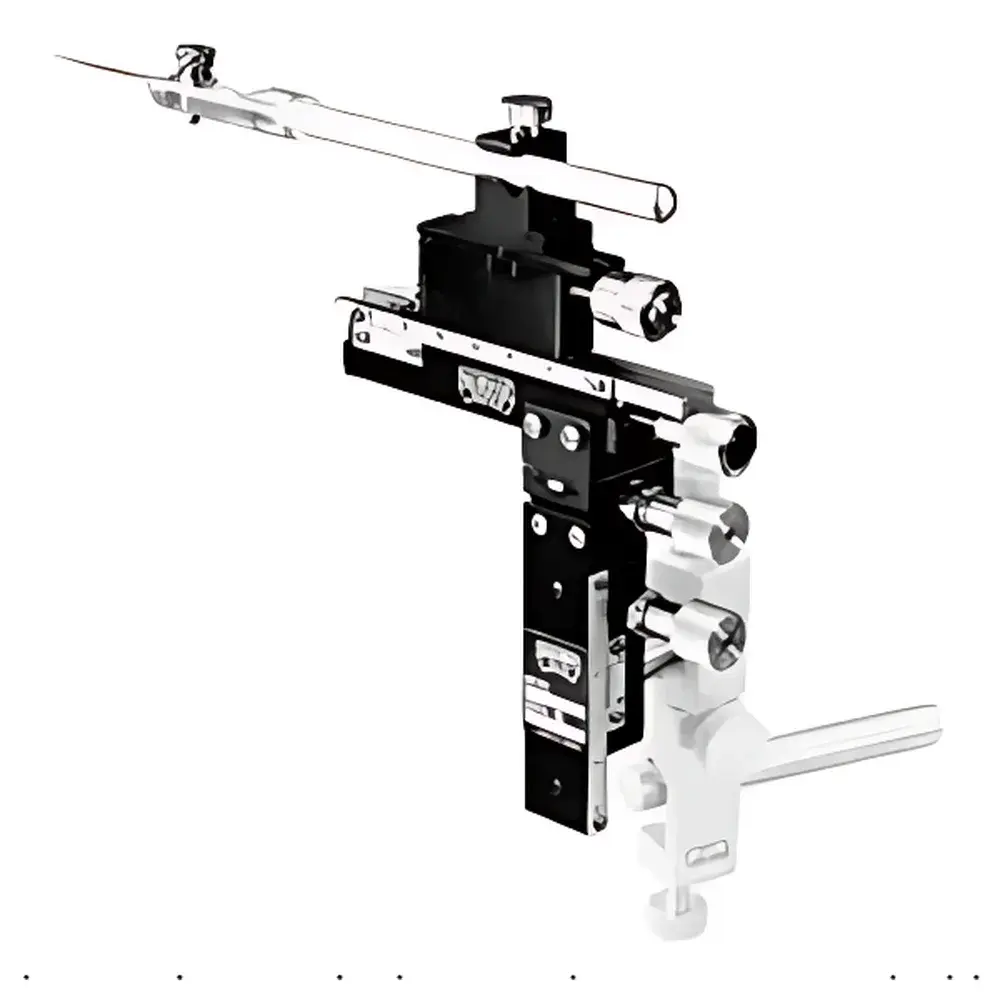
Narishige M-3333 Micromanipulator
| Brand | Narishige |
|---|---|
| Origin | Japan |
| Model | M-3333 |
| Dimensions (W×D×H) | 126 × 43 × 145 mm |
| Weight | 340 g |
| Coarse Motion Range (X/Y/Z) | 40 / 12 / 30 mm |
| Fine Motion Range (X) | 7 mm |
| Minimum Step Size | 10 µm |
| Maximum Step Size | 250 µm |
| Compatible Electrode Holder | H-1 |
| Drive Mechanism | X-4 Rotational X-Block |
| Construction | Compact, Low-Profile Monoblock Design |
Overview
The Narishige M-3333 Micromanipulator is a precision-engineered manual manipulator designed specifically for high-resolution electrophysiological and microelectrode positioning tasks in electrochemical and neurophysiological laboratories. Built upon Narishige’s decades-long heritage in micromanipulation systems, the M-3333 employs a compact monoblock architecture with an ultra-low-profile chassis—optimized to minimize spatial footprint while maximizing mechanical stability and operator ergonomics. Its core operational principle relies on dual-stage motion control: coarse positioning via calibrated rotational knurled knobs and fine adjustment through a high-ratio gear-driven micrometer mechanism. The integrated X-4 rotational X-block enables precise angular alignment of electrode carriers without requiring additional mounting hardware or extended bench space—making it especially suitable for multi-electrode configurations in confined setups such as patch-clamp rigs, SECM (scanning electrochemical microscopy) stations, or microfluidic cell interfacing platforms.
Key Features
- Ultra-compact form factor (126 × 43 × 145 mm) with minimized vertical profile—ideal for integration beneath inverted microscopes or within shielded Faraday cages.
- Dual-range motion system: coarse travel (X: 40 mm, Y: 12 mm, Z: 30 mm) for rapid repositioning; fine X-axis adjustment (7 mm range) with 10 µm minimum step resolution and 250 µm maximum incremental displacement.
- X-4 rotational X-block design eliminates need for separate rotation stages—enabling coaxial alignment of multiple electrodes mounted on the H-1 electrode holder without sacrificing rigidity or introducing parasitic drift.
- All control handles oriented unidirectionally for consistent hand placement and reduced operator fatigue during prolonged experiments.
- Machined aluminum body with hardened stainless steel lead screws and anti-backlash nuts ensures long-term dimensional stability and repeatability under continuous laboratory use.
- Compatible with Narishige H-1 universal electrode holder—designed for secure clamping of glass micropipettes, metal microelectrodes, and carbon fiber probes with outer diameters from 1.0 to 1.5 mm.
Sample Compatibility & Compliance
The M-3333 supports direct mechanical coupling with standard electrophysiology and electrochemical probe types—including borosilicate glass pipettes (pulled or un-pulled), tungsten or platinum-iridium microelectrodes, and carbon-based ultramicroelectrodes. Its low-vibration mechanical design meets baseline requirements for stable signal acquisition in low-noise DC and AC impedance measurements. While the device itself is not electronically certified, its passive mechanical construction complies with general laboratory safety standards (IEC 61010-1) when used within properly grounded electrochemical workstations. The manipulator is routinely deployed in environments adhering to GLP-compliant electrophysiology protocols and supports traceable positioning documentation when paired with digital encoder add-ons (e.g., Narishige EX-300 series optional encoders).
Software & Data Management
As a fully manual, non-motorized instrument, the M-3333 does not incorporate embedded electronics or native software interfaces. However, its mechanical repeatability and standardized mounting geometry allow seamless integration into automated workflows via third-party motion control systems (e.g., Thorlabs Kinesis, Prior ProScan, or custom LabVIEW-based DAQ platforms). When used with optional digital readout modules or optical encoder attachments, positional data can be logged in CSV or HDF5 format for synchronization with electrophysiology acquisition software (e.g., pCLAMP, PatchMaster, or Spike2). All mechanical adjustments are fully auditable through physical scale markings and calibrated micrometer dials—supporting manual record-keeping compatible with FDA 21 CFR Part 11–aligned SOPs when combined with controlled lab notebooks.
Applications
- Patch-clamp electrophysiology: precise approach and seal formation on cultured neurons, HEK cells, or brain slices.
- Scanning electrochemical microscopy (SECM): stable positioning of ultramicroelectrodes for surface topography and redox activity mapping.
- Intracellular recording: controlled penetration of microelectrodes into single cells with minimal membrane damage.
- Microelectrode array (MEA) calibration and referencing: alignment of reference electrodes relative to active sensing sites.
- Electrochemical biosensor development: reproducible placement of enzymatic or affinity-based microsensors in flow cells or microfluidic channels.
- Correlative microscopy-electrochemistry: synchronized positioning of electrochemical probes beneath confocal or two-photon imaging objectives.
FAQ
Is the M-3333 compatible with vibration isolation tables?
Yes—the low center of gravity, rigid monoblock construction, and absence of motor-driven components make it highly suitable for use on active or passive vibration isolation platforms.
Can the M-3333 be retrofitted with motorized drives?
No—its mechanical architecture is purely manual and not designed for aftermarket motorization. For motorized alternatives, consider the Narishige MMO-202ND or MN-403 series.
What is the recommended torque for the Allen wrench included with the H-1 holder?
Narishige specifies a maximum tightening torque of 0.15 N·m for the H-1 set screw to prevent deformation of glass or metal electrode shafts.
Does the M-3333 meet ISO 9001 manufacturing standards?
All Narishige micromanipulators, including the M-3333, are manufactured at ISO 9001-certified facilities in Japan, with full traceability of raw materials and assembly processes.
Is the X-4 rotational block serviceable in the field?
The X-4 block is a sealed, pre-lubricated unit—not user-serviceable. Replacement requires factory recalibration to maintain angular accuracy within ±0.5°.





