
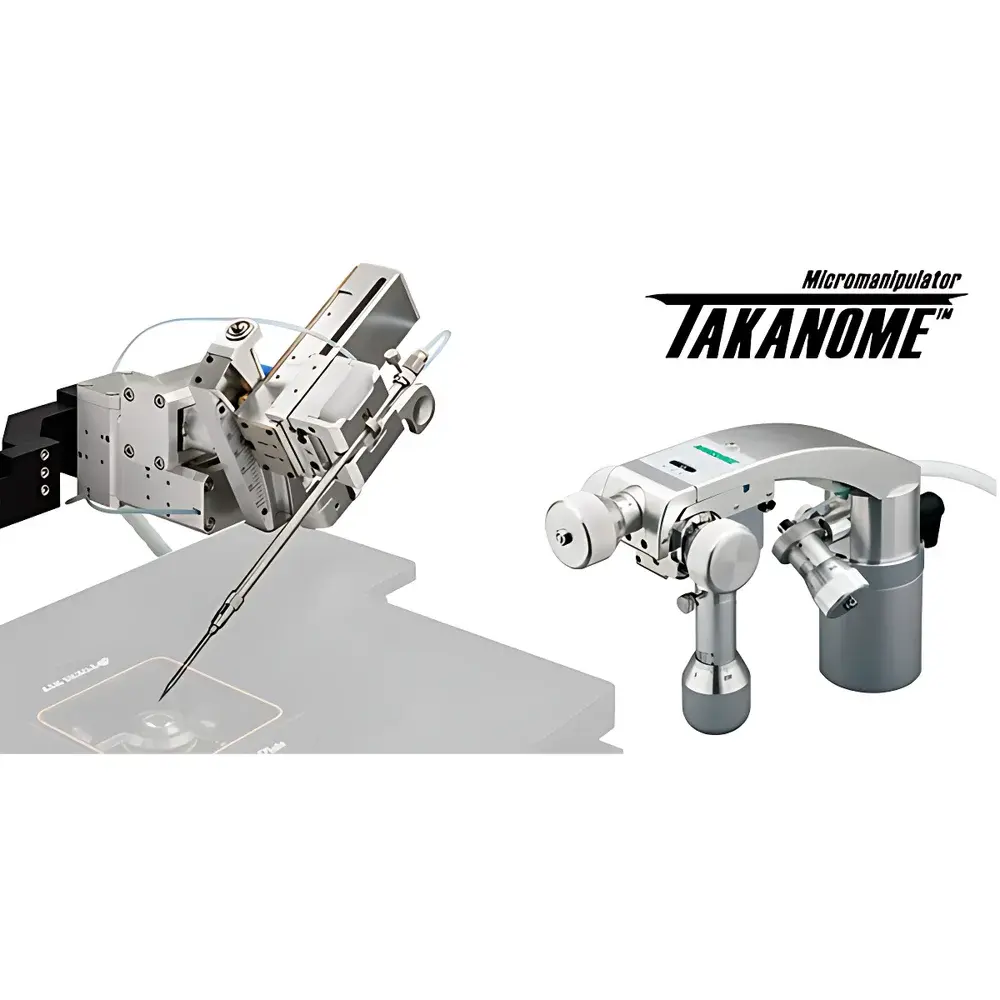
NARISHIGE MTK-1 Series Four-Axis Hydraulic Micromanipulator for Suspended Cell Handling
| Brand | NARISHIGE |
|---|---|
| Origin | Japan |
| Model Variants | MTK-1-O1/O2/O3/N1/N2/N3/N4/Z1/Z2/L1/L2 |
| Drive Principle | Hydraulic |
| Axes | X, Y, Z, Rotation (θ) |
| X/Y/Z Travel (Hydraulic Fine Control) | 10 mm |
| X/Y/Z Step Resolution (Fine Button) | 250 µm (X/Y), 1000 µm (Z) |
| Minimum Increment (Fine Adjustment) | 5 µm (X/Y), 20 µm (Z) |
| Coarse Return Stroke (Manual Reset) | 50 mm |
| Pipette Tip Angular Range | 15°–40° |
| Pipette Tip-to-Anchoring Point Distance | Adjustable & Reproducible |
| Hydraulic Tubing Length | 0.6 m |
| Control Unit Dimensions (W×D×H) | 85.6 × 225–235 × 151–171 mm, ~1.9 kg |
| Driver Unit Dimensions (W×D×H) | 108–138 × 145–155 × 100–150 mm, ~820 g |
Overview
The NARISHIGE MTK-1 Series is a precision-engineered four-axis hydraulic micromanipulator designed specifically for high-fidelity mechanical handling of suspended biological specimens—particularly in patch-clamp electrophysiology, intracellular injection, and single-cell microinjection applications. Its core operational principle relies on oil-filled hydraulic transmission, delivering smooth, backlash-free motion with exceptional force stability and positional repeatability across X, Y, Z, and rotational (θ) axes. Unlike motorized or piezoelectric alternatives, the MTK-1’s hydraulic architecture eliminates electrical noise, thermal drift, and stepwise quantization artifacts—critical requirements for low-noise voltage-clamp recordings and real-time manipulation under high-magnification differential interference contrast (DIC) or infrared differential interference contrast (IR-DIC) microscopy. The manipulator integrates seamlessly with upright and inverted research-grade microscopes via model-specific mounting adapters, ensuring optical axis alignment without iterative calibration.
Key Features
- Four-degree-of-freedom control: Independent hydraulic actuation for X, Y, Z translation and θ-axis rotation enables precise pipette tip positioning in 3D space while maintaining consistent orientation relative to the optical axis.
- Two-stage motion architecture: Fine hydraulic adjustment (250 µm per button press on X/Y; 1000 µm on Z) combined with coarse manual return (50 mm stroke) allows rapid repositioning without sacrificing sub-micron targeting accuracy.
- Dedicated anchoring system: Dual anchor clamps (included) fix pipette position relative to the driver body, enabling reproducible tip-to-anchor distance setting—essential for standardized electrode exchange and multi-pipette experimental protocols.
- Optimized angular geometry: Pipette holder accommodates 15°–40° inclination angles, ensuring tip visibility remains unobstructed within the microscope’s field of view during oblique approaches—minimizing parallax-induced targeting error.
- Microscope-agnostic mounting: Pre-engineered adapter plates (O1–O3, N1–N4, Z1–Z2, L1–L2) provide rigid, zero-adjustment installation on Olympus IX70/71/73/83, Nikon TE2000/Ti/Ts2R/Ti2, Zeiss Axiovert 200/Observer 3–7/Axio Vert.A1, and Leica DMi8 platforms.
- Noise-immune operation: Fully passive hydraulic drive eliminates electromagnetic interference (EMI), making it compatible with sensitive low-current (100 dB) electrophysiological recording setups.
Sample Compatibility & Compliance
The MTK-1 is validated for use with standard borosilicate and quartz glass micropipettes (OD ≤ 1.5 mm, length ≤ 100 mm) and supports both positive-pressure and negative-pressure perfusion configurations. Its mechanical design conforms to ISO 13485-aligned manufacturing practices as implemented by NARISHIGE Co., Ltd. While not a medical device itself, the manipulator supports GLP-compliant electrophysiology workflows when deployed in conjunction with FDA 21 CFR Part 11–enabled data acquisition systems (e.g., HEKA PatchMaster, Molecular Devices pCLAMP). It meets CE marking requirements for laboratory equipment (2014/30/EU EMC Directive and 2014/35/EU Low Voltage Directive) and carries RoHS 3 compliance certification.
Software & Data Management
The MTK-1 operates as a hardware-only platform with no embedded firmware or digital interface. All positioning is executed manually via tactile controls—ensuring deterministic latency-free response and eliminating software-related failure modes. For traceable experimental documentation, users integrate the manipulator into established electrophysiology suites where position metadata (e.g., coarse/fine step counts, anchor reference points) are logged alongside electrophysiological traces in vendor-neutral formats (e.g., ABF 2.0, HDF5). When used in regulated environments, position logs may be archived alongside raw data files under audit-trail-enabled acquisition software meeting ALCOA+ principles (Attributable, Legible, Contemporaneous, Original, Accurate, Complete, Consistent, Enduring, Available).
Applications
- Whole-cell and perforated-patch clamp recordings from neurons, cardiomyocytes, and suspension-cultured cell lines (e.g., CHO, HEK293, iPSC-derived neurons).
- Single-cell mRNA extraction and cytoplasmic/nuclear injection using ultrafine pipettes (≤0.5 µm tip diameter).
- Long-duration intracellular dye loading or CRISPR-Cas9 RNP delivery in live-cell imaging experiments requiring minimal phototoxicity and mechanical perturbation.
- Multi-electrode array (MEA) calibration and probe alignment in hybrid electrophysiology-imaging rigs.
- Microfluidic device interfacing where precise pipette docking to microchannels or hydrogel-embedded tissues is required.
FAQ
Is the MTK-1 compatible with vibration-isolated optical tables?
Yes—the driver unit’s compact mass (~820 g) and rigid aluminum alloy construction minimize resonant coupling; mounting adapters include threaded holes for direct M4/M6 fastening to standard breadboard surfaces.
Can I retrofit an older MTK-1 with updated adapters for a new microscope model?
NARISHIGE provides adapter replacement kits under part numbers corresponding to specific microscope chassis; contact authorized distributors for cross-reference compatibility verification.
What maintenance does the hydraulic system require?
No routine maintenance is specified—sealed hydraulic circuits are factory-filled with low-volatility silicone oil and rated for >10⁵ actuation cycles without fluid replenishment.
Does the manipulator support automated coordinate recall?
No—it is purely manual; however, its anchor-based referencing system enables user-defined “home” positions that can be reproduced within ±2 µm using calibrated micrometer dials and IP measurement plates (included).
Are replacement anchors and pipette holders available as spare parts?
Yes—NARISHIGE catalogs all mechanical subcomponents separately (e.g., Anchor Set P/N ANK-MTK1, Holder Sleeve P/N HLD-MTK1); lead time is typically 2–4 weeks ex-Japan warehouse.





