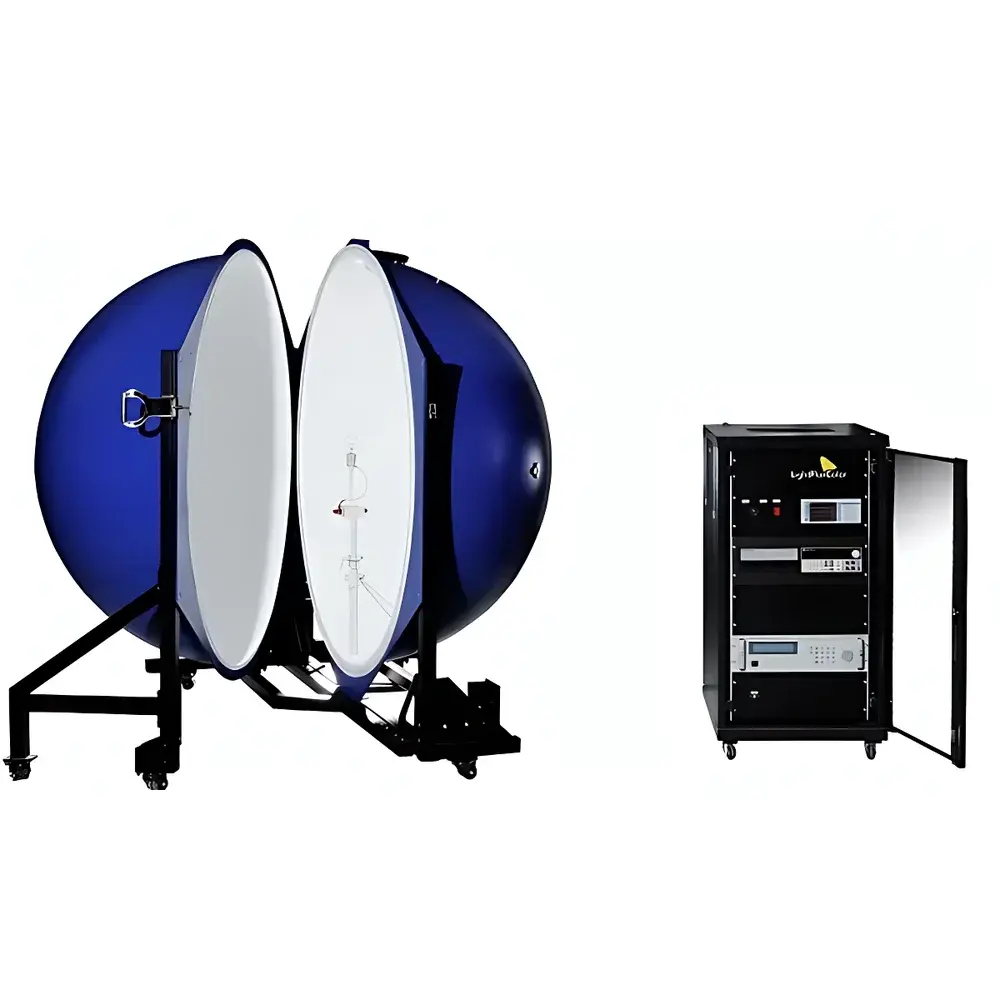
LabSphere LFC LED Luminous Flux and Color Measurement System with Integrating Sphere Spectrometer
| Brand | Labsphere |
|---|---|
| Origin | Shanghai, China |
| Manufacturer Type | Authorized Distributor |
| Country of Origin | China |
| Model | LFC |
| Pricing | Upon Request |
Overview
The LabSphere LFC LED Luminous Flux and Color Measurement System is a fully integrated, NIST-traceable optical characterization platform engineered for precision photometric, radiometric, and colorimetric analysis of solid-state lighting (SSL) devices. Built upon the fundamental principles of integrating sphere photometry and spectroradiometry, the LFC system employs a high-reflectance, Lambertian-coated integrating sphere—internally coated with Labsphere’s proprietary 6080 diffuse reflectance material (≥96% reflectance across 350–1000 nm)—to ensure uniform spatial response and minimal measurement uncertainty in both 2π (hemispherical) and 4π (full-sphere) configurations. The system complies strictly with IESNA LM-79-19 (“Electrical and Photometric Measurements of Solid-State Lighting Products”) and supports full spectral acquisition from 350 nm to 1000 nm using a low-noise, high-dynamic-range CCD-array spectrometer. Its architecture enables simultaneous measurement of luminous flux (lm), radiant flux (W), spectral power distribution (W/nm), correlated color temperature (CCT), chromaticity coordinates (CIE 1931 x,y), color rendering index (CRI Ra), peak wavelength, dominant wavelength, and spectral centroid—each traceable to NIST via calibrated reference lamps certified under NVLAP Lab Code 200951-0.
Key Features
- NIST-traceable calibration: Delivered with factory-certified standard lamps calibrated in an NVLAP-accredited laboratory (Lab Code 200951-0), ensuring metrological integrity across all wavelengths.
- Dual-sphere configuration: Available with 0.5 m and 2.0 m integrating spheres to accommodate devices ranging from bare LED chips and SMD packages to high-power modules and street luminaires.
- Advanced absorption correction: Integrated auxiliary lamp enables per-wavelength absorption compensation—correcting for self-absorption effects caused by fixtures, heat sinks, or mounting hardware—thereby eliminating systematic bias common in single-point calibration systems.
- Labsphere 6080 coating: High-stability, non-yellowing, abrasion-resistant barium sulfate-based coating with near-perfect Lambertian scatter and long-term reflectance stability (>10 years under normal lab conditions).
- High-speed spectral acquisition: CCD spectrometer with millisecond-level exposure control, enabling rapid thermal stabilization studies and production-line throughput without compromising data fidelity.
- LM-79-compliant measurement modes: Supports both 2π (mounted on sphere port) and 4π (suspended inside sphere) geometries as defined in IESNA LM-79-19 Annex A and B.
Sample Compatibility & Compliance
The LFC system accommodates a broad spectrum of light-emitting devices, including but not limited to: discrete LED dice (low- and high-power), COB arrays, PCB-mounted modules, retrofit lamps (A19, PAR30, etc.), linear tubes, horticultural LEDs, UV-A/UV-B sources, and architectural luminaires. All measurements adhere to international photometric standards including CIE S 025/E:2015, IEC 62612, IEC 60901, and ISO/CIE 13370. For regulatory and quality assurance purposes, the system supports GLP-aligned documentation workflows—including audit trails, user access logs, and electronic signature readiness—as required under FDA 21 CFR Part 11 for laboratories engaged in product certification or clinical lighting validation.
Software & Data Management
The LFC-SPEC software suite provides a validated, Windows-based interface for instrument control, spectral acquisition, calibration management, and report generation. It includes automated routines for spectral irradiance-to-radiance conversion, V(λ) weighting, CIE tristimulus integration, and multi-sample comparative analysis. Raw spectral data are exported in industry-standard formats (.csv, .asc, .jdx) and retain full wavelength-resolution metadata. Calibration files embed NIST-traceability statements and uncertainty budgets per wavelength bin. Software versioning, change logs, and electronic record retention comply with ISO/IEC 17025:2017 clause 7.5.2 for software validation in testing laboratories.
Applications
- LED product development labs requiring fast-turnaround spectral feedback during prototype iteration.
- QC/QA departments performing incoming inspection and batch release testing per LM-79 and ENERGY STAR® requirements.
- Third-party test laboratories accredited to ISO/IEC 17025 seeking NIST-traceable photometric infrastructure.
- Research institutions conducting spectral aging studies, thermal roll-off analysis, or phosphor degradation modeling.
- Lighting designers validating spatially integrated photometric performance prior to photometric file generation (IES/LDT).
FAQ
Is the LFC system compliant with IESNA LM-79-19?
Yes—the system implements all geometric, electrical, thermal, and spectral acquisition requirements specified in LM-79-19, including mandatory 30-minute thermal stabilization, ambient temperature control (±2°C), and spectral bandwidth ≤5 nm.
Can the system measure UV and NIR emissions beyond visible light?
Yes—the optional 350–1000 nm spectrometer configuration covers ultraviolet-A (365 nm), visible, and near-infrared (up to 1000 nm), supporting applications such as horticultural lighting efficacy and IR LED characterization.
How often does the integrating sphere require recalibration or recoating?
The 6080 coating is chemically stable and mechanically durable; no recoating is required under normal laboratory use. Annual verification against NIST-traceable standards is recommended per ISO/IEC 17025.
Does the software support automated compliance reporting for ENERGY STAR or DLC submissions?
Yes—LFC-SPEC generates structured XML and PDF reports aligned with ENERGY STAR Lamps v2.1 and DLC Qualified Products List (QPL) templates, including all required metadata fields and uncertainty annotations.
Is remote operation and networked data sharing supported?
Yes—the system supports TCP/IP instrument control and secure database export via ODBC-compatible interfaces, enabling integration into enterprise LIMS or PLM platforms.