
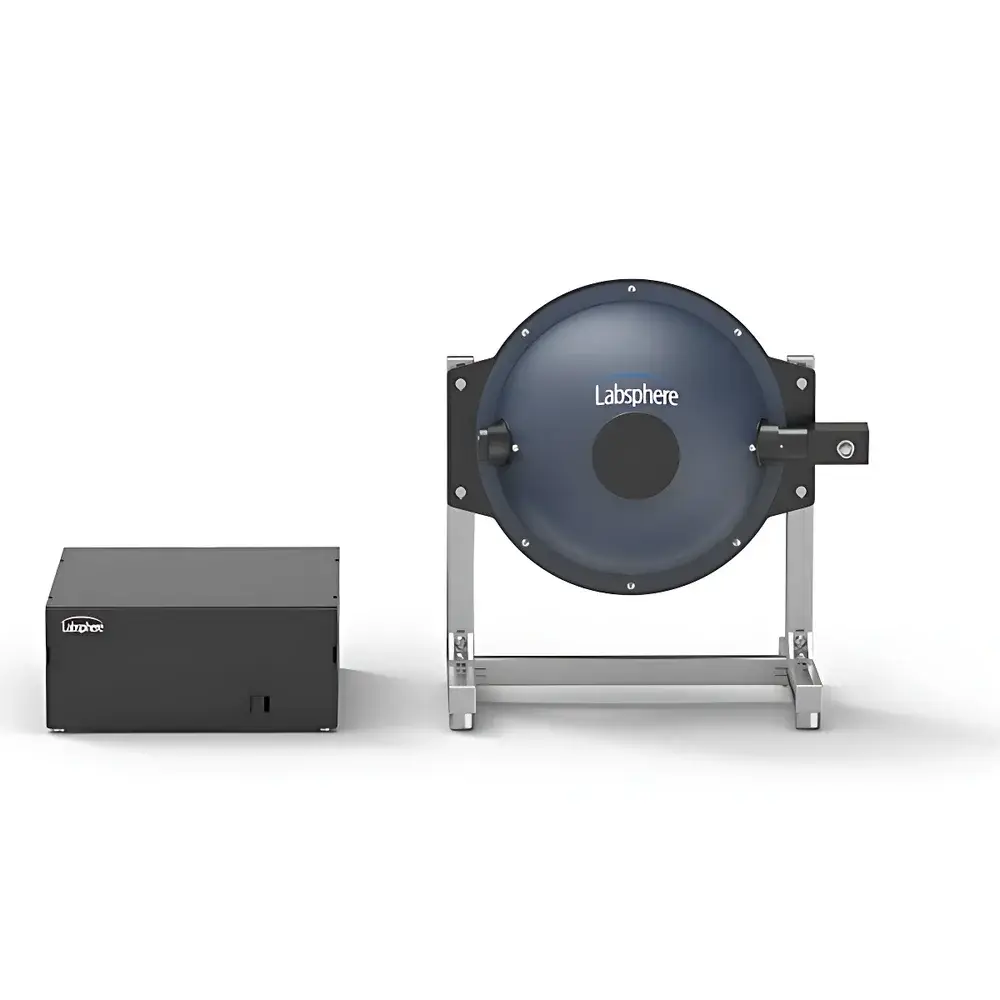
Labsphere CSTM-VCSEL-PW-060-LIVT VCSEL LIVT Testing System
| Brand | Labsphere |
|---|---|
| Origin | USA |
| Manufacturer Type | Authorized Distributor |
| Product Origin | Imported |
| Model | CSTM-VCSEL-PW-060-LIVT |
| Pricing | Available Upon Request |
| Integrating Sphere Material | Spectralon® / Spectraflect® / Permaflect® |
| Sphere Diameter | 6 in (customizable) |
| Input Port Diameter | 1.5 in (customizable) |
| Spectrometer Wavelength Range | 800–980 nm |
| Spectral Resolution (FWHM) | 0.1–0.16 nm |
| Wavelength Accuracy | ±0.1 nm |
| Maximum Sampling Rate | 200 kHz |
| Optical Power Range (Spectralon®, 940 nm) | 1 mW – 200 W |
| High-Speed Detector Linearity | ±0.5% |
| Detector Measurement Accuracy | ±1% |
| Detector Effective Digits | 5 |
| VCSEL Temperature Control Range | 1–85 °C |
| Temperature Stability | ±0.1 °C |
Overview
The Labsphere CSTM-VCSEL-PW-060-LIVT VCSEL LIVT Testing System is a purpose-engineered optical characterization platform designed for the precise, repeatable, and traceable evaluation of Vertical-Cavity Surface-Emitting Lasers (VCSELs) across R&D, quality assurance, and high-throughput manufacturing environments. Built upon Labsphere’s four-decade heritage in radiometric and photometric metrology, this system implements a calibrated, integrator-based optical architecture grounded in fundamental principles of radiant flux capture, spectral responsivity correction, and thermally stabilized device-under-test (DUT) operation. It performs synchronized Light–Current–Voltage–Temperature (LIVT) measurements — capturing real-time optical power, spectral emission (peak wavelength, FWHM), electrical characteristics (forward voltage, drive current), and thermal state — under programmable pulsed or CW excitation. The system’s core measurement traceability is anchored to NIST-traceable 940 nm standard sources, ensuring compliance with ISO/IEC 17025–aligned calibration practices and supporting audit readiness for GLP and GMP workflows.
Key Features
- Automated, synchronized acquisition of LIVT datasets including optical power (average/peak), spectral parameters (λpeak, FWHM), forward voltage, drive current, pulse width, duty cycle, and junction temperature
- NIST-traceable calibration at 940 nm using certified reference sources, enabling quantitative inter-laboratory comparability and regulatory documentation
- High-resolution spectrometer (0.1–0.16 nm FWHM, ±0.1 nm wavelength accuracy) optimized for the 800–980 nm VCSEL emission band
- Thermally robust integrating sphere coatings: Spectralon® (rated to 400 °C), Spectraflect®, and Permaflect® — selected per application requirements for UV-VIS-NIR reflectance uniformity (>99% @ 940 nm) and long-term stability
- Modular thermal management: Precision temperature controller (1–85 °C range, ±0.1 °C stability) with interchangeable cold plates and PID-tuned thermal interfaces for accurate junction temperature control
- High-bandwidth detection: 200 kHz sampling rate with 5-digit resolution, ±1% absolute accuracy, and <0.5% linearity over full dynamic range
- Fully programmable current/voltage drivers supporting user-defined pulse profiles (pulse width, repetition rate, burst mode)
Sample Compatibility & Compliance
The CSTM-VCSEL-PW-060-LIVT accommodates bare-die, packaged TO-can, surface-mount (SMT), and wafer-level VCSEL arrays via adaptable mounting fixtures and thermally conductive interface options. Its 6-inch integrating sphere (with 1.5-inch input port) supports power levels from 1 mW to 200 W at 940 nm — scalable through optional sphere configurations. The system meets foundational requirements for optical safety (IEC 60825-1:2014 Class 1 enclosure design), electromagnetic compatibility (FCC Part 15, CISPR 11), and laboratory environmental robustness (operating humidity: 20–80% RH non-condensing). While not pre-certified to specific industry standards, its architecture enables validation against VCSEL-specific test protocols defined in JEDEC JESD22-A114 (ESD), IEC 61215 (for photonic reliability), and internal OEM qualification procedures aligned with AEC-Q102 for automotive-grade emitters.
Software & Data Management
The proprietary LIVT Control Suite provides a deterministic, scriptable environment for test sequence definition, real-time parameter monitoring, and post-acquisition analysis. It supports automated generation of LIV curves, T–W (temperature vs. wavelength drift) plots, spectral centroid tracking, and pulse-resolved power envelope analysis. All raw and processed data are stored in HDF5 format with embedded metadata (timestamp, calibration ID, operator, DUT ID, thermal setpoint, driver configuration). Audit trails record user actions, parameter changes, and calibration events — configurable to meet FDA 21 CFR Part 11 requirements for electronic records and signatures when deployed in regulated QC labs. Export options include CSV, MATLAB .mat, and PDF reports compliant with internal SOP templates.
Applications
- R&D characterization of single-emitter and multi-junction VCSEL arrays for facial recognition, LiDAR, and optical sensing
- Production-line binning and parametric screening based on threshold current, slope efficiency, spectral stability, and thermal rollover behavior
- Reliability stress testing (e.g., high-temperature operating life — HTOL) with concurrent spectral and electrical degradation monitoring
- Verification of wafer-level testing correlation between probe station and final-packaged device performance
- Support for ISO 13694-compliant laser power measurement uncertainty budgets in accredited calibration labs
FAQ
What spectral range does the integrated spectrometer cover, and is it optimized for VCSEL wavelengths?
The spectrometer operates from 800 nm to 980 nm with peak sensitivity and resolution tuned for common VCSEL emission bands, especially 850 nm and 940 nm.
Can the system measure both continuous-wave and pulsed VCSEL operation?
Yes — the 200 kHz sampling rate and programmable driver support arbitrary pulse widths (ns to ms), variable duty cycles, and burst-mode operation.
Is NIST traceability provided with the system, or must it be obtained separately?
A NIST-traceable 940 nm calibration source is included and factory-applied; full calibration certificates with uncertainty budgets are supplied with each system.
How is thermal crosstalk minimized between the temperature controller and optical detection path?
Thermal isolation is achieved via low-conductivity mounting interfaces, shielded fiber-optic signal paths, and spatial separation of thermal mass and detector electronics — validated by <0.02 nm/°C spectral drift during controlled ramp tests.
Does the software support custom pass/fail limits and automated reporting for production environments?
Yes — limit templates can be defined per parameter (e.g., λpeak tolerance ±0.5 nm, slope efficiency >0.8 W/A), with configurable pass/fail flags and batch summary exports.





