
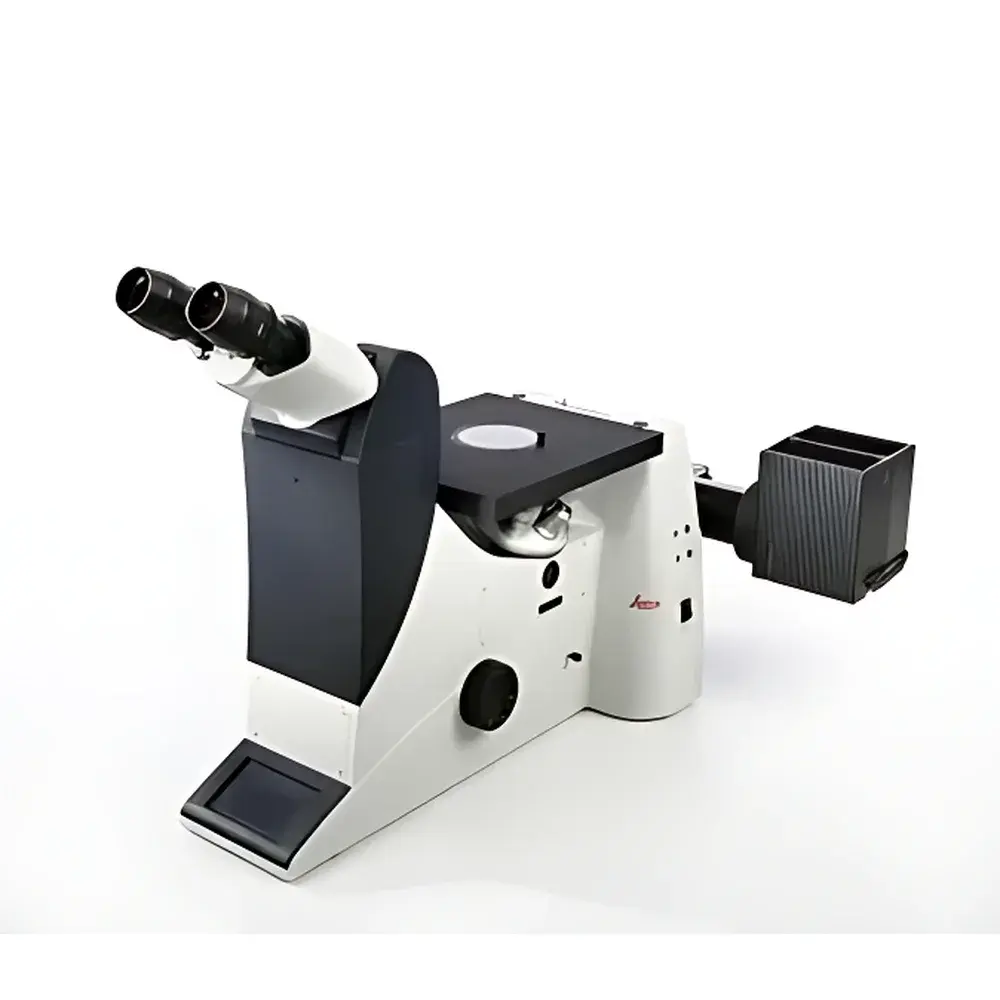
Leica DMI3000M Inverted Metallurgical Microscope
| Brand | Leica |
|---|---|
| Origin | Germany |
| Model | DMI 3000M |
| Type | Manual inverted metallurgical microscope |
| Illumination | 12 V / 100 W halogen lamp |
| Eyepieces | 10×, 25 mm field number |
| Objective turret | 5-position M32 manual nosepiece |
| Magnification range | 50×–1000× (depending on objective configuration) |
| Observation modes | Brightfield, darkfield, polarized light, oblique illumination |
| Stage | Ceramic-coated mechanical stage with >20 sample holders |
| Optical system | HC (Harmonic Contrast) apochromatically corrected optical path |
| Dual-camera ports | Side port (0%/100% or 80%/20% beam splitter) + trinocular tube port |
| Focus and stage controls | Ergonomically co-located left/right hand controls with thermal drift compensation chassis |
Overview
The Leica DMI 3000M is a manually operated, inverted metallurgical microscope engineered for high-precision microstructural analysis of opaque, polished, or etched solid materials—including metals, alloys, ceramics, composites, and electronic packaging substrates. Its inverted architecture positions the objectives beneath the specimen stage, enabling direct observation of large, heavy, or irregularly shaped samples—such as castings, welds, cross-sectioned PCBs, or bulk metallographic mounts—without requiring complex mounting fixtures or top-side objective clearance. The instrument employs an apochromatically corrected HC (Harmonic Contrast) optical pathway, minimizing chromatic and spherical aberrations across the full visible spectrum to ensure quantitative fidelity in image-based grain size measurement, phase distribution mapping, inclusion analysis, and porosity assessment. Designed for compliance with ISO 4287, ASTM E112, and ASTM E3, the DMI 3000M supports standardized metallurgical evaluation workflows in R&D laboratories, quality control departments, and failure analysis centers.
Key Features
- HC Apochromatic Optics: High-numerical-aperture objectives with advanced harmonic contrast correction deliver diffraction-limited resolution, exceptional edge sharpness, and uniform color fidelity—even at maximum magnification—enabling reproducible quantitative metallography.
- Integrated Oblique Illumination: A built-in inclined incident-light module provides directional contrast enhancement without external accessories, revealing subtle surface topography, microcracks, and etch-pit morphology in specimens resistant to conventional brightfield imaging.
- Ergonomic Dual-Port Imaging Architecture: Two independent camera output paths—one side-mounted (with selectable 0%/100% or 80%/20% beam splitting) and one trinocular tube port—allow simultaneous real-time monitoring and time-stamped video capture under identical optical conditions.
- Thermally Stable Mechanical Chassis: Monolithic aluminum alloy housing incorporates reverse thermal compensation design to counteract focal drift induced by prolonged 12 V / 100 W halogen lamp operation, maintaining focus stability over multi-hour acquisition sessions.
- Modular Stage System: A ceramic-coated mechanical stage accommodates over 20 interchangeable sample clamps and accepts precision-ground center-hole inserts (5 mm, 10 mm, 20 mm) for repeatable positioning of small-diameter specimens during serial sectioning or comparative analysis.
- Human-Centered Control Layout: Co-located coarse/fine focus knobs and stage translation controls enable single-hand operation; low-profile right-side focus knob prevents interference with stage movement, reducing operator fatigue during extended inspection tasks.
Sample Compatibility & Compliance
The DMI 3000M is optimized for metallurgical specimens prepared per ASTM E3 and ISO 1463 standards—i.e., planar-polished and chemically or electrolytically etched surfaces mounted in thermosetting resins or cold-mounting media. Its inverted configuration accommodates specimens up to 100 mm in diameter and 50 mm in height. The system supports routine compliance with ISO/IEC 17025-accredited testing protocols when paired with Leica Application Suite (LAS) X software configured for audit-trail-enabled image annotation, calibration verification logs, and user-access-controlled report generation. All optical components comply with RoHS Directive 2011/65/EU and CE marking requirements for laboratory instrumentation.
Software & Data Management
While the DMI 3000M operates as a standalone manual microscope, it is fully compatible with Leica’s LAS X platform (v3.7+), which provides GLP-compliant image acquisition, measurement annotation (grain size per ASTM E112, particle count, phase area fraction), and metadata embedding (objective ID, exposure time, illumination mode, calibration timestamp). The dual-camera interface enables synchronized acquisition from two sensors—for example, a high-speed CMOS sensor for live navigation and a scientific-grade sCMOS sensor for archival-resolution documentation—both referenced to the same optical axis and calibrated scale bar. All exported TIFF/PNG files retain embedded EXIF tags compliant with DICOM-SR and MIAME metadata standards for integration into LIMS or ELN environments.
Applications
- Quality assurance of heat-treated steels, aluminum alloys, and titanium components in aerospace and automotive manufacturing
- Failure analysis of solder joints, wire bonds, and die-attach interfaces in semiconductor packaging
- Microstructure characterization in additive-manufactured metal parts (e.g., porosity quantification, melt pool boundary mapping)
- Evaluation of coating adhesion, interfacial diffusion zones, and corrosion product morphology in coated metals
- Teaching and method validation in university metallurgy and materials science laboratories
FAQ
Is the DMI 3000M compatible with fluorescence imaging?
No—the DMI 3000M is designed exclusively for reflected-light modalities (brightfield, darkfield, polarized light, oblique illumination) and lacks excitation filter cubes or mercury/xenon lamp support required for fluorescence.
Can motorized components be retrofitted to this manual model?
No—motorized focus, stage, or turret functions are not available as field upgrades for the DMI 3000M platform. These capabilities require the automated DMI6000 or DMi8 series.
What is the maximum working distance achievable with the 5× objective?
The standard 5× HC PL Fluotar objective offers a 19.5 mm working distance, sufficient for observing specimens with protruding features or thick mounting media.
Does the system meet FDA 21 CFR Part 11 requirements for electronic records?
When operated with LAS X software configured with electronic signatures, audit trails, and secure user authentication, the imaging workflow satisfies key elements of FDA 21 CFR Part 11 for regulated environments.
Are replacement halogen lamps supplied with NIST-traceable calibration certificates?
Leica-certified 12 V / 100 W halogen lamps are supplied with factory calibration data but do not include NIST-traceable certificates; third-party photometric calibration services are available upon request.





