
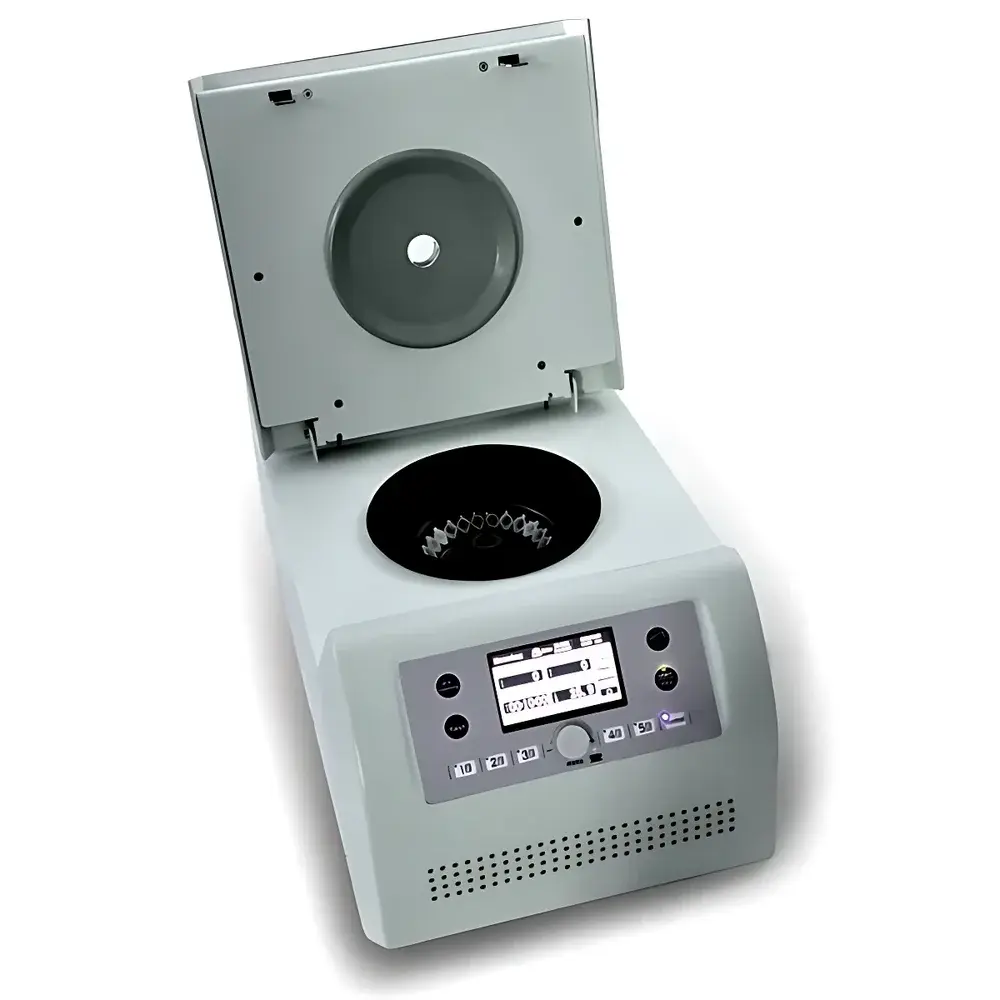
Jiayuan MC-16 Micro-Ultracentrifuge with Refrigeration
| Brand | Jiayuan |
|---|---|
| Origin | Beijing, China |
| Manufacturer Type | Authorized Distributor |
| Product Origin | Domestic (China) |
| Model | MC-16 |
| Price Range | USD 1,400–4,200 |
| Centrifugation Class | Biomacromolecules |
| Max Capacity | 24 × 2 mL tubes |
| Max Speed | 16,000 rpm |
| Dimensions (W×D×H) | 360 × 635 × 280 mm |
| Max RCF | 24,900 × g |
| Temperature Range | −20 °C to +40 °C (0.5 °C increment) |
| Noise Level | ≤52 dB(A) |
| Acceleration/Deceleration Time | 20 s |
| Display | 4.3″ TFT color touchscreen |
| Control System | EssenFuge™ microprocessor-based interface |
| Rotor Recognition | Automatic |
| Safety Features | Dual overspeed detection, real-time imbalance monitoring, motor/compressor overtemperature protection, auto-shutdown with error code display |
| Chamber Material | Teflon-coated stainless steel |
| Insulation | In-situ foamed polyurethane |
| Door Lock | Motorized suction-type electronic latch |
| Pre-cooling | Yes |
| Defrost Function | Yes |
| Flash Spin Mode | Yes |
| Program Storage | 10 user-defined protocols |
| Quick-Start Keys | 5 |
| Ramp Rate Options | 9 selectable profiles |
| Compliance | Designed for GLP-compliant laboratories |
Overview
The Jiayuan MC-16 Micro-Ultracentrifuge with Refrigeration is an engineered solution for high-precision, low-volume biomolecular separation in demanding laboratory environments. Utilizing brushless induction frequency-converter motor technology, the MC-16 delivers direct-drive rotational stability with minimal mechanical wear—eliminating carbon brush replacement and ensuring long-term torque consistency across speed ranges. Its refrigerated chamber maintains temperature setpoints from −20 °C to +40 °C with ±0.5 °C control accuracy, achieving thermal equilibrium at full speed (16,000 rpm) within specified tolerances—critical for preserving nucleic acid integrity, protein conformation, and subcellular organelle viability during ultracentrifugal pelleting or density gradient fractionation. The system operates on eco-friendly refrigerant (R134a or equivalent), paired with a high-efficiency compressor assembly optimized for rapid cooldown (<15 min from ambient to −10 °C) and sustained thermal uniformity across all rotor positions.
Key Features
- Brushless induction motor with direct drive architecture—zero maintenance, <52 dB(A) acoustic emission, and <20 s acceleration/deceleration profiles
- Automatic rotor identification system—prevents overspeed operation by cross-referencing installed rotor geometry and mass against validated speed/RCF limits
- Motorized suction-type electronic door lock—engages/disengages smoothly; halts compressor immediately upon lid opening to prevent frost accumulation
- 4.3″ TFT true-color touchscreen with EssenFuge™ embedded control firmware—displays simultaneous real-time values for speed (rpm), RCF (×g), elapsed time, chamber temperature, and dynamic status indicators
- Pre-cooling (Pro-Cooling) mode—chills chamber and rotor prior to sample loading to minimize thermal shock and ensure reproducible sedimentation kinetics
- Flash spin function—enables rapid, transient centrifugation (e.g., brief pellet collection post-precipitation) without formal program setup
- Teflon-coated stainless-steel chamber with in-situ polyurethane foam insulation—resists corrosion from organic solvents, acids, and halogenated reagents while sustaining thermal efficiency
- Dual overspeed protection circuitry plus real-time electronic imbalance detection—monitors vibration harmonics and load asymmetry continuously during operation
- Comprehensive safety architecture: motor/compressor overtemperature cutoff, self-diagnostic error reporting with alphanumeric codes, and emergency power-fail lid-release mechanism
Sample Compatibility & Compliance
The MC-16 accommodates standard microcentrifuge tube formats including 0.2 mL PCR strips, 0.5 mL conical tubes, 1.5 mL and 2.2 mL screw-cap tubes, and 5 mL round-bottom tubes—supported by interchangeable rotors (CA-1624, CA-1636, CA-1610, CA-1432) and sterilizable metal sealing caps rated for autoclaving at 125 °C. All rotors feature precision-machined aluminum alloy construction with balanced mass distribution verified per ISO 15837. The instrument’s mechanical design and operational logic align with general requirements of ISO/IEC 17025 for testing laboratories and supports GMP/GLP workflows through configurable audit-trail logging (when integrated with compliant LIMS or PC-based acquisition software). Chamber geometry and door interlock meet IEC 61010-1:2010 safety standards for electrical equipment used in laboratory settings.
Software & Data Management
While the MC-16 operates autonomously via its onboard EssenFuge™ controller, it provides RS-232 and USB host interfaces for external data capture and remote parameter configuration. Optional PC software enables protocol synchronization, event logging (start/stop timestamps, temperature history, error events), and export of CSV-formatted session records compatible with ELN platforms. When deployed in regulated environments, the system supports 21 CFR Part 11 compliance through role-based access control, electronic signature integration, and immutable audit trails—provided supplemental software validation documentation is applied per organizational SOPs.
Applications
- High-speed pelleting of plasmid DNA, viral particles, exosomes, and ribosomal subunits
- Clarification of cell lysates prior to chromatographic purification or electrophoretic analysis
- Separation of membrane fractions via sucrose or iodixanol density gradients
- Routine microvolume sample concentration (e.g., antibody eluates, oligonucleotide synthesis products)
- Preparative isolation of extracellular vesicles for downstream omics profiling
- Quality control centrifugation in biopharmaceutical QC labs handling small-batch formulations
FAQ
What is the maximum relative centrifugal force (RCF) achievable with the MC-16?
The MC-16 achieves up to 24,900 × g when using the CA-1624 fixed-angle rotor at 16,000 rpm.
Does the MC-16 support rotor calibration verification?
Yes—rotor identification is hardware-assisted via embedded RFID tags; users may perform periodic speed calibration using an external tachometer through the service menu.
Can the instrument maintain −10 °C at maximum speed?
Yes—the refrigeration system is rated to sustain −10 °C chamber temperature under continuous 16,000 rpm operation, verified per manufacturer thermal load testing.
Are rotor lids autoclavable?
All metal sealing caps (1624M, 1636M, etc.) are rated for 125 °C steam sterilization; polymer adapters (e.g., 0005-01A) are not autoclavable and must be cleaned chemically.
How many programmable methods can be stored internally?
Ten full-parameter protocols may be saved onboard; five quick-access keys allow one-touch recall of frequently used settings.



