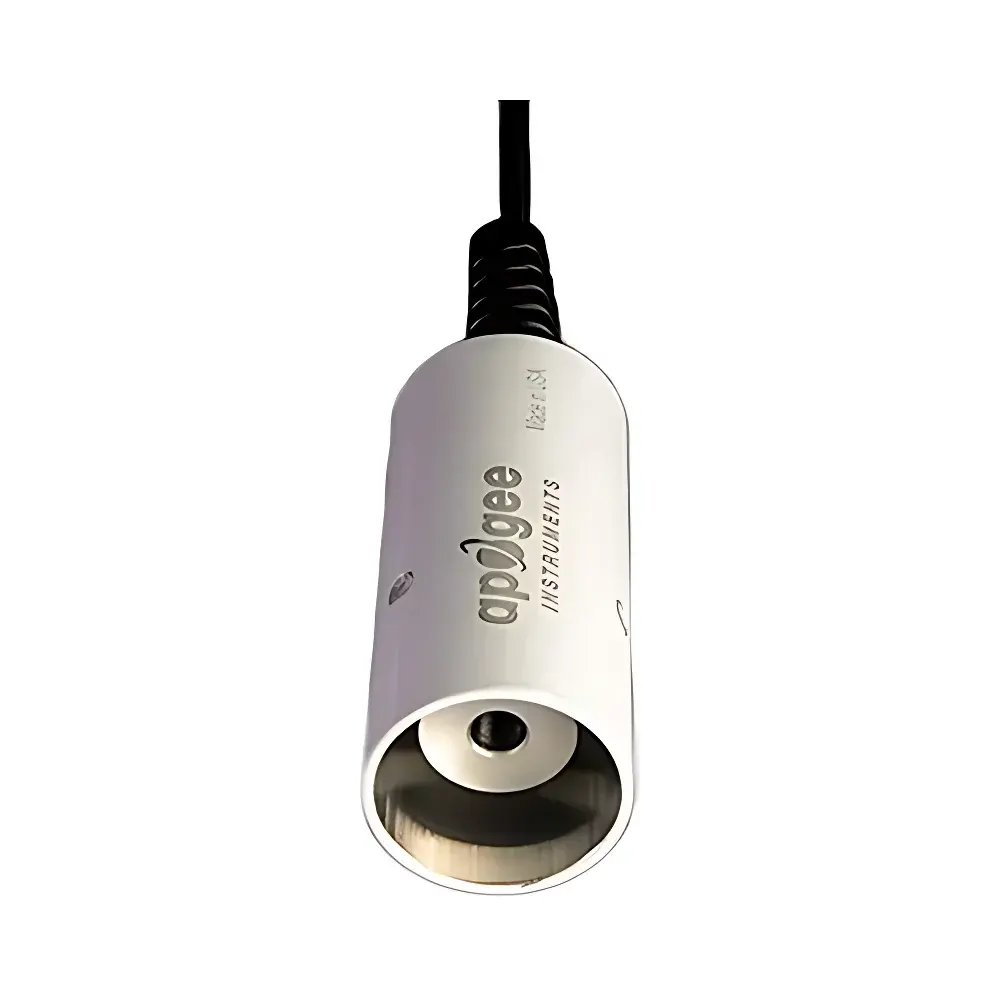
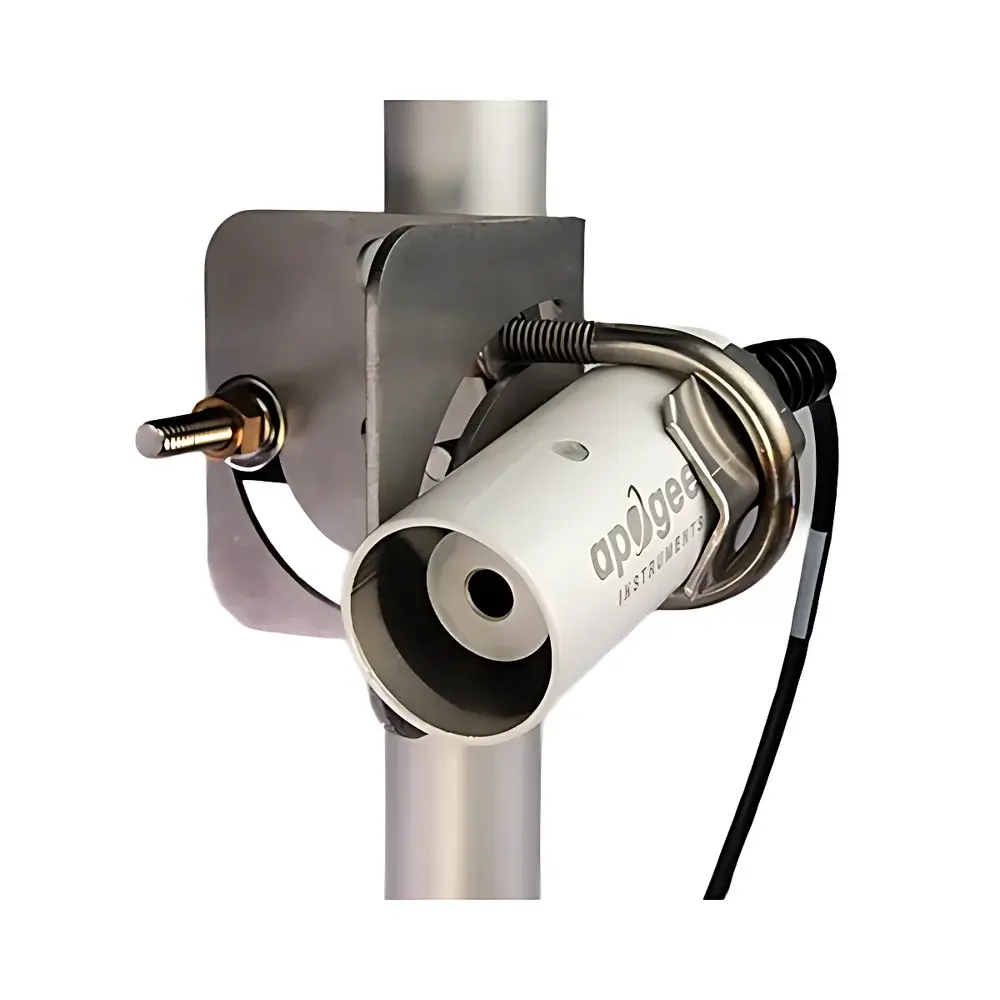
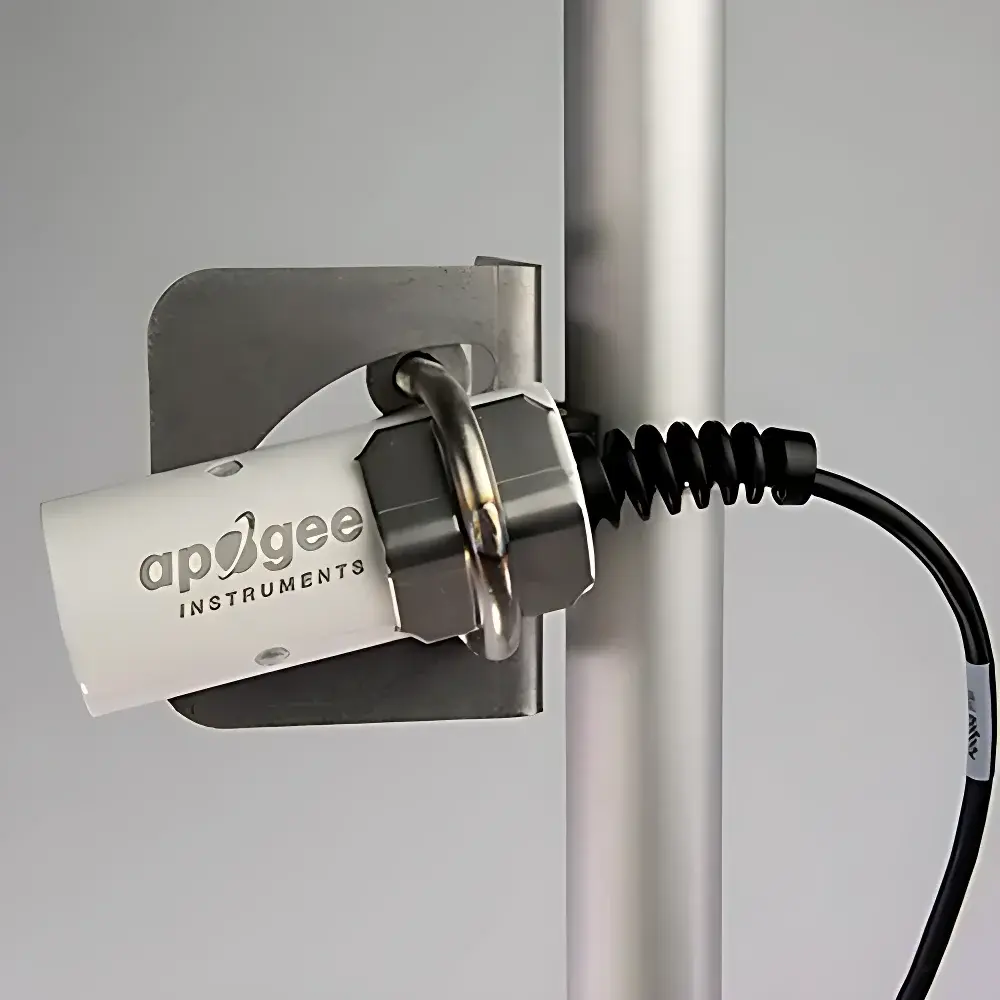
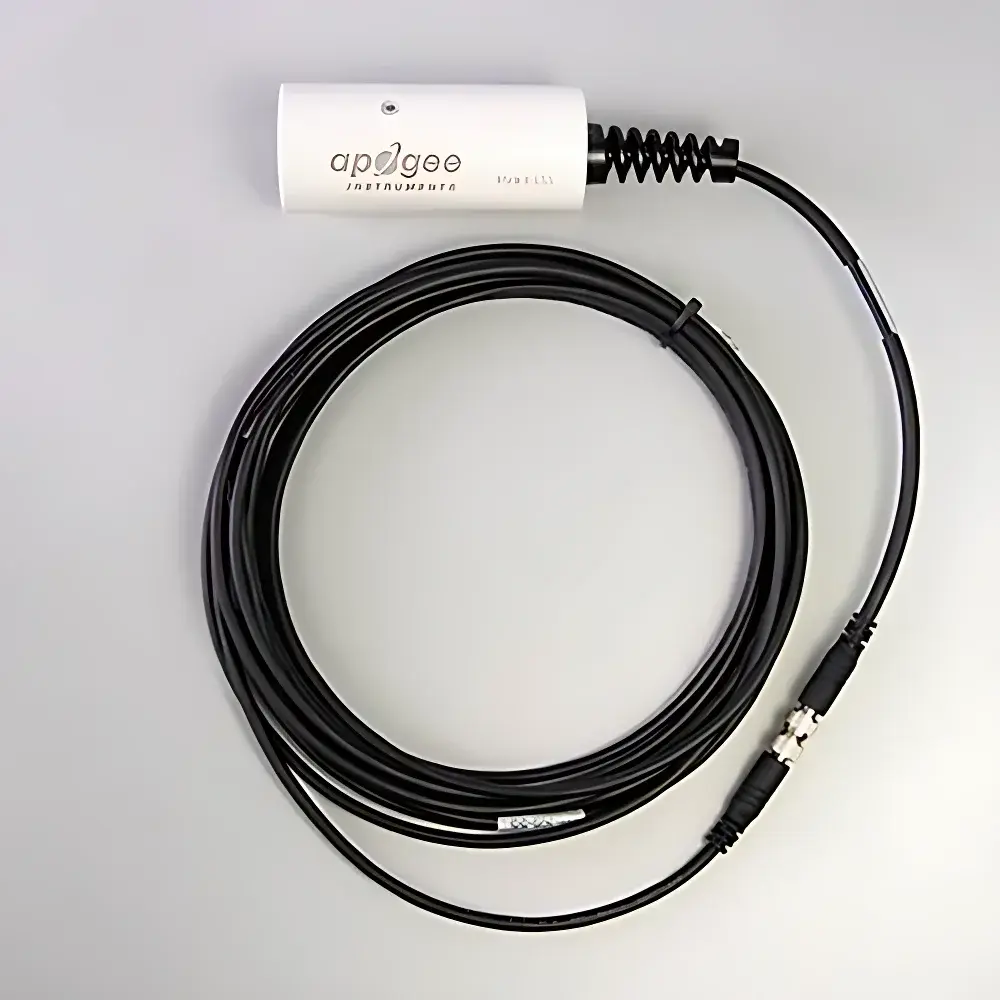
Apogee SI-111 Infrared Temperature Sensor
| Brand | Campbell |
|---|---|
| Origin | USA |
| Manufacturer Type | Authorized Distributor |
| Origin Category | Imported |
| Model | SI-111 |
| Instrument Type | Fixed-Mount Infrared Radiometer |
| Measurement Range | -40 to 70°C |
| Accuracy | ±0.2°C (-10 to 65°C), ±0.5°C (-40 to 70°C) |
| Consistency | ±0.1°C (-10 to 65°C), ±0.3°C (-40 to 70°C) |
| Repeatability | ±0.05°C (-10 to 65°C), ±0.1°C (-40 to 70°C) |
| Spectral Response | 8–14 µm |
| Field of View | 22° half-angle |
| Response Time | <1 s |
| Operating Environment | -55 to 80°C, 0–100% RH |
| Excitation Voltage | 2.5 VDC |
| Thermopile Output | 60 µV/°C (ΔT between target and sensor body) |
| Thermistor Output | 0–2500 mV |
| Signal Channels | One differential (thermopile), one single-ended (thermistor) |
| Dimensions | 2.3 cm (diameter) × 6 cm (length) |
| Weight | 190 g |
Overview
The Apogee SI-111 is a precision fixed-mount infrared radiometer engineered for non-contact surface temperature measurement in environmental, agricultural, and geophysical monitoring applications. Based on the principle of passive thermal radiation detection, the SI-111 operates within the atmospheric transmission window (8–14 µm), where longwave infrared energy emitted by terrestrial surfaces is least attenuated by water vapor and CO₂. Its dual-sensor architecture integrates a thermopile detector for target radiant temperature and a high-stability thermistor for precise sensor body temperature measurement. This configuration enables real-time compensation using the Stefan-Boltzmann law, eliminating errors induced by sensor self-heating or ambient thermal drift. The instrument’s germanium optical window—superior to silicon in transmittance stability across variable humidity conditions—ensures robust performance over extended deployment periods, particularly in field settings where sensor-to-target distance and atmospheric variability are critical.
Key Features
- Germanium optical window optimized for spectral transmission in the 8–14 µm band and reduced sensitivity to atmospheric humidity fluctuations
- Dual-sensor design: thermopile (differential output) for target radiation and thermistor (single-ended, 0–2500 mV) for sensor body temperature
- High absolute accuracy: ±0.2°C from –10°C to +65°C; validated against NIST-traceable blackbody references
- Fast thermal response (<1 second) with excellent repeatability (±0.05°C in nominal range) and inter-unit consistency (±0.1°C)
- Compact, rugged anodized aluminum housing (2.3 cm × 6 cm, 190 g) rated for continuous operation from –55°C to +80°C and 0–100% relative humidity
- Low-power, analog output interface: 2.5 VDC excitation; thermopile sensitivity 60 µV/°C ΔT; compatible with Campbell Scientific, CR series, and other SDI-12 or voltage-input data loggers
Sample Compatibility & Compliance
The SI-111 is designed for measuring the effective kinetic surface temperature of natural and engineered materials—including asphalt, snowpack, vegetative canopies, open water, and sea ice—without physical contact. Its 22° half-angle field of view defines a conical measurement area whose diameter at distance d is approximately 0.84 × d, enabling flexible mounting configurations while maintaining spatial representativeness. The sensor complies with ISO 18434-1:2008 (Condition monitoring — Thermography — Part 1: General principles) for infrared surface temperature assessment and supports traceable calibration per ASTM E1256-22 (Standard Test Methods for Radiation Thermometers). It meets electromagnetic compatibility requirements per IEC 61326-1 for industrial measurement equipment and is suitable for use in GLP-compliant environmental monitoring networks where long-term stability and audit-ready documentation are required.
Software & Data Management
The SI-111 delivers two analog voltage signals requiring simultaneous acquisition: the thermopile’s differential millivolt output (proportional to target–sensor temperature difference) and the thermistor’s single-ended signal (linearized via Steinhart-Hart or factory-polynomial coefficients). When paired with Campbell Scientific dataloggers (e.g., CR1000X, CR6), onboard firmware applies real-time Stefan-Boltzmann correction using user-defined emissivity (default ε = 0.95), yielding calibrated surface temperature in °C. Output data streams support timestamped, high-resolution logging (up to 1 Hz) with optional metadata tagging. All raw and processed values are exportable in CSV or NetCDF format for integration into Python-based analysis pipelines (e.g., Pandas, Xarray), R statistical environments, or GIS platforms such as QGIS and ArcGIS Pro. Firmware updates and calibration certificate management are supported through Campbell’s LoggerNet and PC400 software suites, which maintain full audit trails compliant with FDA 21 CFR Part 11 when configured with electronic signatures and access controls.
Applications
- Continuous road surface temperature monitoring for winter maintenance decision support and pavement freeze-thaw cycle analysis
- Oceanographic and limnological studies: sea surface temperature (SST) and lake skin temperature profiling in buoy- and tower-based observatories
- Agroecological research: canopy temperature differentials (CTD) for crop water stress index (CWSI) derivation and irrigation scheduling
- Cryospheric science: snow surface temperature mapping to model melt onset, albedo feedback, and energy balance partitioning
- Urban climate studies: thermal mapping of impervious surfaces, green roofs, and façade materials under diurnal and seasonal cycles
- Calibration reference for airborne or satellite thermal sensors (e.g., Landsat TIRS, Sentinel-3 SLSTR) via ground truthing protocols
FAQ
What is the recommended mounting orientation for optimal accuracy?
For maximum radiometric fidelity, the SI-111 must be aligned perpendicular to the target surface. When measuring inclined surfaces (e.g., sloped terrain or building façades), use the CM230 adjustable tilt mount to maintain normal incidence.
Can the SI-111 be used indoors or in controlled-environment chambers?
Yes—provided the chamber environment remains within the operating temperature (–55°C to +80°C) and humidity (0–100% RH) specifications, and no condensation forms on the germanium window. Avoid rapid thermal transients exceeding 5°C/min to preserve thermistor stability.
Is emissivity compensation required, and how is it implemented?
Emissivity is a user-configurable parameter in the data logger program. Default setting is ε = 0.95 (typical for vegetation, soil, water); adjustments are necessary for low-emissivity targets such as bare metal (ε ≈ 0.1–0.3) or painted surfaces (ε ≈ 0.8–0.95).
How often does the SI-111 require recalibration?
Apogee recommends annual recalibration against a NIST-traceable blackbody source for applications demanding metrological rigor. Field validation using a portable reference radiometer (e.g., Apogee IR1) is advised every 3–6 months in harsh deployments.
Does the SI-111 comply with regulatory standards for environmental monitoring networks?
Yes—the sensor meets the technical and documentation requirements of EPA Method IO-3.3 (Infrared Thermometry) and supports QA/QC workflows aligned with ISO/IEC 17025:2017 for testing laboratories.