
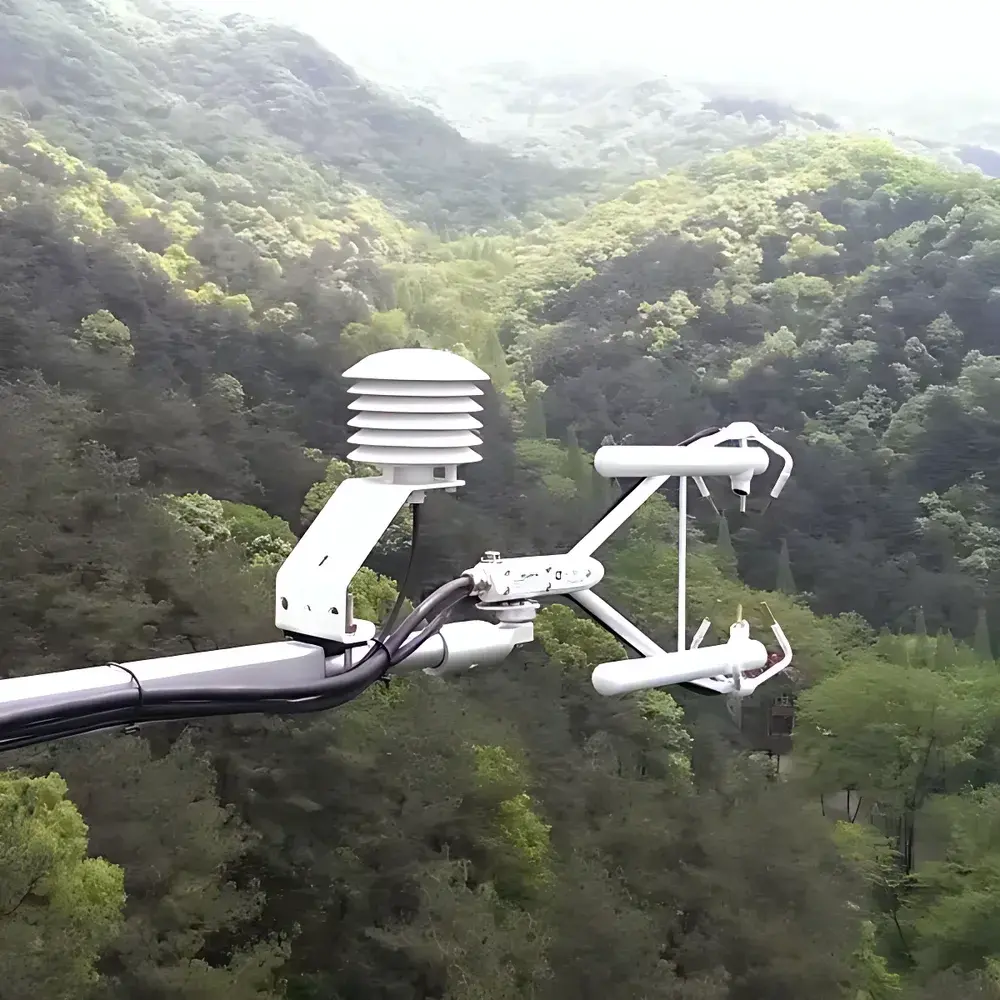
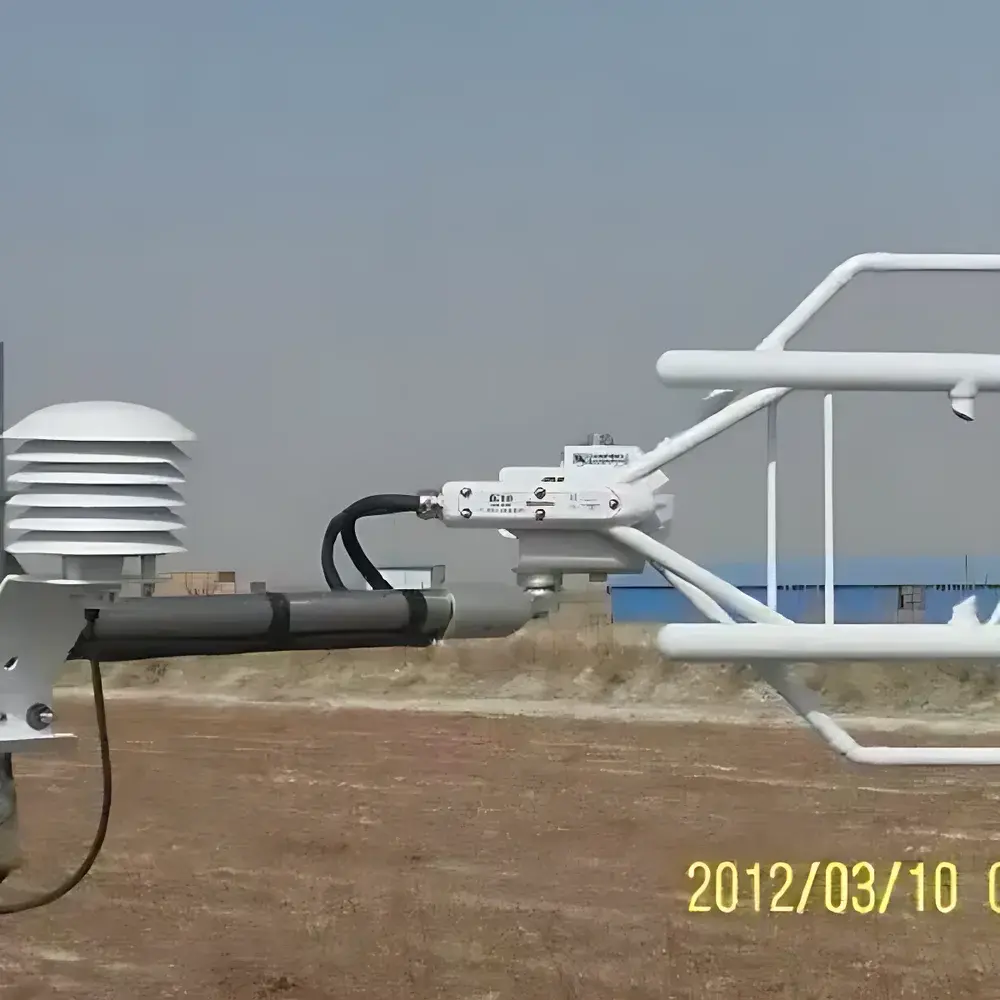
Campbell Scientific CPEC310 Closed-Path Eddy Covariance System
| Brand | Campbell Scientific |
|---|---|
| Model | CPEC310 |
| Origin | USA |
| System Type | Closed-path eddy covariance flux measurement system |
| Power Consumption | 12 W @ 25°C |
| Operating Temperature | −30 to +50°C |
| Operating Pressure Range | 70–106 kPa (expandable) |
| Measurement Frequency | 60 Hz |
| Output Rates | 5, 10, 12.5, or 20 Hz |
| Data Interfaces | SDM, RS-485, USB, analog (CO₂/H₂O only) |
| Total Mass | 15.36 kg |
| Warranty | 1 year from shipment |
| Gas Analyzer Sample Cell Volume | 5.9 mL |
| Cutoff Frequency | 4.3 Hz |
| CO₂ Accuracy | ±1% of reading |
| H₂O Accuracy | ±2% of reading |
| CO₂ Precision (RMS) | ≤0.15 µmol/mol |
| H₂O Precision (RMS) | ≤0.006 mmol/mol |
| CO₂ Zero Drift | ±0.3 µmol/mol/°C |
| H₂O Zero Drift | ±0.05 mmol/mol/°C |
| CO₂ Gain Drift | ±0.1% reading/°C |
| H₂O Gain Drift | ±0.3% reading/°C |
| Cross-sensitivity | CO₂ → H₂O: ±1.1×10⁻⁴ mol CO₂/mol H₂O |
| H₂O → CO₂ | ±0.1 mol H₂O/mol CO₂ |
| CSAT3A Path Lengths | Vertical 10.0 cm, Horizontal 5.8 cm |
| Wind Speed Range | uₓ/uᵧ ±65 m/s, u_z ±8 m/s |
| Wind Direction Range | 2.5°–357.5° (0–360° customizable) |
| Sonic Temperature Range | −50 to +60°C |
| Sonic Temperature Precision | 0.0025°C RMS |
Overview
The Campbell Scientific CPEC310 Closed-Path Eddy Covariance System is a rigorously engineered, field-deployable platform for continuous, high-fidelity quantification of turbulent exchange fluxes across the soil–atmosphere interface. It operates on the eddy covariance (EC) principle—measuring rapid, three-dimensional wind velocity fluctuations (via the CSAT3A ultrasonic anemometer) simultaneously with high-speed, high-precision CO₂ and H₂O mixing ratio variations (via the EC155 closed-path infrared gas analyzer). These synchronous, high-frequency (up to 20 Hz) measurements enable direct calculation of vertical turbulent fluxes of carbon dioxide, water vapor, sensible heat, and momentum in accordance with micrometeorological theory. Designed for unattended, long-term operation in remote terrestrial ecosystems—including forests, grasslands, agricultural fields, and tundra—the CPEC310 integrates hardware-level signal synchronization, real-time diagnostics, and automated calibration routines to maintain metrological integrity under variable environmental loads.
Key Features
- Patented vortex inlet design (U.S. Patent No. 9,217,692) eliminates reliance on inline particulate filters while preserving frequency response up to 4.3 Hz—enabling robust performance during rain, snow, dust storms, and high-humidity conditions without routine filter replacement.
- Low-flow closed-path architecture (5.9 mL sample cell volume) reduces power demand to only 12 W at 25°C—compatible with solar-battery hybrid power systems for off-grid deployments lasting multiple growing seasons.
- Integrated three-valve gas handling module enables fully automated zero-point and CO₂ span calibration; H₂O span correction remains user-initiated to accommodate dynamic dew point variability.
- Real-time flux computation via EasyFlux™ DL firmware running natively on the CR6 datalogger—processing raw 60 Hz sensor streams into gap-filled, coordinate-rotated, Webb-Pearman-Leuning (WPL)-corrected fluxes at user-selectable output intervals (5, 10, 12.5, or 20 Hz).
- VOLT-116 analog input expansion module supports seamless integration of auxiliary biometeorological sensors (e.g., net radiometers, soil heat flux plates, PAR sensors), enabling comprehensive energy balance closure analysis.
Sample Compatibility & Compliance
The CPEC310 is validated for atmospheric sampling in ambient air matrices containing CO₂ (0–1,000 µmol/mol, extendable to 3,000 µmol/mol) and H₂O (0–72 mmol/mol, corresponding to 38°C dew point). Its EC155 gas analyzer meets ISO 14644-1 Class 5 cleanroom air requirements for optical path integrity and exhibits traceable accuracy per NIST-traceable calibration protocols. The system complies with widely adopted flux measurement standards including AmeriFlux and ICOS Tier 1 technical specifications. While not inherently 21 CFR Part 11 compliant, its CR6 datalogger supports audit-trail-capable data logging when configured with secure time-stamping, user-access controls, and encrypted SD card storage—facilitating GLP-aligned environmental monitoring workflows.
Software & Data Management
Data acquisition, preprocessing, and real-time flux computation are executed onboard the CR6 datalogger using Campbell Scientific’s proprietary EasyFlux™ DL software—eliminating dependency on external PCs or post-processing scripts. Raw and derived variables (e.g., uₓ, uᵧ, u_z, Tₛ, CO₂, H₂O, P, Tₚ, ΔP, signal intensities) are logged with microsecond-resolution timestamps and full diagnostic metadata. Export formats include CSV, TOA5, and NetCDF4, compatible with standard flux processing toolchains (e.g., EddyPro®, TK3, REddyProc). Firmware updates, configuration changes, and remote diagnostics are supported via PakBus, FTP, or cellular telemetry—ensuring operational continuity across multi-year campaigns.
Applications
- Long-term ecosystem carbon budgeting and net ecosystem exchange (NEE) partitioning in FLUXNET and regional observatory networks.
- Evaluation of climate–vegetation feedbacks under drought, elevated CO₂, or land-use change scenarios.
- Soil respiration and root-zone carbon dynamics studies requiring high temporal resolution and low instrumental noise floor.
- Model–data fusion activities supporting land surface model (LSM) parameterization and validation (e.g., CLM, ORCHIDEE, JULES).
- Regulatory compliance monitoring for carbon sequestration projects under Verra, Gold Standard, or national MRV frameworks—where traceable, auditable flux records are mandatory.
FAQ
Does the CPEC310 support automatic H₂O span calibration?
No—H₂O span calibration requires manual introduction of a certified moisture standard due to nonlinear absorption characteristics and temperature-dependent saturation behavior.
What is the minimum recommended averaging period for CO₂ flux calculations?
Standard practice follows the 30-minute block-averaging convention defined by FluxNet protocols; however, the system supports sub-minute flux estimation for process-level analysis when turbulence statistics permit.
Can the CPEC310 operate reliably in freezing conditions?
Yes—the EC155 and CSAT3A are rated for −30°C operation, and the vortex inlet mitigates ice accretion risk; optional heated sample lines and enclosure thermostats are recommended for sustained sub-zero deployments.
Is cross-sensitivity correction applied in real time?
Yes—EasyFlux™ DL applies manufacturer-supplied, temperature-compensated cross-sensitivity coefficients during online flux computation to minimize CO₂–H₂O interference artifacts.
How is data integrity ensured during power interruptions?
The CR6 datalogger features non-volatile memory with battery-backed clock and automatic resume-on-power restoration—preserving all pending writes and maintaining time-series continuity without gaps or timestamp corruption.
Related Products







