
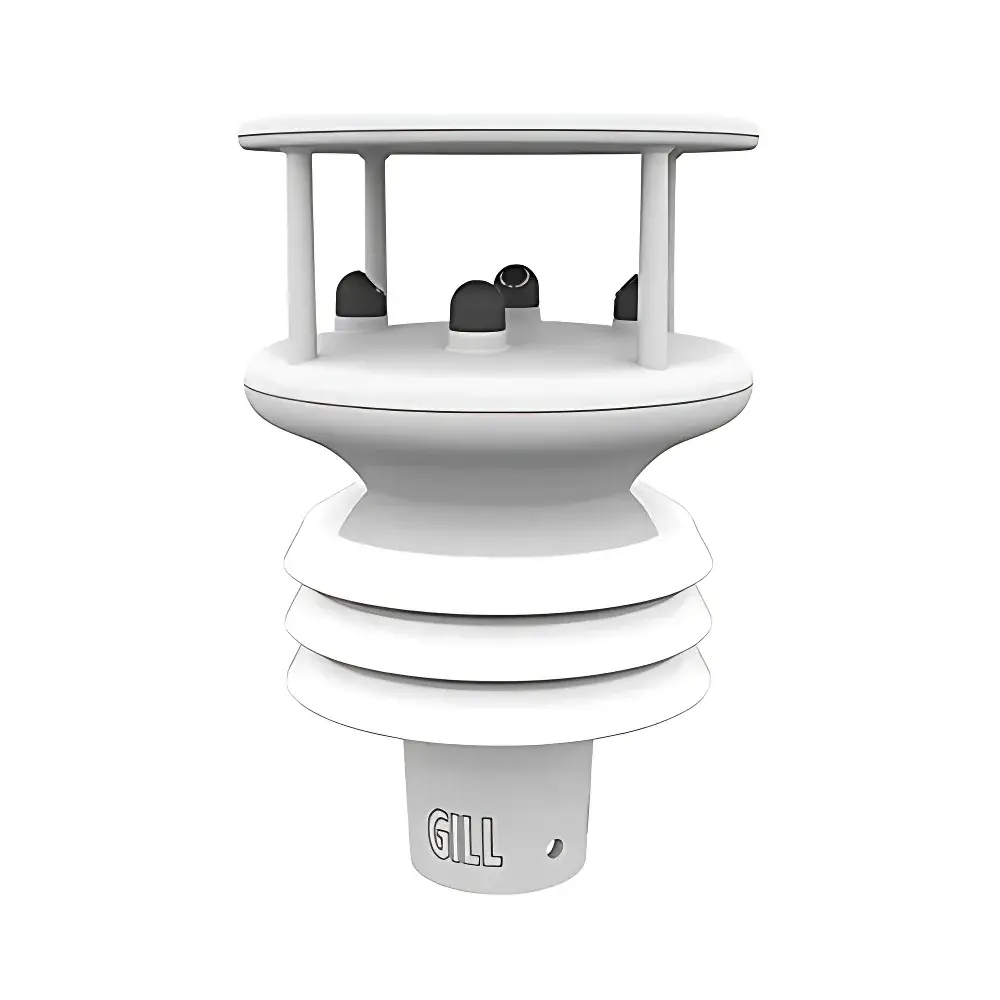
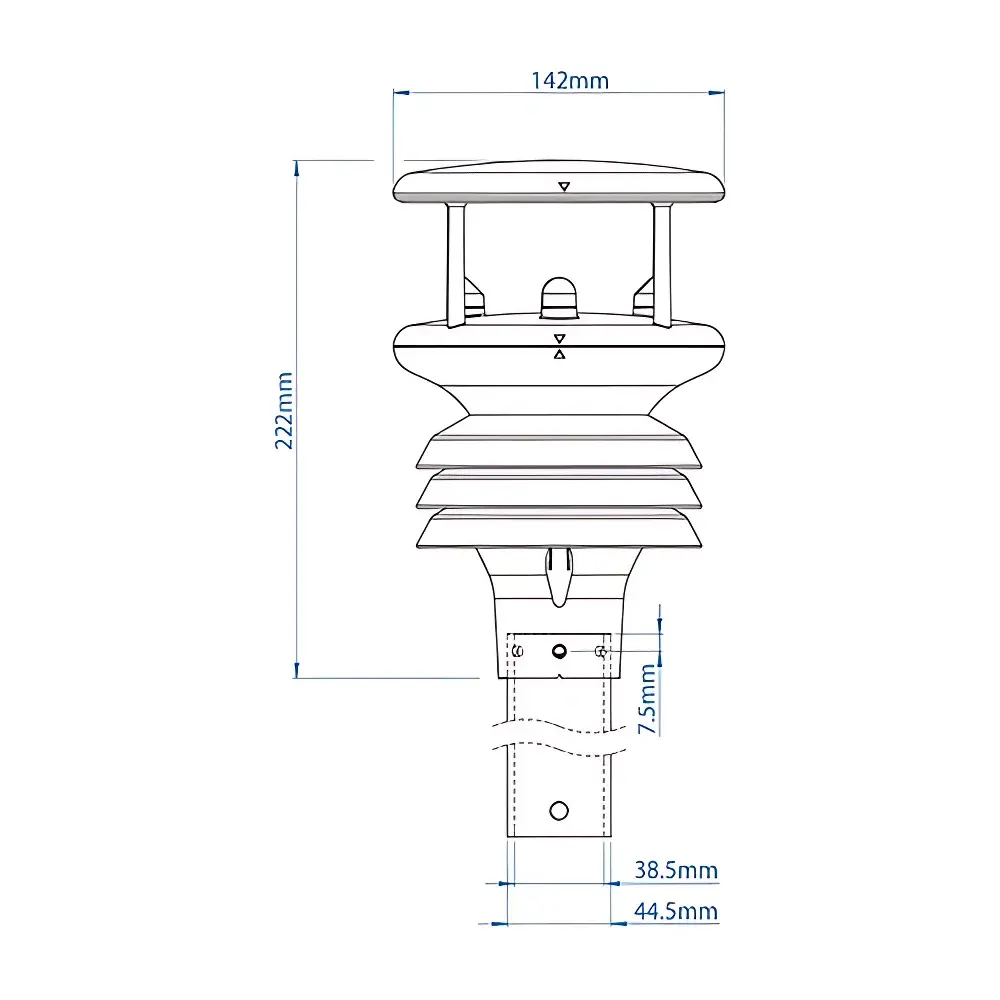
Gill GMX500 Compact Weather Station
| Brand | Gill |
|---|---|
| Origin | United Kingdom |
| Model | GMX500 |
| Type | Portable Weather Station |
| Compliance | WMO-compliant measurement architecture |
| Sensor Technology | Ultrasonic wind sensing, passive ventilated radiation shield, integrated barometric/thermohygrometric module |
| Communication Interfaces | RS-232 / RS-422 / RS-485 (ASCII), SDI-12, NMEA 0183, MODBUS RTU, optional analog outputs |
| Optional Modules | GPS receiver (for true wind calculation, georeferenced timestamping, sunrise/sunset, solar position, MSL pressure correction) |
Overview
The Gill GMX500 Compact Weather Station is a fully integrated, WMO-aligned environmental monitoring system engineered for long-term, maintenance-free operation in demanding outdoor environments. Designed and manufactured in the United Kingdom by Gill Instruments—a globally recognized specialist in precision meteorological instrumentation—the GMX500 employs a physics-based sensor architecture to deliver traceable, high-reproducibility atmospheric measurements without mechanical moving parts. Its core measurement principle combines ultrasonic time-of-flight anemometry for wind vector determination with a naturally ventilated, triple-layer, UV-stabilized radiation shield housing co-located platinum resistance thermometers (PRTs) and capacitive humidity sensors. Barometric pressure is measured via a temperature-compensated silicon piezoresistive transducer, calibrated to sea-level (MSL) reference using real-time GPS-derived altitude when the optional GNSS module is installed. The absence of rotating cups or mechanical hygrometer elements ensures exceptional long-term stability, minimal drift, and immunity to icing, dust accumulation, or bearing wear—critical attributes for unattended deployments across remote infrastructure, coastal zones, agricultural networks, and urban microclimate studies.
Key Features
- Ultrasonic wind sensor providing simultaneous wind speed (0–60 m/s) and wind direction (0–360°) with no moving parts; supports WMO-standard 2- and 10-minute averaging, gust detection (3-second peak), and apparent/true wind vector resolution when paired with GPS.
- Integrated thermohygrometric module housed within a passive, triple-louvered, solar-radiation-shielded enclosure meeting WMO/CIMO guidelines for natural ventilation and thermal equilibrium.
- High-stability absolute pressure sensor with on-board temperature compensation and optional MSL correction using real-time GPS altitude data.
- Built-in electronic compass for magnetic declination compensation and heading-referenced wind reporting.
- Optional GNSS receiver enabling precise geolocation (latitude/longitude), elevation above mean sea level, solar geometry calculations (sunrise, sunset, solar noon, twilight phases), and UTC-synchronized timestamping compliant with ISO 8601 and IETF RFC 3339.
- Multi-protocol digital interface supporting ASCII serial (RS-232/422/485), SDI-12, NMEA 0183, MODBUS RTU, and configurable analog outputs (4–20 mA or 0–10 V) for SCADA integration.
Sample Compatibility & Compliance
The GMX500 is validated for continuous exposure to ambient conditions ranging from −40 °C to +70 °C and 0–100 % RH, with IP66-rated enclosures ensuring protection against wind-driven rain, sand, and dust ingress. All sensor outputs conform to internationally accepted metrological standards: temperature accuracy ±0.2 °C (−20 to +60 °C), relative humidity ±2 % RH (10–90 % RH), and barometric pressure ±0.1 hPa (at 25 °C). Data logging and transmission protocols support audit-ready traceability under GLP and GMP frameworks. The station meets EN 61326-1 (EMC), EN 61000-6-2 (immunity), and EN 61000-6-4 (emissions) requirements. Optional GPS module complies with ETSI EN 303 413 and supports SBAS (WAAS/EGNOS) for sub-5-meter horizontal positioning accuracy.
Software & Data Management
The GMX500 operates autonomously with embedded firmware supporting user-configurable sampling intervals (1 s to 60 min), internal data buffering (up to 1 million records), and automatic power-cycle recovery. Configuration and diagnostics are performed via terminal emulation or Gill’s proprietary PC-based configuration utility (Windows/macOS/Linux compatible). Output data streams are structured in human-readable ASCII or industry-standard NMEA/SDI-12 frames, facilitating direct ingestion into cloud platforms (e.g., AWS IoT Core, Azure IoT Hub), SCADA systems, or time-series databases (InfluxDB, TimescaleDB). Firmware updates are delivered over serial or USB-C interface, with version-controlled changelogs and SHA-256 integrity verification. Full data provenance—including sensor calibration IDs, firmware build timestamps, and environmental operating logs—is retained for regulatory review per FDA 21 CFR Part 11 and ISO/IEC 17025 requirements.
Applications
- Environmental monitoring networks for national meteorological services and regional air quality authorities.
- Smart building energy management systems requiring real-time outdoor weather inputs for HVAC optimization.
- Railway and highway infrastructure monitoring for fog, wind, and precipitation hazard alerts.
- Coastal and offshore operations including port authority weather stations, tidal prediction models, and marine safety systems.
- Precision agriculture decision-support tools integrating microclimate data with irrigation scheduling and pest forecasting models.
- Educational field laboratories and university atmospheric science programs emphasizing hands-on instrumentation and data validation methodologies.
- Renewable energy site assessment for wind resource mapping, solar irradiance correlation, and turbine performance benchmarking.
FAQ
Does the GMX500 require external power, or does it support solar/battery operation?
The GMX500 operates from a wide-input DC supply (9–30 VDC) and is routinely deployed with solar-charged battery banks (e.g., 12 V sealed lead-acid or LiFePO₄) for off-grid applications. Power consumption averages 1.2 W in continuous operation.
Is factory calibration traceable to national metrology institutes?
Yes—each GMX500 ships with a UKAS-accredited calibration certificate (ISO/IEC 17025) for temperature, humidity, pressure, and wind sensors, with traceability to NPL (UK) and BIPM standards.
Can the station be integrated into existing Modbus-based industrial control systems?
Yes—the optional MODBUS RTU implementation supports both master and slave modes over RS-485, with configurable register mapping for all primary and derived parameters (e.g., wet-bulb temperature, air density, wind chill).
What is the typical recalibration interval recommended for long-term deployments?
Gill recommends full recalibration every 24 months under normal environmental exposure; however, field verification using NIST-traceable portable references may extend this interval per ISO 5725-2 uncertainty budgeting guidelines.
How is data security handled during wireless transmission?
While the GMX500 itself does not include onboard radio modules, when connected to third-party LTE/LoRaWAN gateways, end-to-end encryption (TLS 1.2+), device authentication, and secure boot are enforced at the gateway layer—consistent with IEC 62443-3-3 SL2 requirements.
Related Products







