
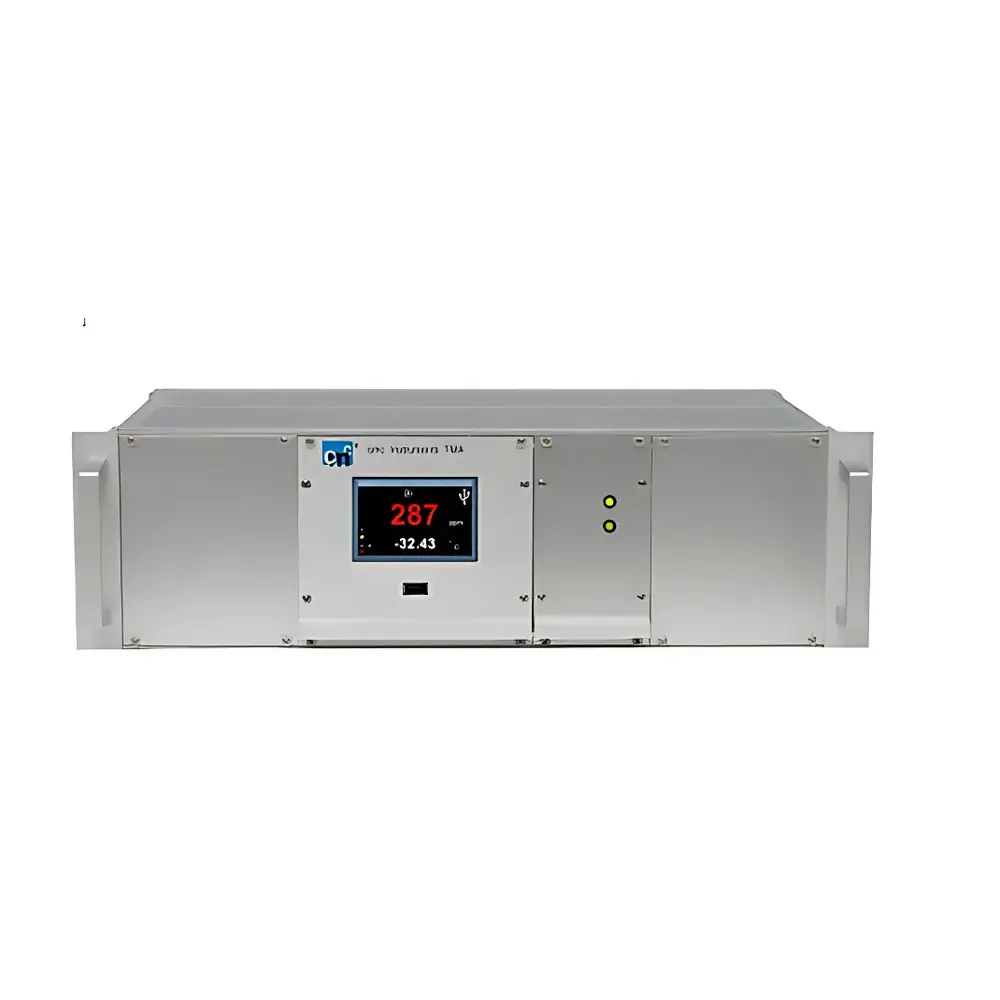
CMC iTMA-204-19″ P₂O₅ Electrolytic Moisture Analyzer for Chlorine and Hydrogen Chloride
| Brand | CMC |
|---|---|
| Origin | Germany |
| Model | iTMA-204-19" |
| Product Type | Online Dew Point Analyzer |
| Principle | Phosphorus Pentoxide (P₂O₅) Electrolytic Method |
| Operating Temperature | -10°C to +50°C |
| Accuracy | ±1% of Full Scale |
| Repeatability | ±0.1% of Full Scale |
Overview
The CMC iTMA-204-19″ is a high-integrity, continuous online moisture analyzer engineered specifically for trace water measurement in aggressive, corrosive, and reactive industrial process gases—most notably chlorine (Cl₂), hydrogen chloride (HCl), sulfur dioxide (SO₂), hydrogen sulfide (H₂S), and other high-purity acid gases. Unlike optical or capacitive sensing technologies, this instrument employs the fundamental electrochemical principle of phosphorus pentoxide (P₂O₅) electrolysis: water vapor in the sample gas is quantitatively decomposed into hydrogen and oxygen at a P₂O₅-coated electrode pair, generating a stoichiometric current directly proportional to the water concentration. This absolute measurement method eliminates drift-related recalibration requirements and ensures long-term stability—even under sustained exposure to highly corrosive matrices. The sensor core consists of a fused-silica cylindrical cell with parallel platinum or rhodium electrodes, coated with a thin, hygroscopic layer of phosphoric acid (H₃PO₄). Upon application of a polarizing voltage, the acid layer absorbs ambient moisture from the gas stream and electrolytically converts it to P₂O₅—a thermodynamically favored, non-volatile oxide. The resulting electrolytic current is linearly correlated to water partial pressure, enabling direct ppmv quantification without empirical curve fitting.
Key Features
- True absolute measurement principle: No zero/span drift; no routine calibration required under stable operating conditions
- P₂O₅ sensor architecture optimized for Cl₂ and HCl service: Chemically inert fused-silica body and noble-metal electrodes resist corrosion and catalytic poisoning
- Ultra-fast response: T₅₀ < 8 s; full stabilization < 1 s after step change—critical for real-time process control in chlor-alkali and semiconductor etch gas delivery
- Four auto-ranging measurement spans: 0–10 ppmv, 0–100 ppmv, 0–1000 ppmv, and 0–2500 ppmv—switched automatically based on signal level and user-defined thresholds
- Integrated microprocessor control with self-diagnostics: Power-on system check, sensor health monitoring, and fault logging compliant with NAMUR NE 43 standards
- Robust mechanical design: 19-inch rack-mountable chassis (482 × 133 × 350 mm) rated for industrial environments; IP54 front panel protection
- Configurable analog output: Isolated 4–20 mA (or 0–20 mA) with user-selectable range mapping and HART® protocol support
Sample Compatibility & Compliance
The iTMA-204-19″ is validated for use with dry, non-condensing process streams containing up to 100% Cl₂ or HCl—gases that rapidly degrade conventional aluminum oxide or quartz crystal sensors. It is also suitable for Ar, Kr, Xe, He, N₂, O₂, H₂, D₂, CO₂, CH₄, natural gas, SF₆, freons, acetylene, PH₃, HBr, and ozone. Gases known to react irreversibly with P₂O₅ (e.g., NH₃, amines, strong reducing agents) are excluded. All wetted materials—including sample inlet tubing, flow restrictor, and sensor cell—are selected per ASTM B162 (nickel alloy) and DIN 17440 (1.4571 stainless steel) specifications. The analyzer complies with EN 61000-6-2 (EMC immunity) and EN 61000-6-4 (EMC emission), and supports audit-ready data integrity when integrated with GLP/GMP-compliant SCADA systems. Optional firmware enables 21 CFR Part 11–compliant electronic signatures and audit trails for regulated pharmaceutical and semiconductor manufacturing.
Software & Data Management
The unit features a 7-inch capacitive touchscreen interface with multilingual support (English, German, Chinese, Spanish), intuitive menu navigation, and real-time trend visualization. Internal memory logs timestamped moisture values, sensor voltage, temperature, and alarm status at user-defined intervals (1 s to 24 h). Data export is supported via USB 2.0 (CSV format) or Ethernet (Modbus TCP). Optional CMC Analytical Suite software provides remote configuration, historical data overlay, statistical process control (SPC) charts, and automated report generation aligned with ISO/IEC 17025 documentation requirements. All configuration changes are logged with operator ID, timestamp, and pre-/post-values—enabling full traceability during regulatory audits.
Applications
- Chlor-alkali plant: Continuous monitoring of Cl₂ drying efficiency pre-liquefaction and post-compressor
- HCl synthesis and purification: Verification of moisture removal prior to PVC monomer production or semiconductor-grade gas packaging
- Electronics-grade gas supply: In-line verification of ultra-high-purity (UHP) Cl₂ and HCl used in plasma etching and atomic layer deposition (ALD)
- SO₂ conversion units in sulfuric acid production: Preventing catalyst deactivation by maintaining dew point below -70 °C equivalent
- Liquefied gas cylinder filling stations: Ensuring compliance with ISO 8573-1 Class 1.1.1 (≤0.1 ppmv H₂O in Cl₂)
- Research laboratories: Quantitative kinetic studies of hydrolysis reactions in anhydrous halogen environments
FAQ
Does the P₂O₅ sensor require periodic replacement or regeneration?
Yes—while the sensor exhibits exceptional longevity in clean Cl₂/HCl streams (typically 12–24 months), the P₂O₅ film depletes gradually under continuous electrolysis. CMC recommends scheduled sensor regeneration every 6 months or after exposure to >500 ppmv moisture spikes. Regeneration is performed in situ via controlled reverse-current cycling and takes <15 minutes.
Can the analyzer operate at sub-atmospheric sample pressure?
The standard configuration requires sample pressure between 0.1 and 0.5 barg. Operation below 0.1 barg is possible with optional vacuum-rated flow control module and pressure-compensated algorithm—but accuracy degrades above ±5% if uncorrected.
Is the 4–20 mA output intrinsically safe for Zone 1 hazardous areas?
No—the base unit is rated for general-purpose industrial use (Class I, Division 2). For Zone 1 installation, CMC offers an ATEX-certified version (iTMA-204-19″-ATEX) with galvanically isolated outputs and flameproof enclosure (Ex d IIB T4 Gb).
How does temperature fluctuation in the sample line affect measurement?
The analyzer includes a built-in sample temperature sensor (5–50 °C range) and applies real-time vapor pressure compensation using the Goff-Gratch equation. Uncompensated ambient shifts outside this range will introduce systematic error exceeding ±0.5% FS.
What maintenance is required beyond sensor regeneration?
Annual verification of flow rate (20 NL/h ±5%), zero-check with certified dry nitrogen (<0.1 ppmv), and inspection of inlet particulate filter. No optical alignment or mechanical recalibration is necessary due to the absolute nature of the P₂O₅ method.





