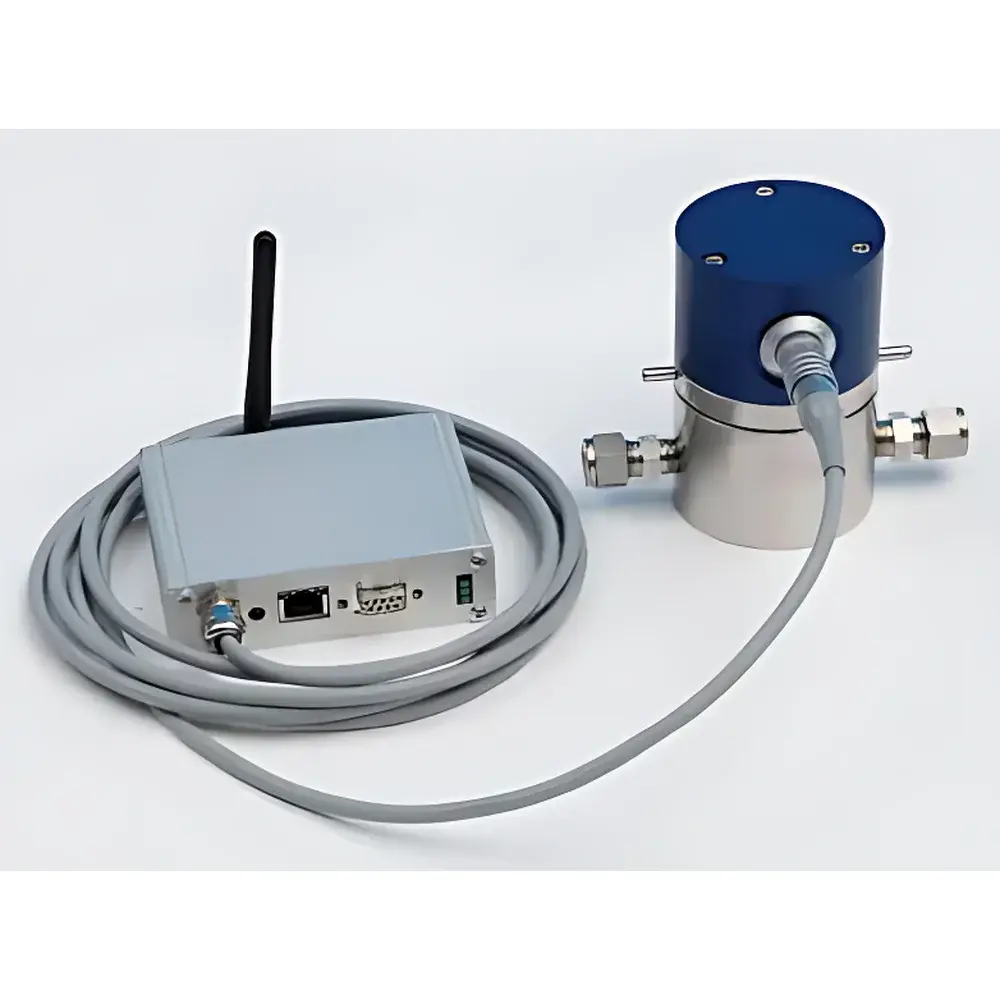
CMC WearSens Online Oil Degradation Monitoring System
| Brand | CMC |
|---|---|
| Origin | Germany |
| Model | WearSens |
| Conductivity Range | 0.1–100,000 pS/m |
| Conductivity Sensitivity | 0.1 pS/m |
| Conductivity Accuracy | ±1% of reading ±0.5 pS/m |
| Relative Permittivity Range | 1–5 |
| Relative Permittivity Sensitivity | 1×10⁻⁶ |
| Relative Permittivity Accuracy | ±1% of reading ±0.0001 |
| Response Time | <45 s |
| Oil Pressure Rating | up to 60 barg @ 20 °C |
| Oil Temperature Range | −20 °C to +65 °C |
| Ambient Temperature Range | −20 °C to +65 °C |
| Sensor Material | Stainless steel flow cell & fittings, aluminum sensor head |
| Cable | 3 m shielded (custom lengths available) |
| Connection | 1/4″ compression or 6 mm push-to-connect |
| Power Supply | 90–264 VAC, 50–60 Hz, 0.2 W |
| Dimensions & Weight | Sensor: Ø70 × H103 mm, 1.6 kg |
| Communication Unit | 110 × 87 × 30 mm, 0.25 kg |
Overview
The CMC WearSens Online Oil Degradation Monitoring System is a purpose-engineered, real-time condition monitoring solution for lubricating oils in rotating machinery. Unlike conventional offline laboratory analysis or vibration-based diagnostics, WearSens employs dual-parameter dielectric spectroscopy—simultaneously measuring electrical conductivity (in pS/m) and relative permittivity (dimensionless)—to detect molecular-level oil degradation before mechanical failure initiates. Its core principle relies on the fact that oxidation, additive depletion, particle generation, and hydrolysis alter the oil’s bulk dielectric properties long before viscosity shifts or metal particle counts exceed ISO 4406 thresholds. This enables predictive identification of incipient wear mechanisms—including micro-pitting, surface fatigue, and boundary-lubrication breakdown—in gearboxes, wind turbine drivetrains, and high-value bearing assemblies. Developed and manufactured in Germany, WearSens operates continuously under process conditions, delivering sub-45-second response latency with temperature-compensated metrology traceable to SI units.
Key Features
- Dual-parameter real-time measurement: Simultaneous acquisition of conductivity (0.1–100,000 pS/m) and relative permittivity (1–5), enabling cross-validated interpretation of oil aging pathways
- Adaptive neural-network-inspired temperature compensation: Compensates for inherent thermal drift without requiring pre-defined calibration curves or reference fluids
- High-fidelity metrology: Conductivity resolution of 0.1 pS/m and permittivity sensitivity of 1×10⁻⁶ ensure detection of sub-ppm additive depletion or early-stage oxidation byproducts
- Robust in-line sensor architecture: Stainless steel flow cell rated to 60 barg at 20 °C; operational oil temperature range from −20 °C to +65 °C
- Web-native communication: Embedded Ethernet/Wi-Fi and RS-485 interfaces support integration into SCADA, CMMS, and IIoT platforms without gateway dependency
- Low-power, CE-compliant design: 0.2 W nominal consumption; compliant with EN 61000-6-2 (immunity) and EN 61000-6-4 (emissions)
Sample Compatibility & Compliance
WearSens is validated for mineral, synthetic hydrocarbon (PAO), and ester-based lubricants used in industrial gearboxes, wind turbine main bearings, and hydraulic systems. It does not require oil sampling, filtration, or reagent addition. The system meets functional safety requirements per IEC 61508 SIL 2 for condition-monitoring subsystems and supports audit-ready data integrity through configurable timestamped logging. While not a certified laboratory instrument per ASTM D2624 or ISO 6296, its output correlates strongly with established oil health indicators—including RPVOT (ASTM D2272), FTIR carbonyl index, and elemental spectroscopy—and has demonstrated early-warning capability where lab reports remained within specification limits for >120 days post-detection.
Software & Data Management
The embedded web interface provides real-time trend visualization, threshold-based alerting (email/SNMP), and CSV export of time-stamped datasets. All measurements include automatic metadata tagging (temperature, pressure, UTC timestamp). Historical data retention is configurable up to 30 days onboard; longer-term archiving is supported via OPC UA or Modbus TCP integration with enterprise historians. Audit trails record all configuration changes, user logins, and firmware updates—meeting GLP/GMP documentation expectations for regulated maintenance programs. Optional API access enables custom dashboard development and correlation with vibration spectra or thermal imaging feeds.
Applications
- Wind turbine gearbox oil health monitoring—detecting oxidative stress prior to micropitting onset
- Preventive maintenance scheduling for critical centrifugal compressor bearing systems
- Condition-based oil change decisions in marine propulsion gear trains
- Verification of lubricant compatibility during fleet-wide oil upgrades
- Root-cause analysis of premature bearing failures in paper mill calender rolls
- Validation of oil reclamation effectiveness in closed-loop hydraulic systems
FAQ
How does WearSens differ from traditional particle counters or ferrography?
WearSens detects chemical degradation—not just particulate contamination. Particle-based methods only report after wear debris exceeds detection thresholds; WearSens identifies molecular breakdown preceding measurable particle generation.
Can it be installed on pressurized circulating systems?
Yes—the stainless steel flow cell is rated to 60 barg at 20 °C and compatible with standard API 610/614 piping configurations using 1/4″ compression or 6 mm push-to-connect fittings.
Is calibration required onsite?
No routine field calibration is needed. Factory calibration is NIST-traceable; drift verification is performed automatically during each measurement cycle using internal reference impedance networks.
Does it support integration with existing CMMS or SAP PM modules?
Yes—via Modbus TCP or OPC UA, enabling direct synchronization of oil health status, alert timestamps, and maintenance work order triggers.
What environmental certifications does it hold?
CE marked per EMC Directive 2014/30/EU and Low Voltage Directive 2014/35/EU; RoHS 2011/65/EU compliant; operating temperature range certified per IEC 60068-2-1 and IEC 60068-2-2.