
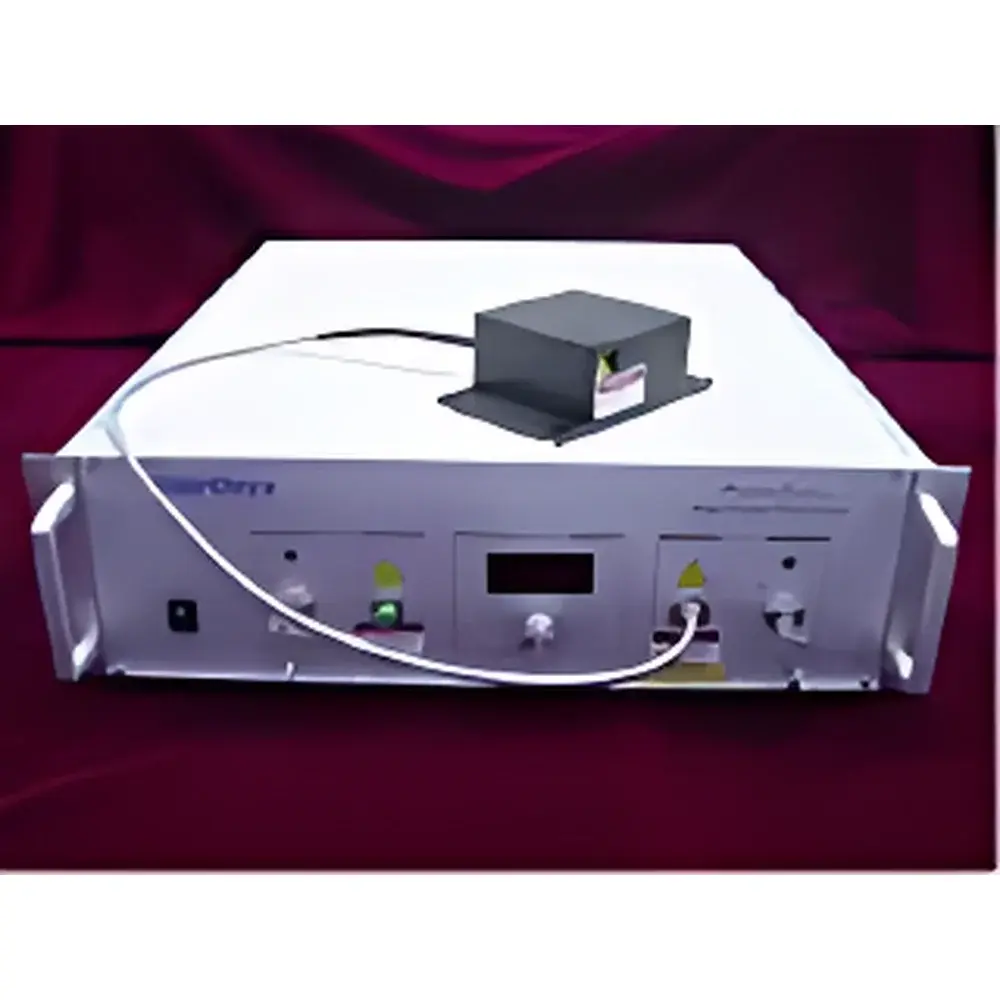
NewOpto Polaronyx Femtosecond Fiber Laser Systems
| Brand | NewOpto |
|---|---|
| Origin | USA |
| Manufacturer Type | Authorized Distributor |
| Product Category | Imported |
| Model Series | Polaronyx MERCURY, URANUS, PLUTO |
| Core Technology | Mode-locked Er/Yb-doped fiber oscillator + amplifier architecture |
| Wavelength Range | 480–2050 nm (fundamental + harmonic outputs) |
| Pulse Duration | <100 fs to <1000 fs (model-dependent) |
| Repetition Rate | 10 kHz – 100 MHz (fixed or tunable per platform) |
| Average Power | >20 mW to >5 W |
| Pulse Energy | >10 nJ to >50 µJ |
| Polarization | Polarized (PM-fiber-coupled) or unpolarized options available |
| Harmonic Generation | Optional SHG (2ω), THG (3ω), FHG (4ω) modules for UV–visible extension |
| Compliance | CE, RoHS, FDA 21 CFR Part 11-ready software interface (via optional control suite) |
Overview
NewOpto Polaronyx femtosecond fiber laser systems are engineered for high-reproducibility ultrafast photonics applications requiring precise temporal resolution, spectral flexibility, and industrial-grade reliability. Built upon robust all-fiber, mode-locked Er3+/Yb3+-doped oscillator-amplifier architectures, these lasers deliver sub-100-fs pulses across near-infrared (NIR), mid-infrared (MIR), and visible spectral bands—enabling time-resolved spectroscopy, nonlinear frequency conversion, and precision ablation without thermal damage. Unlike Ti:sapphire-based systems, Polaronyx platforms eliminate complex water cooling, alignment sensitivity, and vacuum requirements—offering turnkey operation in standard laboratory environments. Each system integrates dispersion-compensated pulse compression, polarization-maintaining (PM) fiber delivery (where specified), and thermally stabilized cavity design to ensure long-term amplitude and timing jitter stability (<0.1% RMS power fluctuation over 8 hours).
Key Features
- Multi-platform architecture: MERCURY (low-noise oscillators), URANUS (amplified high-energy sources), and PLUTO (broadband supercontinuum-seeded tunable sources) serve distinct experimental demands—from pump-probe spectroscopy to multiphoton microscopy.
- Harmonic generation compatibility: Integrated or external SHG/THG/FHG modules extend output to 256–533 nm with >30% conversion efficiency (depending on fundamental wavelength and pulse energy).
- Repetition rate flexibility: MERCURY series operates at fixed 20–100 MHz; URANUS supports dual-regime operation (MHz-range for imaging, kHz-range for high-energy ablation); PLUTO maintains stable 20–100 MHz for broadband applications.
- Industrial-grade packaging: All units feature convection-cooled housings, EMI-shielded electronics, and RS-232/Ethernet interfaces for remote monitoring and synchronization with delay stages, detectors, or data acquisition systems.
- Factory-calibrated performance: Each unit ships with traceable calibration reports for central wavelength, average power, pulse duration (autocorrelator-verified), and beam pointing stability (±2 µrad over 24 h).
Sample Compatibility & Compliance
Polaronyx femtosecond lasers are routinely deployed in ISO/IEC 17025-accredited laboratories and GMP-compliant biophotonics facilities. Their low timing jitter (<50 fs RMS), narrow spectral bandwidth (transform-limited pulses), and PM-fiber output ensure compatibility with interferometric setups (e.g., OCT, FROG, SPIDER) and nonlinear optical parametric amplifiers (OPAs). The systems comply with IEC 60825-1:2014 Class 4 laser safety standards, and optional interlock integration supports compliance with local occupational health regulations (OSHA 29 CFR 1926.102). When paired with NewOpto’s GLP/GMP-aligned control software (v3.2+), full audit trails—including user access logs, parameter change history, and calibration metadata—are maintained per FDA 21 CFR Part 11 requirements.
Software & Data Management
Control is managed via NewOpto’s Polaronyx Control Suite—a cross-platform application supporting Windows, Linux, and macOS. The suite provides real-time monitoring of diode current, cavity temperature, output power, and repetition rate lock status. It enables scripting (Python/LabVIEW APIs included) for automated parameter sweeps, synchronization with external triggers (TTL/PECL), and integration into larger experimental workflows (e.g., combined with spectrometers or TCSPC modules). Raw pulse characterization data (intensity autocorrelation traces, RF spectra) are exportable in HDF5 and CSV formats. Firmware updates are delivered via secure HTTPS channel with SHA-256 signature verification to maintain system integrity.
Applications
- Time-resolved fluorescence spectroscopy: Sub-100-fs excitation pulses resolve electronic relaxation pathways in quantum dots, organic semiconductors, and photosynthetic complexes.
- Optical coherence tomography (OCT): MERCURY 780/1550-nm models provide axial resolution down to 2.5 µm (in tissue) with high signal-to-noise ratio due to low-amplitude noise floor (<−145 dBc/Hz).
- Multiphoton microscopy: URANUS 1030/1550-nm sources enable deep-tissue imaging with reduced phototoxicity and enhanced penetration depth (>500 µm in scattering media).
- Ultrafast materials processing: High-energy URANUS systems support cold ablation of polymers, glasses, and thin-film solar cells with minimal heat-affected zones (<100 nm).
- Nonlinear optics research: Broadband PLUTO sources seed OPAs for tunable IR generation (up to 16 µm) and serve as pump sources for high-harmonic generation in gas-phase targets.
FAQ
Are Polaronyx lasers compatible with third-party pulse measurement tools?
Yes—standard FC/APC or free-space collimated outputs allow direct coupling to commercial autocorrelators (e.g., APE PulseCheck), FROG devices, or single-shot spectrometers.
Can repetition rate be externally modulated?
URANUS platforms support external RF modulation (10 kHz–100 MHz range) via SMA input; MERCURY and PLUTO models operate at factory-set fixed rates but allow optical pulse picking using synchronized AOMs.
What maintenance is required?
No consumables or periodic alignment is needed. Recommended annual verification of output power calibration and pulse duration against NIST-traceable reference standards.
Is OEM integration supported?
Yes—custom mechanical form factors, TTL-triggered standby modes, and embedded FPGA control logic are available under NDA for OEM partners.
Do you provide application-specific configuration guidance?
NewOpto technical support offers pre-purchase beam path modeling, harmonic conversion efficiency estimation, and OCT system integration consulting—free of charge for qualified academic and industrial users.




