
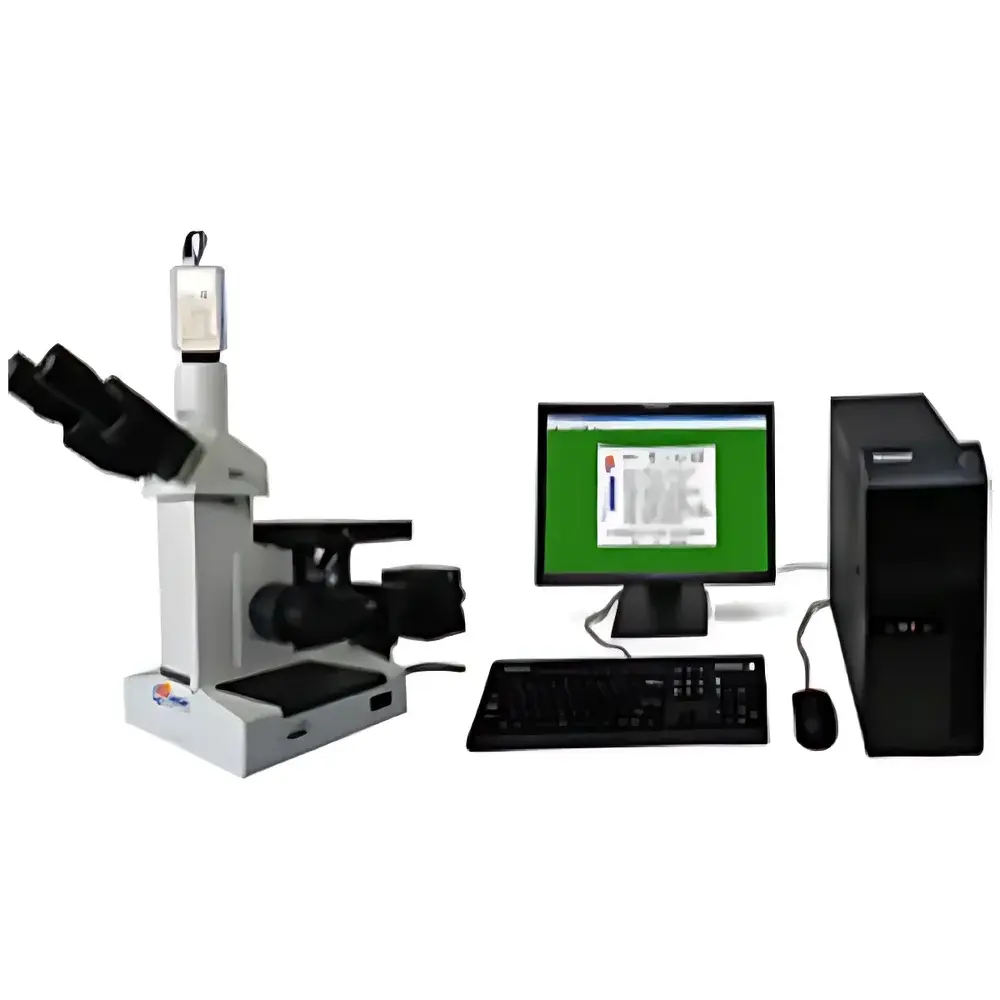
YANRUN 4XC-ST Inverted Metallurgical Microscope with Image Processing Capability
| Brand | YANRUN |
|---|---|
| Origin | Shanghai, China |
| Manufacturer Type | Direct Manufacturer |
| Product Type | Inverted |
| Optical Total Magnification | 100×–1000× (Optional Extended to 1600×) |
| Eyepieces | 10×, Field Number 18 mm |
| Objective Lenses | 10×/0.25, 20×/0.40, 40×/0.60, 100×/1.25 (Oil Immersion), Working Distances: 8.8 mm, 8.6 mm, 3.7 mm, 0.44 mm |
| Trinocular Head | Inclined 30°, Interpupillary Adjustment 53–75 mm, Diopter Adjustable |
| Fine Focus Resolution | 2 µm |
| Mechanical Stage | 180 × 150 mm, Travel Range 15 × 15 mm |
| Köhler Illumination | 6 V / 20 W Halogen Lamp, Brightness Continuously Adjustable |
| Power Supply | 220 V / 50 Hz (Optional 110 V / 60 Hz) |
| Tube Length | 160 mm |
| Compliance | Designed for ISO 9001-manufactured optical instrumentation environments |
Overview
The YANRUN 4XC-ST is an inverted metallurgical microscope engineered for high-precision microstructural analysis of opaque, polished metallic and alloy specimens. Its inverted optical configuration positions the objective lenses beneath the specimen stage—enabling stable, vibration-resistant observation of large, heavy, or irregularly shaped samples commonly encountered in metallography laboratories, foundry QA/QC departments, and materials R&D facilities. The system operates on conventional brightfield illumination with Köhler optical alignment, ensuring uniform intensity distribution across the field of view and optimal resolution at all magnifications. With a standardized 160 mm mechanical tube length and parfocal, parcentric plan achromatic objectives, the 4XC-ST delivers consistent image fidelity from 100× to 1000× optical magnification—extendable to 1600× when paired with optional high-magnification eyepieces or auxiliary lens modules. Designed for routine and semi-quantitative metallographic evaluation—not real-time digital imaging—the instrument serves as a robust platform for manual grain size assessment, inclusion rating per ASTM E112/E45, phase distribution mapping, and heat-affected zone (HAZ) characterization under controlled lighting conditions.
Key Features
- Inverted trinocular head with 30° inclination, interpupillary adjustment (53–75 mm), and individual diopter correction for ergonomic long-duration observation
- Plan achromatic objective set: 10×/0.25, 20×/0.40, 40×/0.60, and 100×/1.25 oil immersion—each calibrated to ISO 10110 optical standards with specified working distances (8.8 mm to 0.44 mm)
- Precision coaxial coarse/fine focusing mechanism: 30 mm vertical travel, fine focus graduation of 2 µm per division, with upper-limit stop and tension control
- Large-format mechanical stage (180 × 150 mm) with 15 × 15 mm bidirectional translation range and dual concentric knob control for repeatable positioning
- Köhler-optimized halogen illumination (6 V / 20 W) featuring continuous brightness regulation, field and aperture diaphragms, and heat-absorbing filter integration
- Standardized 160 mm mechanical tube length compatible with legacy accessories, calibration tools, and third-party measurement reticles (e.g., 0.1 mm/grad crosshair eyepiece)
Sample Compatibility & Compliance
The 4XC-ST accommodates standard metallographic specimens up to 40 mm in height and 100 mm in diameter, including mounted cross-sections, castings, weld coupons, and thermal spray coatings. Its inverted design eliminates interference from specimen holders or clamps during high-magnification work, particularly beneficial for evaluating subsurface defects, decarburization layers, or diffusion zones. The microscope conforms to foundational metrological principles outlined in ISO/IEC 17025 for calibration traceability of optical magnification systems. While not certified to GLP or FDA 21 CFR Part 11 out-of-the-box, its mechanical stability, repeatability (±0.5% magnification tolerance per objective), and documentation-ready configuration support audit-ready workflows when integrated into validated laboratory procedures per ASTM E883, ISO 643, or EN 10365.
Software & Data Management
The base 4XC-ST configuration does not include embedded image capture or analysis software. However, it supports seamless integration with external USB 3.0 or HDMI-compatible digital cameras via its trinocular port—enabling connection to industry-standard platforms such as Olympus Stream, Zeiss ZEN Core, or open-source solutions like Fiji/ImageJ. When configured with optional video image processing or data processing packages (sold separately), users gain access to static image annotation, basic threshold-based particle counting, and measurement logging compliant with internal SOPs. All configurations maintain full compatibility with laboratory information management systems (LIMS) through TIFF/PNG export and metadata tagging (EXIF-compliant magnification, objective ID, illumination settings). No proprietary drivers or cloud dependencies are required.
Applications
- Manual grain size evaluation per ASTM E112 (comparative chart method) and quantitative intercept analysis
- Inclusion rating and morphology classification in steel per ASTM E45 and ISO 4967
- Porosity and void fraction estimation in sintered metals and additive manufacturing builds
- Carbide network analysis in tool steels and cast irons
- Coating thickness verification (cross-sectional) and interfacial integrity assessment
- Educational metallography instruction and standardized proficiency testing
FAQ
Is the 4XC-ST suitable for fluorescence or polarized light metallography?
No—the standard configuration lacks polarization optics, analyzer sliders, or excitation filter sets. Polarization capability can be added via aftermarket Bertrand lens and strain-free objectives; fluorescence requires dedicated epi-illuminator retrofitting.
Can the microscope be used with immersion oil at 100× magnification?
Yes—the supplied 100×/1.25 NA objective is designed for oil immersion use. Ensure use of Type A immersion oil (n = 1.518) and strict adherence to cleaning protocols between sessions.
What is the maximum specimen weight supported by the stage?
The mechanical stage supports specimens up to 3 kg without compromising focus stability or stage movement precision.
Does the system meet CE or UL safety certification requirements?
The instrument complies with IEC 61010-1:2010 for electrical safety in laboratory equipment. CE marking applies to EU-distributed units meeting EMC Directive 2014/30/EU and Low Voltage Directive 2014/35/EU.
Are replacement objectives and eyepieces available with documented calibration certificates?
Yes—YANRUN provides NIST-traceable calibration reports for objective magnification accuracy and eyepiece field number verification upon request, aligned with ISO/IEC 17025 accredited service providers.



