
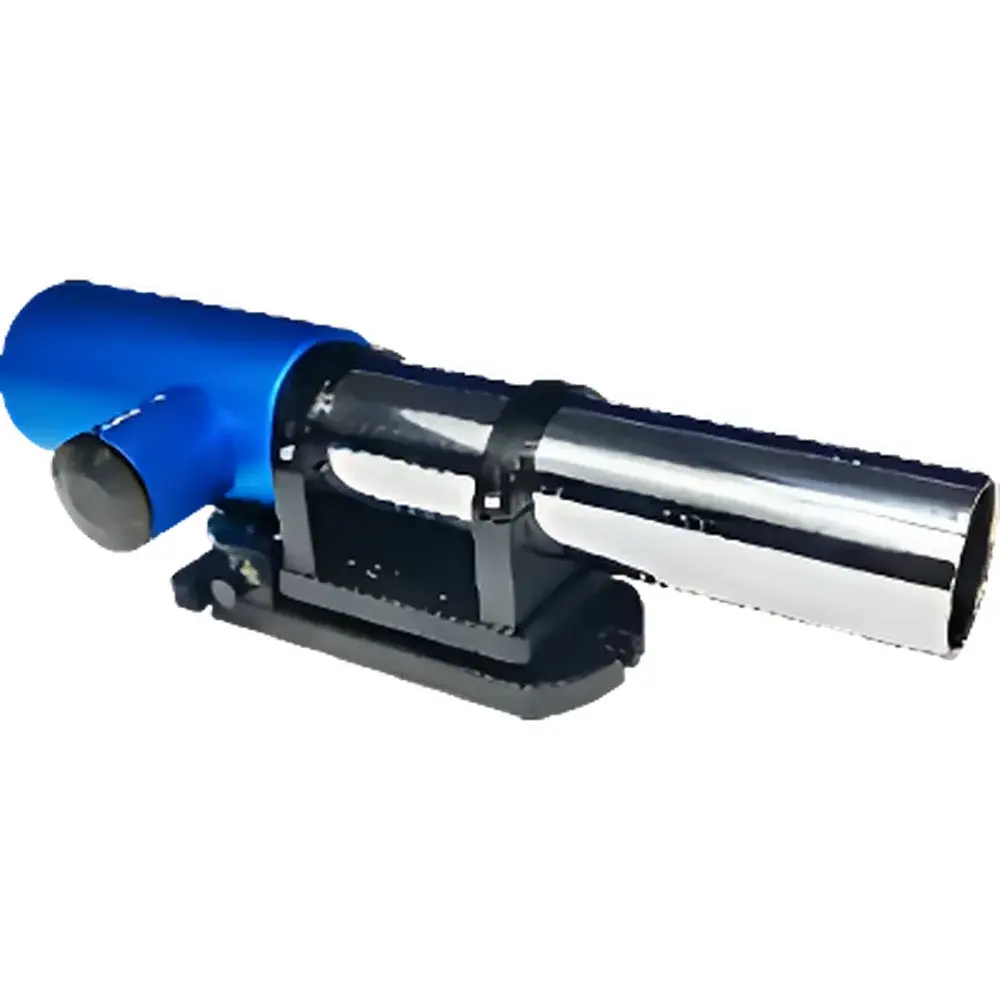
YANRUN MC030-ZJPX300-2350HZ Dual-Axis Electronic Autocollimator
| Brand | YANRUN |
|---|---|
| Origin | Shanghai, China |
| Manufacturer Type | Direct Manufacturer |
| Product Origin | Domestic (China) |
| Model | MC030-ZJPX300-2350HZ |
| Price Range | USD 7,000 – 28,000 |
Overview
The YANRUN MC030-ZJPX300-2350HZ is a high-precision dual-axis electronic autocollimator engineered for non-contact angular metrology in demanding industrial and metrological environments. Based on the fundamental optical principle of autocollimation—where a collimated beam is reflected back from a retroreflective or flat mirror surface and imaged onto a high-resolution CMOS sensor—the instrument quantifies angular deviations by measuring centroid displacement of the returned spot with sub-pixel interpolation algorithms. Unlike traditional visual autocollimators, this model integrates real-time digital image acquisition, embedded signal processing, and calibrated geometric modeling to deliver simultaneous, independent angular measurements along orthogonal X and Y axes. Its design targets applications requiring traceable, repeatable angular assessment under ambient laboratory or controlled production-floor conditions, with inherent immunity to mechanical hysteresis and thermal drift typical of mechanical inclinometers.
Key Features
- Dual-axis synchronous measurement capability: Simultaneous acquisition of pitch and yaw angles without mechanical reorientation.
- High-resolution CMOS imaging sensor with optimized optical path: Enables detection of angular changes down to 0.0001 arcseconds (100 nanoradians) in high-sensitivity configurations—subject to optical path length, mirror quality, and environmental stabilization.
- Integrated digital processing unit: Performs real-time centroid calculation, temperature-compensated calibration mapping, and noise suppression using adaptive filtering.
- Modular optical head design: Compatible with optional motorized mirror mounts, beam splitters, and extended focal length objectives for customized measurement setups.
- Robust mechanical architecture: Aluminum alloy housing with precision-machined kinematic mounts ensures long-term alignment stability and vibration resistance.
- USB 3.0 and Ethernet interfaces: Support for deterministic data streaming, remote triggering, and integration into automated test systems.
Sample Compatibility & Compliance
The MC030-ZJPX300-2350HZ is compatible with standard optical flats (e.g., λ/20 or better surface flatness), kinematic mirror mounts, and retroreflective targets meeting ISO 10110-7 specifications. It supports measurement distances ranging from 0.5 m to 30 m, with optimal performance achieved at 1–10 m working distances under ISO 5725-defined repeatability conditions. The system complies with core requirements of ISO 10110 (optics and optical elements), ISO 230-1 (machine tool testing), and GB/T 22097–2008 (Chinese national standard for autocollimators). Calibration procedures follow traceable methodologies aligned with ISO/IEC 17025-accredited laboratories, and raw measurement data supports audit-ready documentation per GLP and GMP frameworks when used in regulated manufacturing environments.
Software & Data Management
YANRUN provides the proprietary AutoAlign Pro software suite, compatible with Windows 10/11 (64-bit) and supporting both English and multilingual UI options. The software enables live waveform visualization, time-series logging (up to 100 Hz sampling), statistical process control (SPC) charting, and export of ASCII, CSV, and HDF5 formats. Built-in calibration management allows storage of multiple user-defined sensor/mirror configurations with versioned metadata. Audit trail functionality records operator ID, timestamp, parameter changes, and measurement session logs—meeting foundational requirements of FDA 21 CFR Part 11 for electronic records in quality-critical workflows. API support (DLL and RESTful endpoints) facilitates integration with LabVIEW, MATLAB, and MES platforms.
Applications
- Precision alignment of optical benches, laser cavities, and interferometer components in R&D labs.
- In-process verification of angular accuracy in CNC machine tool spindles, linear stages, and hydrostatic guideways.
- Dynamic tilt monitoring during thermal soak tests of semiconductor lithography platforms.
- Calibration of inclinometers, gyroscopes, and MEMS-based attitude sensors against primary angular standards.
- Flatness and straightness evaluation of granite surface plates and precision air-bearing tables via reversal techniques (e.g., reversal method per ISO 230-2 Annex B).
- Verification of collimation stability in astronomical telescope mounting systems and synchrotron beamline optics.
FAQ
What is the minimum resolvable angle for the MC030-ZJPX300-2350HZ in standard configuration?
The base resolution is specified at 0.01 arcseconds (≈50 nanoradians) under nominal 5 m measurement distance and stabilized thermal conditions; higher resolutions (e.g., 0.001″ or 0.0001″) require optional high-magnification optics and environmental isolation.
Does the system support real-time feedback for closed-loop motion control?
Yes—via Ethernet TCP/IP or USB HID mode, the device delivers low-latency angular error signals (<15 ms end-to-end latency) suitable for integration with PID controllers in active alignment systems.
Is factory calibration traceable to national metrology institutes?
All units ship with a certificate of calibration traceable to NIM (National Institute of Metrology, China), with optional UKAS or PTB-traceable certificates available upon request.
Can the instrument operate in vacuum or cleanroom environments?
The standard optical head is rated for ISO Class 8 (100,000) cleanrooms; custom hermetic variants with CF flanges and outgassing-tested materials are available for vacuum-compatible deployment (10⁻⁴ Pa range).
What mirror specifications are recommended for optimal performance?
A λ/20 or better surface flatness, ≥95% reflectivity at 632.8 nm, and rigid kinematic mounting are strongly recommended; deviations beyond these thresholds directly impact measurement uncertainty budgets per GUM (JCGM 100:2008).






