
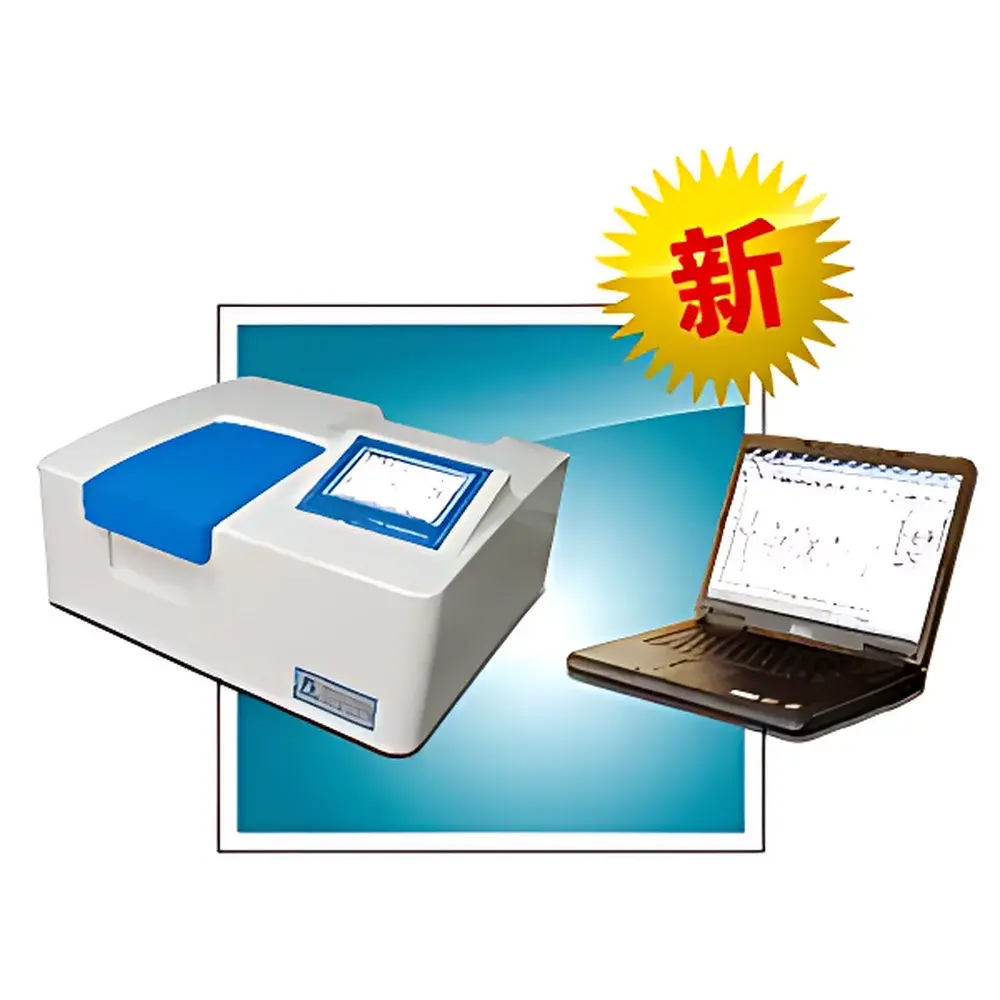
Shanghai Huaming 7600 Dual-Beam Ultraviolet-Visible Spectrophotometer
| Origin | Shanghai |
|---|---|
| Manufacturer Type | Distributor |
| Origin Category | Domestic (China) |
| Model | 7600 Dual-Beam |
| Quotation | Upon Request |
| Wavelength Range | 200–1000 nm |
| Wavelength Setting Range | 190–1100 nm |
| Wavelength Accuracy | ±0.5 nm |
| Wavelength Repeatability | ≤0.2 nm |
| Photometric Accuracy (Transmittance) | ±0.5% T |
| Photometric Repeatability (Transmittance) | ±0.2% T |
| Transmittance Range | 0–200% T |
| Absorbance Range | −0.301 to 3.000 A |
| Concentration Display Range | 0–99999 |
| Stray Light | ≤0.10% T (measured with NaI at 220 nm) |
| Baseline Flatness | ±0.002 A |
| Drift | ≤0.2% T (0.001 A) / hour at 500 nm (after warm-up) |
| Noise | ≤0.2% T at 100% T, ≤0.1% T at 0% T |
| Scan Speed Modes | High / Medium / Low |
| Printer Interface | Integrated |
Overview
The Shanghai Huaming 7600 Dual-Beam Ultraviolet-Visible Spectrophotometer is a precision optical instrument engineered for quantitative and qualitative analysis of molecular absorption in the ultraviolet (190–400 nm) and visible (400–1100 nm) spectral regions. Based on the principle of dual-beam photometry—where sample and reference beams are measured simultaneously—the system compensates for source intensity fluctuations and detector drift, ensuring high photometric stability and measurement reproducibility over extended acquisition periods. Its broad wavelength coverage (190–1100 nm setting range, 200–1000 nm operational range) supports routine analysis of organic compounds, transition metal complexes, nucleic acids, proteins, and pharmaceutical actives. The instrument complies with core performance expectations defined in ISO 8579-1:2021 (spectrophotometer performance verification) and aligns with method validation requirements under USP and EP 2.2.25 for UV-Vis absorbance measurements.
Key Features
- Dual-beam optical architecture with real-time reference beam correction, minimizing baseline drift and enhancing long-term photometric consistency.
- High-stability tungsten-halogen and deuterium lamp combination, automatically switched at ~340 nm to ensure optimal spectral output across UV and visible ranges.
- Grating monochromator with <0.5 nm wavelength accuracy and ≤0.2 nm repeatability—validated per ASTM E275-22 protocols for spectrophotometer calibration.
- Photometric linearity verified from −0.301 to 3.000 A (equivalent to 0–200% T), supporting both dilute and concentrated sample quantification without manual range switching.
- Stray light performance ≤0.10% T at 220 nm (NaI test), critical for low-transmittance measurements in UV-sensitive applications such as nitrate or aromatic compound analysis.
- Three selectable scan speeds (high/medium/low) enable optimization between spectral resolution and acquisition time—particularly valuable for kinetic studies or high-throughput screening workflows.
- Integrated thermal printer interface for immediate hard-copy output of spectra, calibration reports, and quantitative results—supporting GLP-compliant documentation practices.
Sample Compatibility & Compliance
The 7600 accommodates standard 10 mm pathlength quartz or glass cuvettes (including matched pairs for ratio-based referencing) and supports optional accessories such as microvolume holders, temperature-controlled cells, and fiber-optic probes. Its optical design minimizes polarization effects and beam deviation, ensuring compatibility with turbid, colored, or scattering samples when used with appropriate baseline correction routines. Instrument qualification follows IQ/OQ protocols aligned with FDA 21 CFR Part 11 data integrity principles where electronic records are generated; audit trail functionality is implemented via external PC-based software (not embedded). The system meets essential safety and electromagnetic compatibility requirements per GB/T 18268.1–2010 (IEC 61326-1 equivalent) for laboratory equipment.
Software & Data Management
Control and data processing are performed via dedicated Windows-compatible application software that supports spectral acquisition, peak identification, multi-wavelength quantitation, kinetics modeling, and derivative spectroscopy. All raw absorbance/transmittance data are stored in vendor-neutral ASCII format (.txt) or CSV, enabling direct import into LIMS platforms or statistical analysis tools (e.g., JMP, MATLAB, R). Software enforces user-level access control, electronic signature prompts for report finalization, and timestamped metadata logging—including lamp hours, wavelength calibration history, and photometric validation logs—to satisfy GMP traceability demands. Data backups and export workflows comply with ALCOA+ principles (Attributable, Legible, Contemporaneous, Original, Accurate, Complete, Consistent, Enduring, Available).
Applications
- Pharmaceutical QC: Assay of active pharmaceutical ingredients (APIs) per USP monographs requiring UV quantitation at specified λmax (e.g., paracetamol at 243 nm, aspirin at 277 nm).
- Environmental testing: Nitrate/nitrite determination in water using colorimetric methods (e.g., cadmium reduction + diazotization) with measurement at 540 nm.
- Biochemical analysis: Bradford and Lowry protein assays, DNA/RNA purity assessment (A260/A280 ratios), and enzyme kinetics (e.g., NADH oxidation at 340 nm).
- Chemical education and research: Teaching Beer-Lambert law fundamentals, equilibrium constant determination, and ligand-binding stoichiometry via titration spectroscopy.
- Food & beverage QA: Color index evaluation (e.g., AOAC 993.01 for tomato paste), preservative quantification (e.g., benzoic acid at 228 nm), and antioxidant capacity assays.
FAQ
What wavelength calibration standards are recommended for routine verification?
NIST-traceable holmium oxide (Ho₂O₃) and didymium filters are recommended for wavelength accuracy checks at multiple points (e.g., 241.1, 279.4, 360.9, 418.5, 480.0, 536.3 nm); annual verification is advised per ISO/IEC 17025 accreditation requirements.
Is the instrument compatible with 21 CFR Part 11-compliant environments?
While the hardware supports secure data capture, full Part 11 compliance—including electronic signatures, audit trails, and role-based permissions—requires deployment with validated third-party LIMS or ELN software; the native application provides foundational data integrity features but lacks embedded digital signature modules.
Can the 7600 perform kinetic measurements over time?
Yes—time-scan mode enables continuous monitoring of absorbance changes at fixed or multi-wavelength settings, with user-defined intervals from 0.1 s to 600 s, suitable for enzymatic reaction profiling or photochemical degradation studies.
What maintenance is required to sustain photometric accuracy?
Lamp replacement every 1,000–2,000 hours (deuterium) or 2,000–3,000 hours (tungsten-halogen), quarterly cleaning of optical windows and cuvette compartment, and biannual wavelength/photometric calibration using certified reference materials.
Does the system support remote operation or network integration?
The instrument connects via RS-232 or USB to host PCs; Ethernet or Wi-Fi capability is not natively integrated but may be enabled through external serial-to-Ethernet converters compatible with the device’s ASCII command protocol.



