
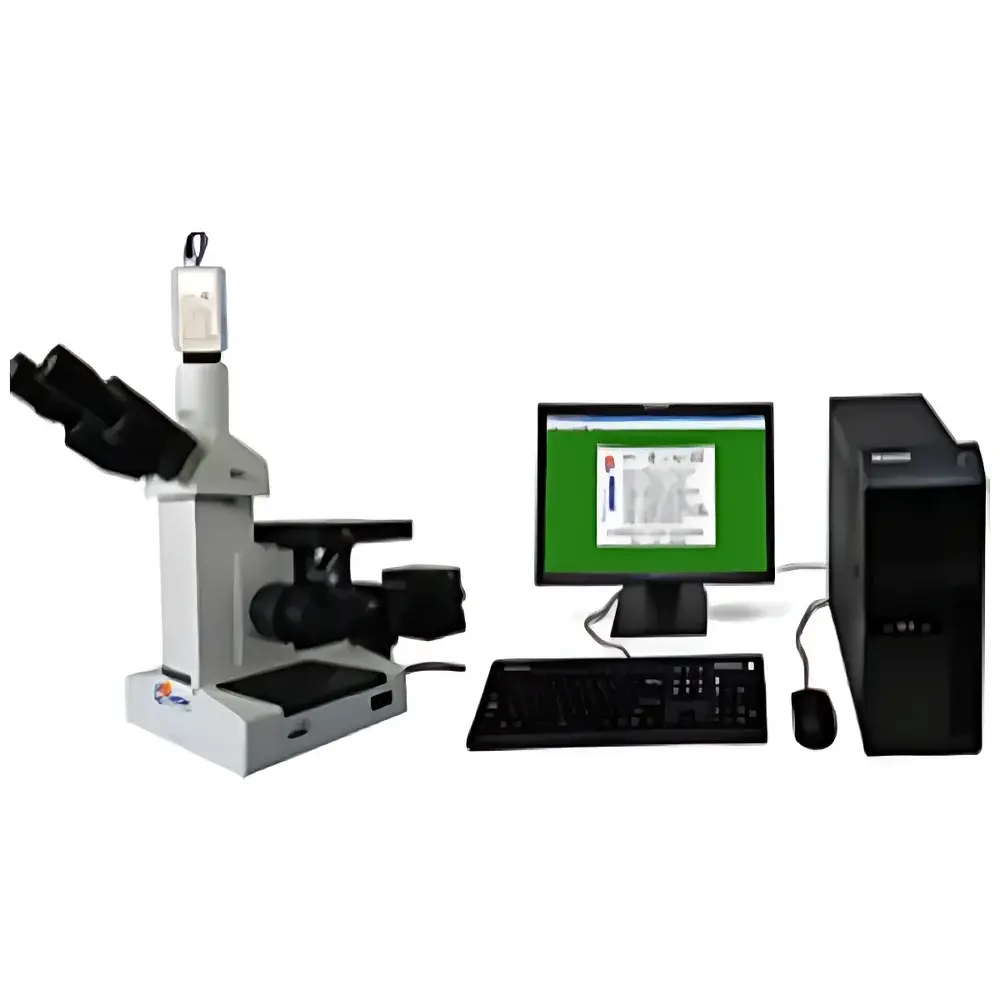
YANRUN 5XB-PC Inverted Polarizing Metallurgical Microscope
| Brand | YANRUN |
|---|---|
| Origin | Shanghai, China |
| Manufacturer Type | Direct Manufacturer |
| Product Category | Domestic (China-Made) |
| Model | 5XB-PC Inverted Polarizing Metallurgical Microscope |
| Configuration | Inverted |
| Optical Total Magnification | 100×–1000× |
| Optional Total Magnification | 1600× |
| Eyepieces | 10×, Field Number 18 mm |
| Objectives | 10×, 20×, 40×, 100× (oil immersion optional) |
| Head | 45° inclined trinocular head (interpupillary distance 50–75 mm) |
| Nosepiece | Quadruple revolving nosepiece |
| Objective Specifications | Plan metallurgical objectives — 4×/0.10 (W.D. 25 mm), 10×/0.25 (W.D. 11 mm), 20×/0.40 (W.D. 9 mm), 40×/0.60 (W.D. 3.8 mm) |
| Stage | Dual-layer mechanical stage (242 × 172 mm), travel range 75 × 50 mm, central circular stage Φ110 mm |
| Focus Mechanism | Coaxial coarse/fine focusing with gear-driven fine adjustment (graduation: 2 µm per division) |
| Illumination | Reflected Köhler illumination with adjustable aperture and field diaphragms |
| Polarization System | Rotatable analyzer (0–360°), polarizer and analyzer both removable from optical path |
| Filter Set | Yellow, green, blue interference filters |
| Calibration Tool | 0.01 mm micrometer scale |
Overview
The YANRUN 5XB-PC is an inverted polarizing metallurgical microscope engineered for high-precision microstructural analysis of opaque, polished metallic and alloy specimens. Its inverted optical configuration positions the objective lenses beneath the specimen stage—enabling stable observation of large, heavy, or irregularly shaped samples commonly encountered in foundry QA, failure analysis laboratories, and materials R&D environments. The system integrates a fully aligned polarized light pathway compliant with ASTM E3–22 and ISO 4967 standards for inclusion assessment, grain size evaluation, and phase identification in ferrous and non-ferrous alloys. Designed around a rigid cast-aluminum base and precision-machined optical column, the 5XB-PC delivers mechanical stability essential for repeatable quantitative metallography under both brightfield and polarized contrast modes.
Key Features
- Inverted optical layout with fixed-stage design—ideal for large-section samples, heat-treated components, and mounted cross-sections up to 110 mm in diameter.
- Plan-apochromatic metallurgical objectives (4×, 10×, 20×, 40×) featuring high numerical aperture and long working distances optimized for reflected-light imaging of polished surfaces.
- Trinocular head with 45° inclination and standardized C-mount interface for direct coupling to industrial cameras (0.5× adapter included).
- Reflected Köhler illumination system with independent aperture and field diaphragm control—ensuring uniform, glare-free illumination across magnifications and enabling critical alignment for quantitative intensity-based measurements.
- Full polarization module: rotatable analyzer with vernier scale (0–360°), removable polarizer/analyzer units, and strain-free optical path—supporting birefringence analysis of carbides, intermetallics, and deformed microstructures.
- Coaxial coarse/fine focusing mechanism with 2 µm fine-focus graduation and gear-reduction transmission—providing tactile feedback and positional repeatability required for serial sectioning and focus stacking workflows.
Sample Compatibility & Compliance
The 5XB-PC accommodates standard metallographic mounts (up to 50 mm diameter) and oversized specimens via its 242 × 172 mm dual-layer mechanical stage. Its Φ110 mm central stage supports large-area weld inspection coupons, turbine blade sections, and castings requiring multi-field correlation. All optical components comply with ISO 10934-1 for metallurgical microscopy and meet mechanical stability requirements outlined in ASTM E7–23 for instrument qualification. The polarization system satisfies ISO 80000-7:2019 definitions for linearly polarized light measurement and supports reporting traceable to NIST-traceable calibration standards when used with certified reference scales.
Software & Data Management
While the base 5XB-PC configuration does not include integrated image analysis software, it is fully compatible with third-party and OEM digital acquisition platforms via its C-mount port and 0.5× reduction lens. When paired with external hardware (e.g., USB3.0 CMOS camera), the system supports GLP-compliant data capture under FDA 21 CFR Part 11–enabled software environments. Optional MMAS (Metallographic Measurement & Analysis System) modules provide audit-trail logging, user-role access control, and electronic signature support—facilitating compliance with ISO/IEC 17025 accreditation requirements for testing laboratories. Image metadata—including magnification, objective ID, illumination settings, and timestamp—is embedded in TIFF/OME-TIFF exports for full chain-of-custody documentation.
Applications
- Quantitative grain size determination per ASTM E112 and ISO 643 using manual or semi-automated threshold-based segmentation.
- Inclusion rating in steels per ASTM E45 and ISO 4967 through standardized comparison against reference charts or AI-assisted classification.
- Carbide morphology and distribution analysis in tool steels and stainless alloys under crossed polars.
- Phase identification in aluminum-silicon eutectics, titanium α/β microstructures, and nickel-based superalloys.
- Heat-affected zone (HAZ) characterization in welded joints using differential interference contrast (DIC) or polarized light enhancement.
- Failure analysis of fatigue cracks, intergranular corrosion, and stress-corrosion cracking initiation sites.
FAQ
Is the 5XB-PC suitable for oil-immersion observation?
Yes—the 100× objective (optional) is designed for oil immersion and achieves enhanced resolution for sub-micron precipitate analysis.
Can the microscope be integrated into an automated production line?
Its robust mechanical construction and standardized C-mount interface enable integration with PLC-controlled XY stages and auto-focus modules for inline metallographic QC.
Does the polarization system support quantitative retardation measurement?
No—the system provides qualitative birefringence visualization; quantitative retardation requires a calibrated compensator and photometric detector not included in base configuration.
What power supply standards does the illumination unit meet?
The 12 V / 30 W halogen illuminator accepts universal AC input (85–230 V, 50/60 Hz) and complies with IEC 61000-3-2 harmonic emission limits.
Are replacement bulbs and filters available as spare parts?
Yes—standard 12 V / 30 W halogen lamps and interference filter sets (yellow/green/blue) are stocked globally and supplied with full OEM part numbers for traceability.



