
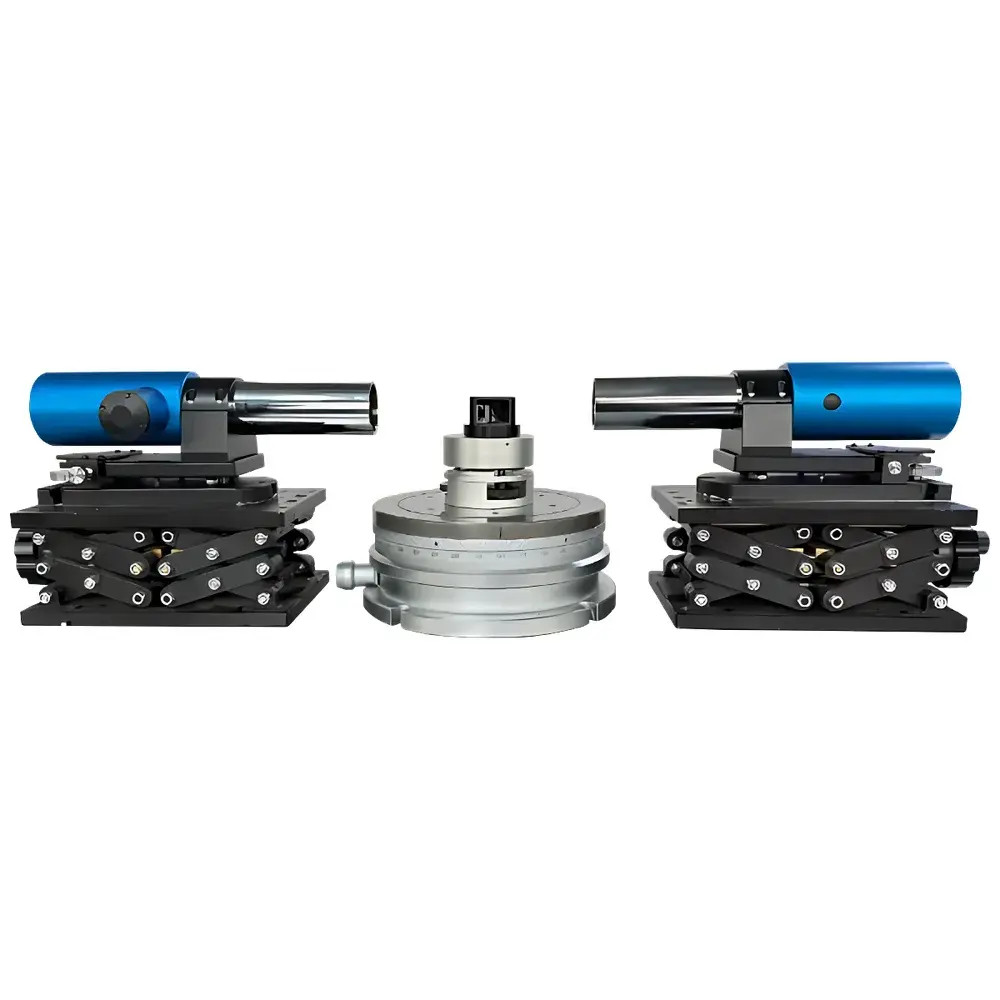
YANRUN MC030-MCE200X2 Dual-Axis Electronic Autocollimator
| Brand | YANRUN |
|---|---|
| Origin | Shanghai, China |
| Manufacturer Type | Direct Manufacturer |
| Country of Origin | China |
| Model | MC030-MCE200X2 |
| Price Range | USD 7,000 – 12,600 |
Overview
The YANRUN MC030-MCE200X2 is a dual-axis electronic autocollimator engineered for high-precision angular metrology in controlled laboratory, production, and calibration environments. It operates on the principle of optical autocollimation—where a collimated beam is reflected from a high-quality mirror surface back into the instrument’s objective lens—and leverages a high-resolution CMOS image sensor coupled with real-time digital centroid detection algorithms to determine angular deviations in both X and Y axes simultaneously. Unlike traditional visual or single-axis autocollimators, this system eliminates human reading error, provides traceable digital output, and supports automated measurement sequences. Its core architecture integrates a stabilized He–Ne or laser diode light source (depending on configuration), precision air-bearing or kinematic mirror mounts (for reference reflector stability), and thermally compensated optical path design to minimize drift. The instrument is designed for applications demanding sub-arcsecond resolution and long-term repeatability under ambient temperature fluctuations typical of industrial metrology labs.
Key Features
- Dual-axis simultaneous measurement capability for pitch and yaw angles, enabling full 2D angular vector analysis without mechanical reorientation
- Configurable angular resolution options: 0.1 arcsecond, 0.01 arcsecond, 0.001 arcsecond, and 0.0001 arcsecond—achieved via pixel-level centroid interpolation and optimized optical magnification
- Integrated high-frame-rate CMOS sensor with on-board FPGA-based image processing for real-time centroid calculation and noise suppression
- Thermal drift compensation algorithm embedded in firmware, calibrated against NIST-traceable reference standards across 15–25 °C operating range
- Compact, portable housing with integrated battery option and ruggedized aluminum chassis for field deployment or mobile metrology carts
- USB 3.0 and Ethernet interfaces supporting both streaming mode (≥100 Hz update rate) and triggered acquisition for synchronization with external motion controllers or interferometers
Sample Compatibility & Compliance
The MC030-MCE200X2 is compatible with standard optical flats, kinematic mirror mounts, and retroreflective targets meeting ISO 10110-7 surface quality specifications (scratch-dig ≤ 10-5). It supports measurement distances from 0.3 m to 10 m, with optimal performance verified at 1–5 m using λ/20 or better mirrors. The instrument complies with ISO 10110 (optical element tolerances), ISO 230-1 (machine tool testing—geometric accuracy), and GB/T 22097–2008 (Chinese national standard for autocollimator performance). While not inherently FDA-regulated, its data integrity features—including user-access logging, audit trail generation, and password-protected configuration modes—support alignment with GLP and GMP documentation requirements for regulated manufacturing environments (e.g., semiconductor lithography tool qualification or aerospace component assembly).
Software & Data Management
The instrument ships with YANRUN Autocollimator Control Suite (v4.x), a Windows-based application offering real-time vector display, statistical process control (SPC) charting, multi-point trend analysis, and export to CSV, XML, and HDF5 formats. Software supports configurable measurement protocols compliant with ISO 5725 (accuracy and precision of measurement methods) and includes built-in uncertainty estimation per GUM (Guide to the Expression of Uncertainty in Measurement). Raw image frames and centroid coordinates are timestamped and stored with metadata (temperature, humidity, operator ID, calibration certificate ID). For enterprise integration, RESTful API and OPC UA server modules enable bidirectional communication with MES, SCADA, or LabVantage LIMS platforms. All software modules adhere to IEC 62304 Class B medical device software lifecycle requirements where applicable.
Applications
- Alignment and straightness verification of precision machine tool guideways (e.g., CNC grinders, coordinate measuring machines)
- In-process angular monitoring during optical component centering and cementing in lens assembly lines
- Calibration of rotary stages, goniometers, and hexapod positioners used in synchrotron beamline instrumentation
- Dynamic tilt characterization of active vibration isolation platforms under load
- Verification of angular stability in inertial navigation system test benches
- Reference-grade angular metrology for national metrology institutes performing inter-laboratory comparisons under CIPM MRA frameworks
FAQ
What is the maximum recommended measurement distance for optimal resolution?
For resolutions ≤0.001″, the recommended working distance is 1–5 m using a λ/20 flat mirror; beyond 5 m, atmospheric turbulence and beam divergence require environmental stabilization.
Does the system support external triggering and synchronization?
Yes—TTL-compatible trigger input and programmable delay settings allow synchronization with motion controllers, laser interferometers, or data acquisition systems at up to 1 kHz pulse rate.
Is factory calibration traceable to international standards?
Each unit is calibrated against a primary autocollimator standard accredited to ISO/IEC 17025 by CNAS (China National Accreditation Service), with full calibration certificate including uncertainty budget and environmental conditions.
Can the software generate PDF reports compliant with ISO/IEC 17025?
Yes—the report generator includes customizable templates, digital signatures, revision history, and embedded calibration certificate references required for accredited testing laboratories.
What maintenance is required to sustain angular accuracy over time?
Annual recalibration is recommended; no routine optical alignment is needed due to monolithic optical bench design and passive thermal compensation—only periodic verification using certified reference mirrors is advised.






