
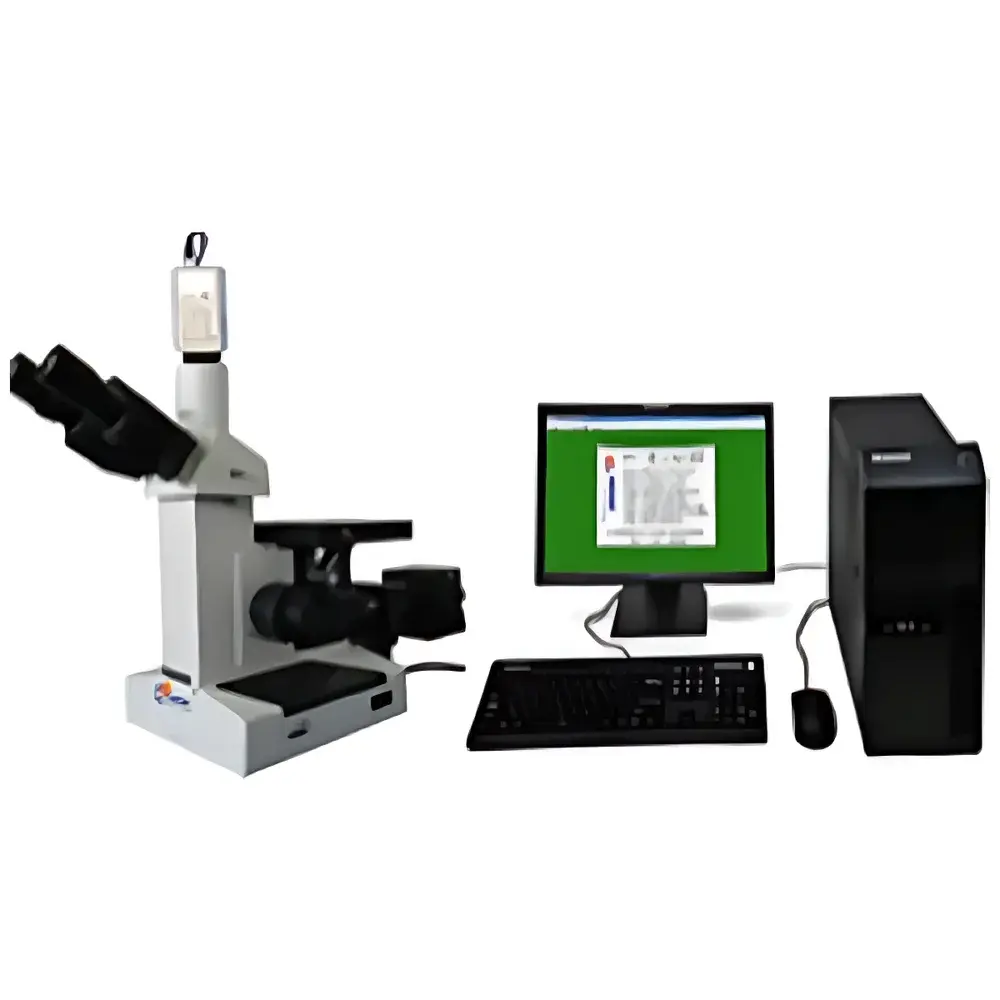
YANRUN 4XCT Inverted Metallurgical Microscope with Digital Data Processing Capability
| Brand | YANRUN |
|---|---|
| Origin | Shanghai, China |
| Manufacturer Type | Direct Manufacturer |
| Product Type | Inverted |
| Optical Total Magnification | 100×–1000× (Optional Extended to 1600×) |
| Eyepieces | 10×, Field Number 18 mm |
| Objectives | 10×/0.25, 20×/0.40, 40×/0.60, 100×/1.25 (Oil Immersion), Working Distances: 8.8 mm, 8.6 mm, 3.7 mm, 0.44 mm |
| Focusing | Coaxial coarse/fine adjustment, Fine Focus Graduation: 2 µm |
| Stage | Dual-layer mechanical stage, 180 × 150 mm base, 15 × 15 mm travel range |
| Illumination | Köhler illumination, 6 V / 20 W halogen lamp, adjustable brightness |
| Power Supply | 220 V / 50 Hz (optional 110 V / 60 Hz) |
| Tube | Inverted trinocular head, 30° inclination, interpupillary adjustment 53–75 mm, diopter adjustment available |
Overview
The YANRUN 4XCT is a precision-engineered inverted metallurgical microscope designed for routine and advanced metallographic analysis in industrial quality control, failure analysis, and materials R&D laboratories. Its inverted optical configuration places the objective lenses beneath the specimen stage—enabling stable observation of large, heavy, or irregularly shaped metallic samples without requiring sample inversion or complex mounting. The system operates on standard finite-conjugate optical principles (mechanical tube length: 160 mm), optimized for high-contrast brightfield imaging of polished and etched metallographic sections. It supports both visual inspection via eyepieces and digital documentation through optional camera integration pathways, making it compatible with third-party image acquisition hardware and software platforms used in regulated environments.
Key Features
- Inverted trinocular head with 30° inclined viewing angle, interpupillary distance adjustment (53–75 mm), and individual eyepiece diopter compensation for ergonomic long-duration use.
- High-performance plan achromatic objectives: 10×/0.25, 20×/0.40, 40×/0.60, and 100×/1.25 oil immersion—each calibrated for optimal resolution, flatness of field, and chromatic correction across the visible spectrum.
- Precision coaxial focusing mechanism featuring 30 mm coarse travel and fine focus with 2 µm graduation (0.002 mm), enabling reproducible Z-axis positioning critical for serial sectioning and depth profiling.
- Dual-layer mechanical stage (180 × 150 mm footprint) with 15 × 15 mm translation range, anti-slip vernier scales, and dual-stage limit stops for repeatable specimen repositioning.
- Köhler illumination system with 6 V / 20 W halogen lamp, centerable condenser, field diaphragm, and aperture diaphragm—ensuring uniform, glare-free illumination and optimal contrast control per ISO 9343 and ASTM E3.
- Modular design supporting multiple digital upgrade paths: direct C-mount interface for analog/digital cameras; compatibility with USB 3.0 or HDMI video capture devices; and integration-ready architecture for third-party image analysis software.
Sample Compatibility & Compliance
The 4XCT accommodates standard metallographic specimens up to 50 mm in diameter and 40 mm in height, including mounted cross-sections, bulk castings, weld joints, and heat-treated components. Its large-stage aperture (Φ10 mm and Φ20 mm options) allows unobstructed access for microhardness testing or localized thermal treatment verification. The microscope conforms to core optical safety standards (IEC 61010-1) and supports laboratory compliance workflows—including GLP documentation protocols when paired with validated image acquisition software. While the base configuration does not include built-in image analysis algorithms, its standardized output interfaces enable traceable data capture aligned with FDA 21 CFR Part 11 requirements when deployed with compliant software and audit-trail-enabled hardware.
Software & Data Management
The YANRUN 4XCT functions as a hardware platform rather than an embedded-software appliance. It delivers analog RGB or digital HDMI/USB video signals suitable for ingestion into industry-standard image processing suites such as Olympus Stream, Zeiss ZEN Core, or open-source alternatives like ImageJ/Fiji with appropriate calibration plugins. Users may configure metadata tagging (magnification, objective ID, timestamp, operator ID) externally via host PC software. For regulatory environments, laboratories typically implement separate validation packages covering camera calibration, pixel-to-micron conversion, and measurement uncertainty estimation—procedures outlined in ISO/IEC 17025 and ASTM E1558.
Applications
- Microstructural evaluation of ferrous and non-ferrous alloys per ASTM E112 (grain size), ASTM E1245 (inclusion rating), and ISO 643.
- Porosity, dendrite arm spacing, and secondary phase distribution quantification in castings and additive-manufactured parts.
- Coating thickness assessment and interfacial integrity analysis in thermal spray and PVD/CVD coatings.
- Fractography support—particularly for cleavage, ductile dimple, and fatigue striation identification in failure analysis labs.
- Educational instruction in materials science curricula, where mechanical robustness and intuitive operation support high-throughput student lab sessions.
FAQ
Is the 4XCT supplied with image analysis software?
No—the microscope is delivered as a hardware-only platform. Image analysis functionality requires external software installation and camera integration.
Can the 4XCT be configured for darkfield or polarized light observation?
Yes—optional accessories include darkfield condensers and strain-free polarizing kits compatible with the standard nosepiece and illumination path.
What is the maximum specimen weight supported on the stage?
The reinforced stage and inverted stand design support specimens up to 5 kg without compromising focus stability or mechanical alignment.
Does the system meet CE or UL certification requirements?
The instrument complies with IEC 61010-1 for electrical safety; CE marking is applied for EU market distribution upon completion of full conformity assessment by authorized bodies.
Is calibration documentation provided with delivery?
A factory-issued Certificate of Conformance is included, listing optical alignment verification, magnification accuracy check (±2% tolerance), and mechanical stage repeatability test results.




