
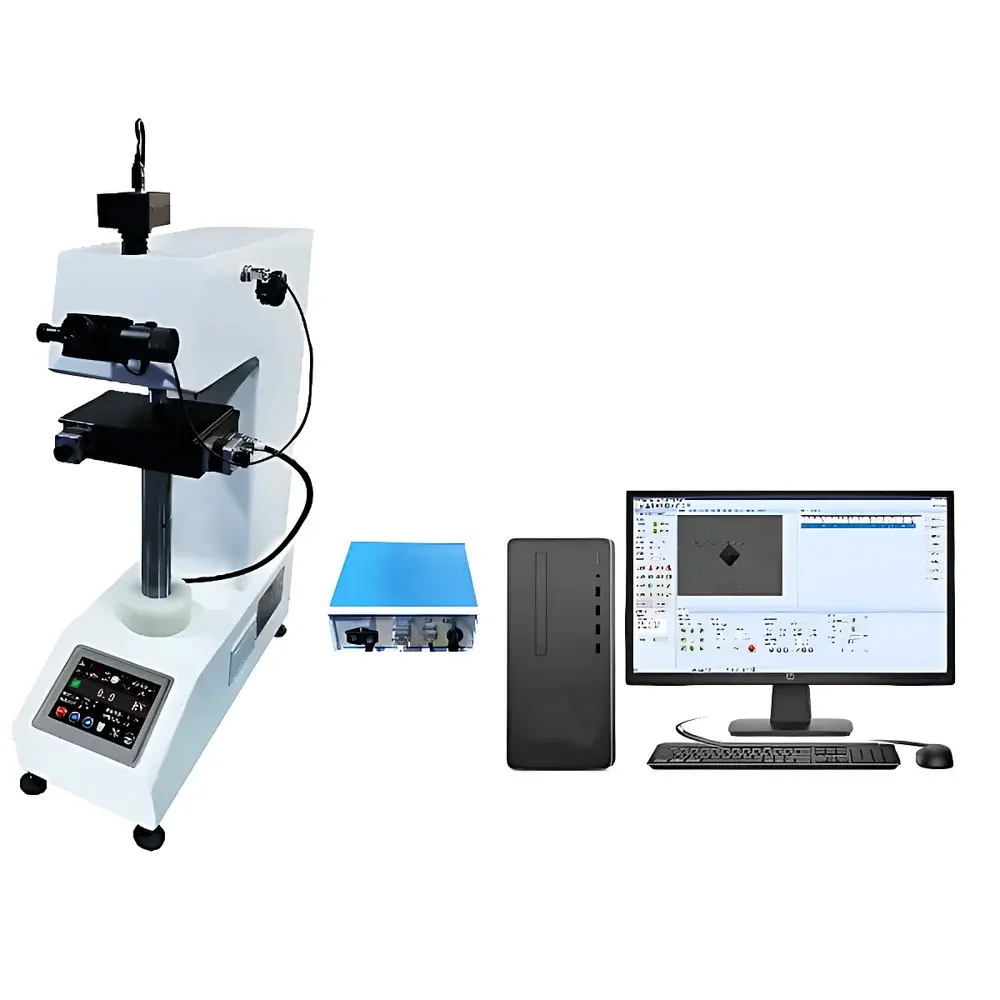
English Product Name
| Brand | YANRUN |
|---|---|
| Origin | Shanghai, China |
| Manufacturer Type | OEM Manufacturer |
| Instrument Type | Vickers Hardness Tester |
| Measurement Range | 0.001–6000 HV |
| Total Test Forces | 10, 25, 50, 100, 200, 300, 500, 1000 gf |
| Standards Compliance | GB/T 4340.2, JJG 151 |
| Objective Lenses | 10×, 40× |
| Total Optical Magnification | 100×, 400× (digital zoom up to ~1600×) |
| X-Y Motorized Stage | 50 mm × 50 mm travel, 185 mm × 140 mm platform, 50 kg load capacity |
| Maximum Specimen Height | 180 mm |
| Indenter-to-Column Distance | 130 mm |
| Dwell Time | 0–60 s (1 s increments) |
| Illumination | Adjustable LED brightness |
| Data Acquisition | Encoded digital measurement |
| Software Interface | Multilingual (English, Chinese, German, Spanish, Russian) |
Overview
The YANRUN HMAS-D1000SMZB Semi-Automatic Microhardness Testing and Analysis System is an engineered solution for precision Vickers microhardness evaluation in metallurgical laboratories, quality control departments, and materials R&D facilities. Based on the standardized Vickers indentation principle—where a diamond pyramid indenter (136° apex angle) is applied under controlled static load to produce a geometrically reproducible impression—the system delivers traceable, quantitative hardness values (HV) calibrated per ISO 6507-1, ASTM E384, and GB/T 4340.1. Unlike fully manual or entry-level semi-automatic systems, the HMAS-D1000SMZB integrates a motorized X-Y stage, programmable load application, high-resolution CCD imaging (5 MP), and a purpose-built analysis engine capable of sub-pixel edge detection. Its architecture supports both single-point verification and systematic cross-sectional profiling—including case depth mapping, gradient analysis, and multi-specimen comparative studies—while maintaining full compliance with GLP documentation requirements and audit-ready data integrity protocols.
Key Features
- Precision-engineered mechanical frame with vibration-damped base and rigid column design ensures long-term stability and minimal thermal drift during extended test sequences.
- Motorized dual-objective turret (10× and 40×) enables rapid switching between low-magnification survey and high-magnification indentation measurement without manual realignment.
- Eight-step programmable test force range (10–1000 gf), covering HV0.01 to HV1 scales, with automatic force calibration and real-time load monitoring via integrated load cell feedback.
- Encoded digital measurement system synchronizes indenter displacement, dwell timing, and optical axis positioning—eliminating parallax errors associated with analog eyepiece micrometers.
- High-fidelity 5-megapixel CCD imaging module with adjustable LED illumination and dynamic contrast enhancement ensures consistent, noise-resistant indentation capture across reflective, matte, or coated surfaces.
- Auto-focus option (optional) employs contrast-based iterative focusing for optimal depth-of-field alignment post-indentation—critical for accurate diagonal measurement on curved or polished specimens.
- Comprehensive mechanical offset compensation routine corrects for inherent misalignment between indenter axis and optical axis, improving measurement repeatability to ≤±0.8% RSD at HV500.
Sample Compatibility & Compliance
The HMAS-D1000SMZB accommodates specimens up to 180 mm in height and 50 kg in mass, supporting standard metallographic mounts, thin foils, coatings, ceramics, and composite laminates. Its 130 mm indenter-to-column clearance permits testing near specimen edges or within complex fixtures. Curved surface correction algorithms—aligned with ASTM E384 Table I and Table II—enable valid HV reporting on cylindrical rods, spherical bearings, and turbine blades. All hardness measurements adhere to GB/T 4340.2 (equivalent to ISO 6507-2) for verification and JJG 151 metrological verification procedures. The system supports full traceability through embedded timestamped logs, operator ID tagging, and electronic signature-capable workflows compliant with FDA 21 CFR Part 11 Annex 11 requirements when deployed in regulated environments.
Software & Data Management
The proprietary YANRUN Hardness Analysis Suite provides a modular, ISO/IEC 17025-aligned software environment. Core capabilities include: automatic indentation recognition using adaptive thresholding and morphological filtering; dual-mode calibration (optical pixel scaling + certified reference block averaging); and context-aware coefficient selection based on objective magnification, load level, and camera resolution. Measurement outputs include diagonal lengths (µm), calculated HV/HK values, statistical summaries (mean, SD, CV%), and customizable pass/fail thresholds. Path planning supports 17 predefined geometries—from linear traverses and edge normals to ring arrays and matrix grids—for case depth profiling and microstructural correlation. All data exports natively to .xlsx and .docx formats with embedded images, metadata, and revision-controlled report templates. Role-based access control (administrator/operator modes), password-protected method libraries, and full audit trail logging ensure procedural integrity and regulatory readiness.
Applications
This system serves critical functions across industrial and academic domains: evaluating carburized and nitrided case depths in gear steels; quantifying hardness gradients in additive-manufactured Ti-6Al-4V builds; verifying heat treatment uniformity in aerospace aluminum alloys; characterizing thin-film adhesion strength via microindentation fracture analysis; assessing grain boundary hardening in nickel-based superalloys; and validating coating integrity on biomedical implants. It is routinely deployed in third-party certification labs accredited to ISO/IEC 17025, automotive Tier-1 supplier QC centers operating under IATF 16949, and university materials science departments conducting NSF- or EU Horizon-funded research on advanced metallic composites.
FAQ
Does the system support ASTM E384-compliant testing on curved surfaces?
Yes—built-in curvature correction algorithms adjust diagonal measurements according to specimen radius and indentation geometry, enabling compliant HV reporting per ASTM E384 Section 7.3.
Can the software interface with LIMS or ERP systems?
Data export modules support CSV, XML, and ODBC-compatible structured outputs for seamless integration with laboratory information management systems and enterprise resource planning platforms.
Is hardware calibration traceable to national standards?
All force calibration is performed using NIST-traceable deadweight standards; optical calibration utilizes certified stage micrometers with ±0.1 µm uncertainty, documented in the出厂 calibration certificate.
What video acquisition formats does the system support?
Native support for uncompressed AVI and compressed MP4 recording at 30 fps; still-frame capture in TIFF (16-bit) and JPEG formats with embedded EXIF metadata.
How is data integrity maintained during power interruption?
The system implements non-volatile memory buffering for active test sequences; unsaved measurements are retained in volatile cache and recoverable upon reboot with no loss of positional or load-state context.



