
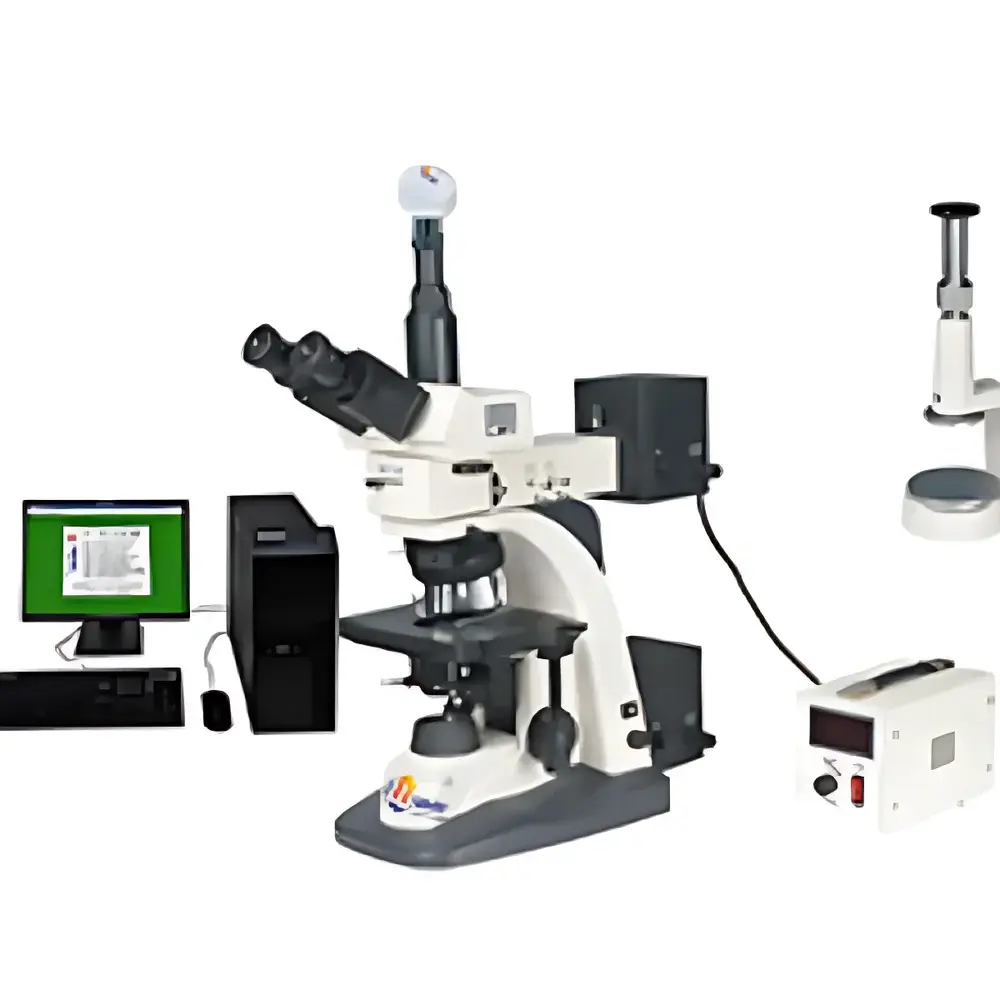
YANRUN 10XB-PC Upright Polarized Metallurgical Microscope
| Brand | YANRUN |
|---|---|
| Origin | Shanghai, China |
| Manufacturer Type | Direct Manufacturer |
| Model | 10XB-PC Upright Polarized Metallurgical Microscope |
| Eyepieces | Widefield 10× (25 mm FOV), Widefield 10× with 0.1 mm reticle graticule (20 mm FOV) |
| Objectives | 5×/0.1 (WD 29.4 mm), 10×/0.25 (WD 16 mm), 20×/0.4 (WD 10.6 mm), 40×/0.6 (WD 5.4 mm) |
| Tube | 30° inclined trinocular head (interpupillary adjustment 50–75 mm) |
| Nosepiece | Quadruple revolving nosepiece with DIC slot |
| Stage | Dual-layer mechanical stage (190 × 160 mm), travel range 80 × 50 mm |
| Focus | Coaxial coarse/fine focusing mechanism with rack-and-pinion drive |
| fine focus graduation | 2 µm |
| Condenser | N.A. 1.25 Abbe condenser with adjustable iris diaphragm and filter holder |
| Illumination | Reflected halogen illumination (with adjustable aperture and field diaphragms) |
| transmitted illumination | 12 V / 50 W halogen, AC 85–230 V, continuously variable brightness |
| Polarization System | Rotatable analyzer (0–360°), polarizer and analyzer both removable from optical path |
| Filters | Slide-in green, blue, and neutral density filters |
| Calibration Tool | 0.01 mm stage micrometer |
Overview
The YANRUN 10XB-PC is an upright polarized metallurgical microscope engineered for high-fidelity microstructural analysis of opaque, polished metallic and ceramic specimens. Designed around an infinity-corrected optical pathway, it delivers diffraction-limited resolution and chromatic fidelity across its full magnification range (50×–400× with standard eyepieces and objectives). Its integrated polarization optics—comprising a rotatable analyzer and removable polarizer—enable quantitative birefringence assessment, extinction angle measurement, and identification of anisotropic phases such as martensite, ferrite, or intermetallic compounds. The system supports both epi-illumination (for reflected-light observation of polished surfaces) and transmitted illumination (for semi-transparent inclusions or thin-sectioned geological samples), making it suitable for ISO 4967, ASTM E112, ASTM E3, and GB/T 6394-compliant metallographic evaluation in QC laboratories, foundry R&D, and materials science education.
Key Features
- Trinocular observation tube with 30° inclination and interpupillary adjustment (50–75 mm) for ergonomic long-duration use and simultaneous visual inspection + digital imaging
- Quadruple nosepiece with dedicated DIC slot—compatible with future differential interference contrast upgrades without optical realignment
- Infinity-corrected achromatic objectives (5×, 10×, 20×, 40×) featuring parfocal design and standardized working distances—ensuring rapid objective switching with minimal refocusing
- Precision dual-layer mechanical stage (190 × 160 mm) with 80 × 50 mm travel range and vernier-scale positioning—critical for systematic grid-based grain size mapping per ASTM E112
- Coaxial coarse/fine focusing system with 2 µm fine-focus graduation and backlash-free rack-and-pinion transmission—enabling reproducible Z-stack acquisition for depth profiling
- N.A. 1.25 Abbe condenser with independent aperture and field diaphragm control—optimizing contrast and resolution for both brightfield and darkfield metallurgical imaging
- Dual-illumination architecture: 12 V / 50 W halogen source with continuous intensity control for both reflected and transmitted paths—compliant with IEC 61000-3-2 harmonic emission limits
Sample Compatibility & Compliance
The 10XB-PC accommodates standard 25 mm and 30 mm diameter metallographic mounts up to 30 mm in height. Its robust stage clamping system secures specimens during polishing residue removal or thermal expansion testing. The polarization module meets ISO 10810-2 requirements for polarizing microscope performance verification. All optical components are coated with anti-reflection multilayer films (R < 0.5% per surface at 550 nm), minimizing stray light in high-contrast phase identification. The instrument’s mechanical stability and thermal mass minimize drift during extended acquisition—supporting GLP-aligned documentation workflows when paired with compliant image capture hardware.
Software & Data Management
While the base configuration includes a 0.5× C-mount adapter and monochrome CCD camera (not bundled with proprietary software), the platform is fully compatible with third-party image analysis suites—including Olympus cellSens, Zeiss ZEN Blue, and open-source Fiji/ImageJ—via standard USB 2.0 or GigE interfaces. Metadata embedding (objective ID, magnification, exposure time, stage coordinates) follows DICOM-SR and TIFF/EP standards. For regulated environments, optional FDA 21 CFR Part 11–compliant software packages provide electronic signatures, audit trails, and user role–based access control—ensuring traceability from raw image to final grain size report.
Applications
- Quantitative metallography: Grain size distribution (ASTM E112), inclusion rating (ASTM E45), phase fraction analysis (ISO 16232)
- Failure analysis: Crack path characterization, heat-affected zone (HAZ) mapping, decarburization depth measurement
- Coating & plating inspection: Thickness uniformity, interfacial diffusion, porosity quantification
- Geological thin-section analysis: Mineral birefringence ordering, twinning identification, cleavage angle measurement
- Quality assurance in aerospace, automotive, and power-generation component manufacturing
FAQ
Is this microscope compatible with digital imaging systems beyond the included CCD?
Yes—the trinocular port accepts standard C-mount adapters (0.5× or 1×), supporting integration with CMOS sensors up to 20 MP resolution and scientific-grade cameras with global shutter and cooling capabilities.
Can the polarization system be calibrated traceably to national standards?
The rotatable analyzer includes a vernier scale with ±0.5° accuracy; calibration against NIST-traceable quartz wedge standards is supported using optional accessory kits.
What maintenance intervals are recommended for long-term optical alignment stability?
Annual verification of Köhler illumination alignment and polarization axis orthogonality is advised; no routine collimation is required due to the fixed infinity-space design and rigid mechanical construction.
Does the instrument meet electromagnetic compatibility (EMC) requirements for laboratory deployment?
Yes—it complies with EN 61326-1:2013 for laboratory equipment, including radiated and conducted emissions testing per CISPR 11 Class B.
Are replacement lamps and fuses supplied with regulatory documentation (RoHS, REACH)?
All halogen lamps and electrical components carry CE marking and full RoHS 2011/65/EU and REACH SVHC declarations, provided upon request with batch-specific certificates of conformance.




