
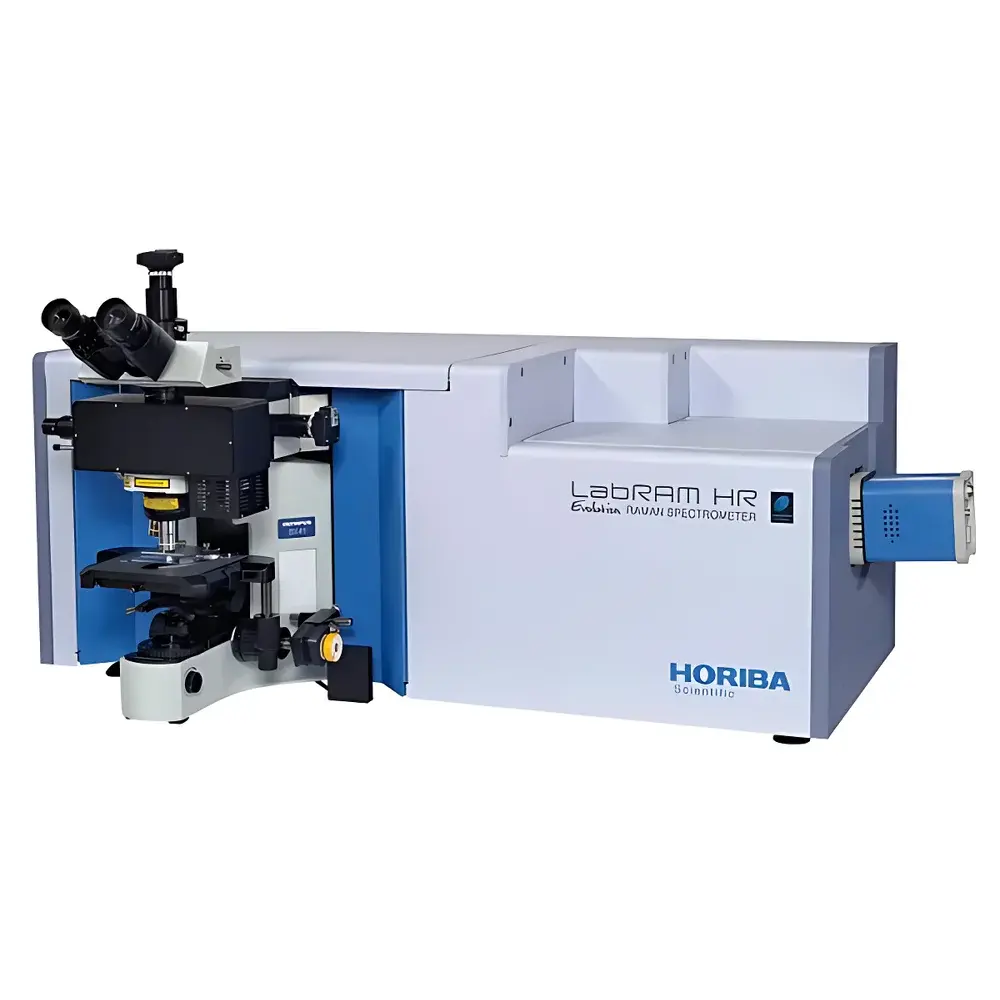
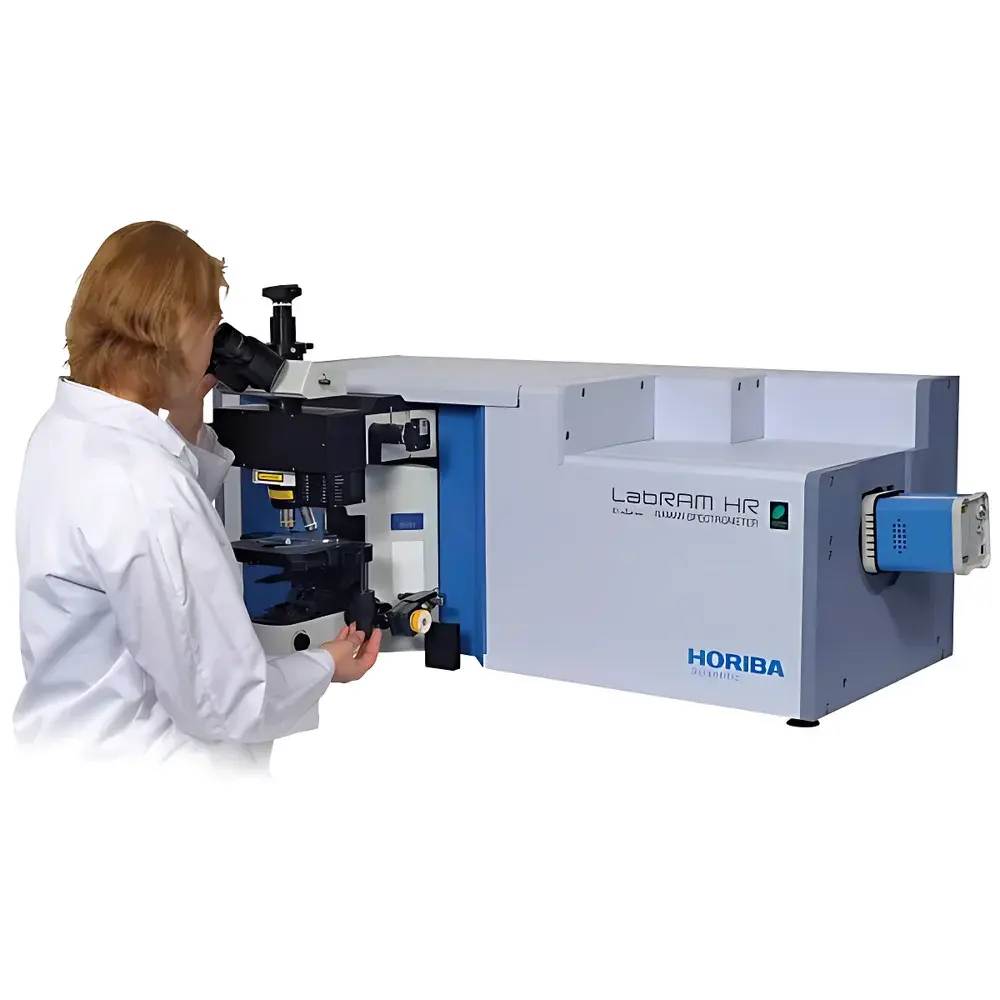
HORIBA LabRAM HR Evolution High-Resolution Confocal Raman Spectrometer
| Brand | HORIBA |
|---|---|
| Origin | France |
| Model | LabRAM HR Evolution |
| Instrument Type | Confocal Micro-Raman Spectrometer |
| Spectral Range | 100–4000 cm⁻¹ |
| Spectral Resolution | 0.6 cm⁻¹ |
| Spatial Resolution | 400 nm |
| Low-Wavenumber Limit | 10 cm⁻¹ |
| Spectral Reproducibility | ±0.2 cm⁻¹ |
| Focal Length | 800 mm |
| Excitation Wavelength Range | 200–2100 nm |
| Detector | Research-Grade Air-Cooled Large-Format CCD |
| Optical Design | Achromatic Flat-Field Spectrograph |
Overview
The HORIBA LabRAM HR Evolution is a research-grade confocal micro-Raman spectrometer engineered for maximum spectral fidelity, spatial precision, and operational flexibility in both academic and industrial analytical laboratories. Based on the proven single-stage Czerny–Turner spectrograph architecture with an 800 mm focal length, it delivers exceptional optical throughput and wavelength-independent resolution across the full excitation range (200–2100 nm). Its core measurement principle relies on inelastic light scattering—where monochromatic laser photons interact with molecular vibrational modes—enabling non-destructive, label-free chemical identification and structural characterization at sub-micron spatial scales. The system integrates true confocal microscopy optics with motorized XYZ stage control, enabling depth-resolved spectral acquisition and high-fidelity 2D/3D Raman mapping. Designed for compliance with rigorous scientific workflows, the HR Evolution supports traceable calibration protocols aligned with ISO/IEC 17025 requirements for spectral instrument validation.
Key Features
- Ultra-high spectral resolution of ≤0.6 cm⁻¹ (FWHM) maintained across all grating configurations and excitation wavelengths
- True confocal optical design with adjustable pinhole aperture for precise depth sectioning and rejection of out-of-focus signal
- Dual-beam path architecture enabling seamless, software-controlled switching between UV and VIS/NIR excitation without realignment or recalibration
- Automated grating and filter turret with up to three synchronized detectors (e.g., back-illuminated CCD, EMCCD, InGaAs) for multimodal detection (Raman, photoluminescence, fluorescence)
- Extended low-wavenumber capability down to 10 cm⁻¹ using optimized notch filters and ultra-stable interferometric alignment
- Motorized high-precision XYZ stage with sub-100 nm step resolution and closed-loop feedback for reproducible micro-mapping
- Integrated laser power attenuation via calibrated neutral density wheels, supporting quantitative intensity normalization per ASTM E1840
Sample Compatibility & Compliance
The LabRAM HR Evolution accommodates diverse sample geometries—from bulk solids and thin films to biological tissues, polymers, and nanomaterials—via interchangeable microscope configurations (upright, inverted, or open-frame). Optional environmental stages (cryo, heating, humidity-controlled) enable in situ and operando measurements under regulated thermal conditions (−190 °C to +600 °C). All hardware and software components comply with CE, RoHS, and IEC 61000-6-3 electromagnetic compatibility standards. For regulated environments, LabSpec 6 supports audit trails, electronic signatures, and user-access-level controls compliant with FDA 21 CFR Part 11 and EU Annex 11 when deployed under GLP/GMP frameworks.
Software & Data Management
LabSpec 6 serves as the unified platform for instrument control, spectral acquisition, and advanced data analysis. It features modular chemometric tools—including multivariate curve resolution (MCR), principal component analysis (PCA), and cluster analysis—for unsupervised spectral classification. Fluorescence background subtraction employs iterative polynomial fitting and morphological filtering algorithms validated against NIST SRM 2241 reference spectra. Automated particle search functionality identifies spectral outliers within large-area maps using intensity variance and peak-shape metrics. Raw and processed data are stored in vendor-neutral HDF5 format with embedded metadata (excitation wavelength, grating, objective, integration time), ensuring FAIR (Findable, Accessible, Interoperable, Reusable) data principles. Batch processing scripts support Python API integration for laboratory information management system (LIMS) synchronization.
Applications
This system is routinely deployed in materials science for phase distribution mapping in battery cathodes, stress/strain profiling in semiconductor heterostructures, and defect characterization in 2D transition metal dichalcogenides. In life sciences, it enables label-free histopathological differentiation of tumor margins based on collagen/lipid/protein Raman signatures. Geochemical labs utilize its low-wavenumber performance for mineral fingerprinting (e.g., quartz vs. cristobalite) and fluid inclusion analysis. Catalysis researchers apply time-resolved Raman imaging to monitor surface adsorbate dynamics during reaction cycles. Its compatibility with AFM, SEM, and nano-FTIR platforms further extends correlative multimodal analysis capabilities beyond standalone spectroscopy.
FAQ
What excitation wavelengths are supported?
The system accepts continuous-wave lasers from 200 nm (deep UV) to 2100 nm (short-wave IR), with automatic alignment compensation for each line.
Can the HR Evolution perform resonance Raman measurements?
Yes—its broad excitation coverage and tunable laser coupling allow optimization of resonance enhancement for specific chromophores (e.g., heme proteins, conjugated polymers).
Is vacuum or purged operation required for low-wavenumber work?
No—mechanical stability and optimized optical coatings eliminate the need for environmental purging below 100 cm⁻¹; however, optional purge ports are available for extended stability in humid environments.
How is spectral calibration verified and maintained?
Built-in neon/argon lamp references enable daily automated wavelength calibration; NIST-traceable polystyrene and silicon standards support intensity and resolution verification per ISO 17830.
Does LabSpec 6 support third-party spectral libraries?
Yes—it imports and searches commercial (e.g., KnowItAll®, BioRad) and custom-built libraries in JCAMP-DX format, with configurable matching thresholds and spectral preprocessing options.





