
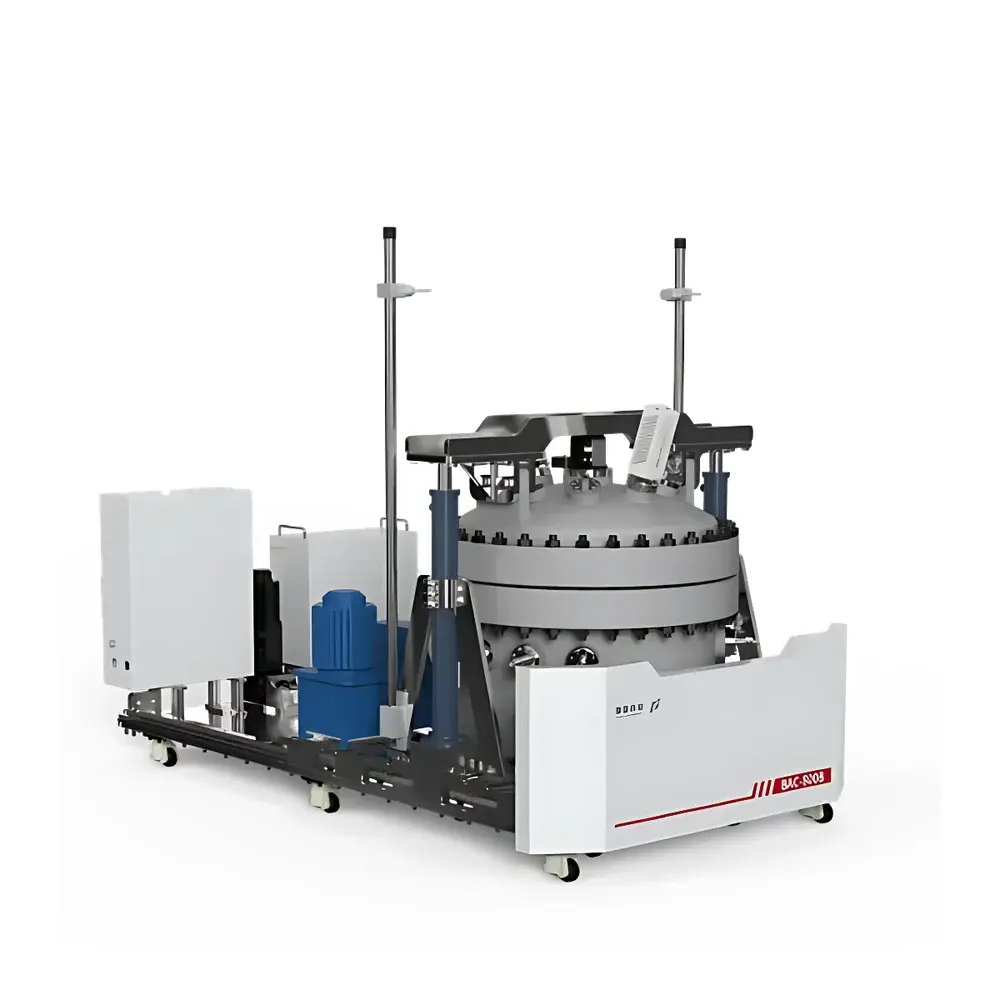
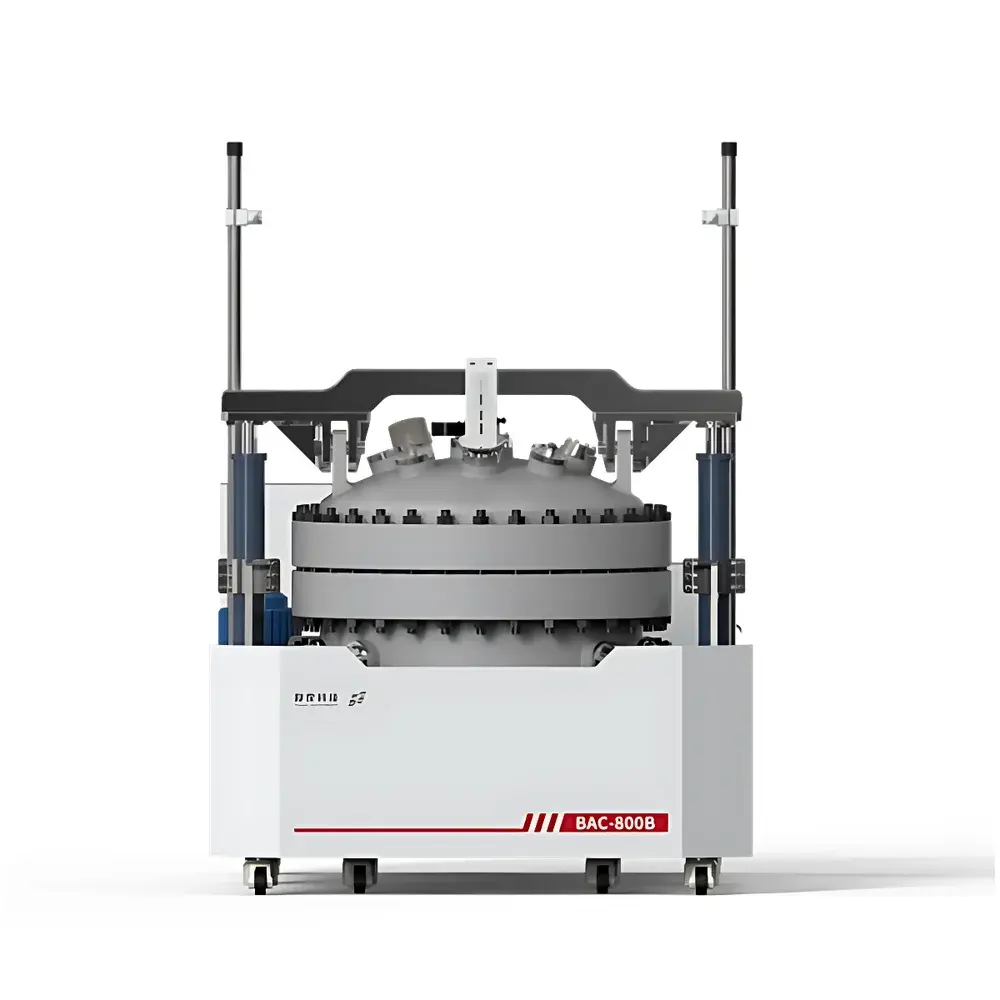
Young Instruments BAC-800B Large-Scale Battery Adiabatic Calorimeter for Thermal Runaway and Gas Evolution Testing
| Brand | Young Instruments |
|---|---|
| Origin | Zhejiang, China |
| Manufacturer Type | Manufacturer |
| Origin Category | Domestic |
| Model | BAC-800B |
| Measurement Mode | Adiabatic Calorimetry |
| Instrument Type | Accelerating Rate Calorimeter (ARC) |
| Adiabatic Chamber Internal Dimensions | Ø800 mm × 520 mm depth |
| Self-Heating Detection Sensitivity | <0.02 °C/min |
| Wall–Sample Temperature Difference | ≤1 °C |
| Temperature Control Range | RT to 300 °C (with optional low-temp module: –40 °C to 300 °C |
| Pressure Range | 0–2 MPa |
| Temperature Tracking Rate | 0.02–15 °C/min |
| Nail Penetration Max Stroke | Software-Configurable |
| Current Handling Capacity (Charge/Discharge Electrodes) | ±1000 A |
| Compliance Standards | GB/T 36276–2023, UL 9540A, SAE J2464–2009, ASTM E1981–98(2012), SN/T 3078.1–2012, UL 1973, SAND99-0497, FreedomCAR SAND2005-3123 |
Overview
The Young Instruments BAC-800B is a large-scale, high-fidelity adiabatic calorimeter engineered specifically for the thermal safety evaluation of prismatic and pouch lithium-ion battery cells with dimensions up to 900 mm in length, as well as small-format battery modules. Operating on the principle of heat-wait-search (HWS) and dynamic adiabatic tracking, the BAC-800B maintains near-zero heat exchange between sample and environment—enabling precise quantification of self-heating onset, adiabatic temperature rise rate (dT/dt)ad, time-to-thermal-runaway (TTR), maximum self-heating rate, and total adiabatic temperature rise (ΔTad). Its integrated pressure-rated chamber (up to 2 MPa) and real-time gas volume monitoring capability allow concurrent measurement of gas evolution kinetics—including cumulative gas volume, gas generation rate, and composition-dependent thermal feedback—during electrochemical abuse events such as overcharge, external heating, nail penetration, or internal short circuit.
Key Features
- High-sensitivity adiabatic control: Achieves wall–sample temperature differentials ≤1 °C and self-heating detection threshold <0.02 °C/min—exceeding the sensitivity requirement specified in GB/T 36276–2023 and UL 9540A for early-stage exotherm detection.
- Large-volume adiabatic chamber: Internal cavity diameter of 800 mm and depth of 520 mm accommodates full-size EV and grid-scale battery cells (100–900 mm length), eliminating geometric scaling artifacts common in smaller ARC systems.
- Integrated electrochemical interface: Dual ±1000 A current-capable feedthroughs enable synchronized charge/discharge cycling during calorimetric testing—supporting combined electrothermal characterization under realistic operating conditions.
- Multi-layer safety architecture: Includes rupture disc, spring-loaded pressure relief valve, redundant temperature/pressure sensors, and programmable alarm logic for overtemperature, overpressure, electrical fault, and thermal runaway—fully compliant with IEC 62619 and UL 1973 mechanical safety requirements.
- Low-temperature operation: Optional cryogenic module extends operational range to –40 °C, enabling quantitative assessment of low-temperature charge heat generation, specific heat capacity (Cp) variation, and cold-start thermal stability per SAE J2464 and ASTM E1981 protocols.
- Thermal runaway–gas evolution correlation: Unique dual-sensor fusion algorithm synchronizes calorimetric data (heat flow, dT/dt) with volumetric gas accumulation (via calibrated pressure–volume–temperature modeling), delivering time-resolved thermal–chemical coupling metrics critical for vent gas flammability modeling and fire propagation analysis.
Sample Compatibility & Compliance
The BAC-800B supports standardized thermal abuse testing of single-cell and small-module configurations per major international battery safety standards. It is validated for use in compliance-driven environments requiring traceable, auditable test records—including GLP and GMP-aligned laboratories. Test methods implemented align directly with: GB/T 36276–2023 Clause 7.3.2 (adiabatic temperature rise), UL 9540A Section 8 (cell-level thermal runaway propagation), SAE J2464–2009 Section 4.4.2 (thermal stability), ASTM E1981–98(2012) (accelerating rate calorimetry), SN/T 3078.1–2012 (chemical thermal stability screening), and SAND99-0497 (thermal abuse protocol for Li-ion systems). All calibration procedures follow ISO/IEC 17025–2017 principles, and system validation reports include uncertainty budgets for temperature, pressure, and time measurements.
Software & Data Management
Control and analysis are performed via Young Instruments’ proprietary CALORIS™ software suite, designed for regulatory-grade data integrity. The platform provides full 21 CFR Part 11 compliance—including electronic signatures, audit trails, role-based access control, and immutable raw data archiving. Real-time visualization includes synchronized plots of temperature, pressure, voltage, current, and calculated heat flow. Post-test analysis modules support automatic onset temperature detection (ASTM E698), kinetic parameter extraction (Ea, A), gas evolution curve fitting (first-order decomposition models), and comparative benchmarking against reference cell datasets. Export formats include CSV, PDF test reports, and XML metadata compliant with ISA-88/ISA-95 data exchange frameworks.
Applications
- Quantitative determination of thermal runaway initiation temperature (Tonset) and critical self-heating rate thresholds under adiabatic conditions.
- Measurement of specific heat capacity (Cp) across wide temperature ranges (–40 °C to 300 °C) using modulated heating protocols.
- Gas generation profiling during thermal runaway—total evolved volume, time-resolved generation rate, and pressure-dependent venting dynamics.
- Electrothermal coupling analysis: heat generation during constant-current charge/discharge at subzero temperatures, including coulombic inefficiency-derived heat contributions.
- Validation of battery management system (BMS) thermal protection algorithms using experimentally derived dT/dt and ΔTad boundary conditions.
- Supporting FMEA and hazard analysis (e.g., HAZOP) for battery pack design by providing empirically derived thermal failure envelopes.
FAQ
What battery formats can be tested in the BAC-800B?
The instrument accommodates prismatic, pouch, and cylindrical cells with maximum linear dimension up to 900 mm, including full-length EV traction battery cells and 2–4 cell modules. Custom fixtures are available for mechanical stabilization and uniform thermal contact.
Does the system support automated nail penetration testing?
Yes—the BAC-800B integrates a programmable linear actuator with adjustable stroke depth, speed, and dwell time. Penetration parameters are fully synchronized with calorimetric data acquisition and logged with microsecond timestamp alignment.
Is the gas evolution measurement quantitative and traceable?
Gas volume is calculated in real time from chamber pressure, temperature, and known headspace volume using the ideal gas law with compressibility correction. Calibration is traceable to NIST-standard pressure transducers and platinum resistance thermometers (PRTs).
Can the BAC-800B operate unattended for extended tests?
Yes—system firmware includes watchdog timers, hardware interlocks, and remote monitoring via Ethernet. All safety-critical events trigger automatic shutdown and local/remote alerting via email/SMS gateway integration.
How is data integrity ensured for regulatory submissions?
CALORIS™ enforces ALCOA+ principles (Attributable, Legible, Contemporaneous, Original, Accurate, Complete, Consistent, Enduring, Available). Audit trails record every user action, parameter change, and instrument state transition with digital signature and timestamp.



