
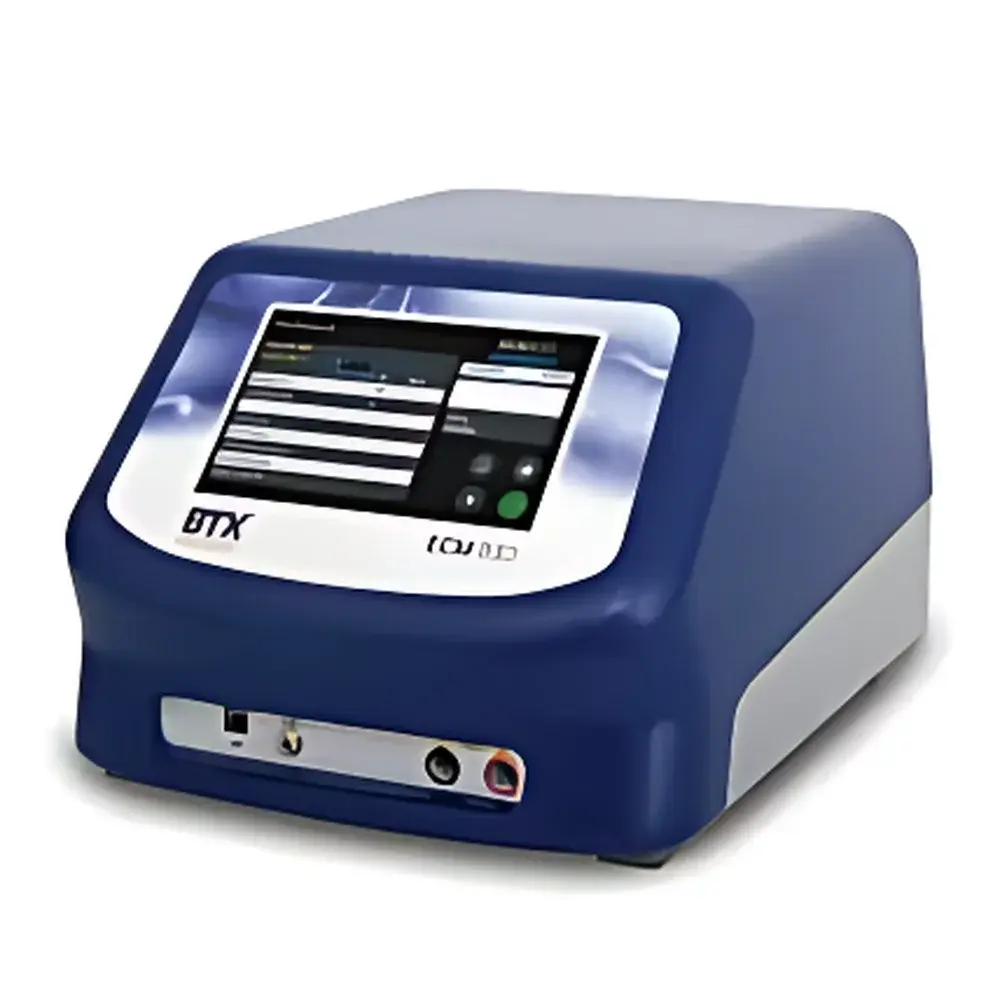
BTX ECM 830 Square Wave Electroporator
| Brand | BTX |
|---|---|
| Origin | USA |
| Model | ECM 830 |
| High Voltage Range | 505–3000 V |
| Low Voltage Range | 5–500 V |
| Pulse Duration | 10 ms–10 s |
| Capacitance | 111 µF |
| Resistance | 25 Ω |
Overview
The BTX ECM 830 Square Wave Electroporator is a precision-engineered, laboratory-grade electroporation system designed for reproducible, high-efficiency delivery of nucleic acids, proteins, and small molecules into diverse biological systems. Operating on the principle of controlled square-wave pulse delivery—characterized by rapid voltage rise/fall times and precisely defined amplitude, duration, and number of pulses—the ECM 830 enables transient membrane permeabilization without excessive thermal or electrochemical damage. Its dual-range voltage architecture (5–500 V for sensitive primary cells and tissues; 505–3000 V for robust applications such as bacterial transformation or plant protoplast electroporation) supports both in vitro and in vivo protocols across mammalian, zebrafish, plant, microbial, and embryonic models. Engineered for compliance with standard biosafety and electrical safety requirements (IEC 61010-1), the system integrates real-time impedance monitoring to ensure consistent field strength delivery across variable sample resistances.
Key Features
- Dual-voltage architecture: Independent high-voltage (505–3000 V) and low-voltage (5–500 V) modes optimized for cell-type-specific electroporation efficiency and viability.
- Pulse flexibility: Programmable square-wave pulses with adjustable amplitude, duration (10 ms–10 s), and repetition count (1–99 pulses per program).
- Intelligent impedance validation: Pre-pulse resistance measurement (25 Ω fixed internal resistance + sample-dependent load) ensures accurate field strength calculation (V/cm) prior to energy delivery.
- Integrated arc suppression and over-current termination: Automatic pulse interruption upon detection of arcing or current surge, protecting both samples and electrodes.
- Large memory capacity: Stores >80 pre-validated protocols for common cell lines (e.g., HEK293, CHO, Jurkat, primary T cells) and up to 1,000 user-defined programs.
- 7-inch capacitive touchscreen interface: Intuitive navigation with graphical parameter entry, real-time status feedback, and timestamped experimental log files—including applied voltage, capacitance, pulse count, measured resistance, and operator ID.
Sample Compatibility & Compliance
The ECM 830 supports broad sample compatibility via BTX’s modular electrode ecosystem—including parallel-plate cuvettes (0.1–4 mm gap), needle array electrodes for in vivo tissue targeting (e.g., mouse muscle, zebrafish embryo yolk), microelectrodes for single-cell manipulation, and multi-well electroporation plates (25- and 96-well formats). It is routinely employed under GLP-aligned workflows for preclinical gene delivery studies and conforms to essential regulatory expectations for instrument traceability: full audit trail logging (per FDA 21 CFR Part 11 principles), parameter locking for SOP-controlled runs, and hardware-level calibration verification. While not certified for clinical use, its design aligns with ISO 13485 risk management frameworks for research-grade life science instrumentation.
Software & Data Management
All experimental parameters and outcomes are stored locally in non-volatile memory with automatic timestamping and operator tagging. Log files export in CSV format for integration with LIMS or statistical analysis platforms (e.g., GraphPad Prism, Python pandas). No proprietary software installation is required—the embedded firmware provides full control and documentation autonomy. For laboratories requiring centralized data governance, optional BTX Connect™ SDK enables API-based protocol synchronization and remote monitoring via Ethernet or USB host connection—supporting automated reporting in ISO/IEC 17025-compliant quality systems.
Applications
- Mammalian cell transfection: High-efficiency plasmid DNA, siRNA, and CRISPR RNP delivery into suspension and adherent lines, including hard-to-transfect primary cells.
- In vivo and ex vivo electroporation: Targeted gene expression or silencing in rodent skeletal muscle, skin, liver, and developing zebrafish embryos using minimally invasive electrode configurations.
- Plant biotechnology: Protoplast transformation and somatic hybridization in Arabidopsis, rice, and tobacco; regeneration-compatible protocols validated for callus and suspension cultures.
- Microbial transformation: Electrocompetent E. coli, Bacillus subtilis, Pseudomonas, and yeast (S. cerevisiae, P. pastoris) with optimized recovery protocols.
- High-throughput screening: Parallel electroporation in 25- and 96-well plate formats for functional genomics, drug uptake assays, and toxicity profiling.
FAQ
What safety certifications does the ECM 830 meet?
The ECM 830 complies with IEC 61010-1 for electrical safety in laboratory equipment and includes redundant hardware interlocks, arc detection circuitry, and isolated output stages.
Can the ECM 830 be used for CRISPR-Cas9 RNP delivery?
Yes—its precise square-wave timing and low-voltage mode enable high-fidelity RNP electroporation into primary T cells, iPSCs, and hematopoietic stem cells with minimal off-target effects.
Is impedance compensation automatic during pulse delivery?
The system measures sample resistance immediately before each pulse train and adjusts delivered energy accordingly; however, it does not dynamically adjust mid-pulse due to inherent square-wave waveform constraints.
How is calibration maintained over time?
Voltage and timing accuracy are factory-calibrated against NIST-traceable standards; users may perform periodic verification using external high-voltage probes and oscilloscopes per BTX’s recommended maintenance schedule.
Does the ECM 830 support pulse trains with variable amplitudes?
No—it delivers uniform-amplitude square waves within a given program; multi-step protocols require sequential program execution or external triggering via TTL input.
Related Products





