
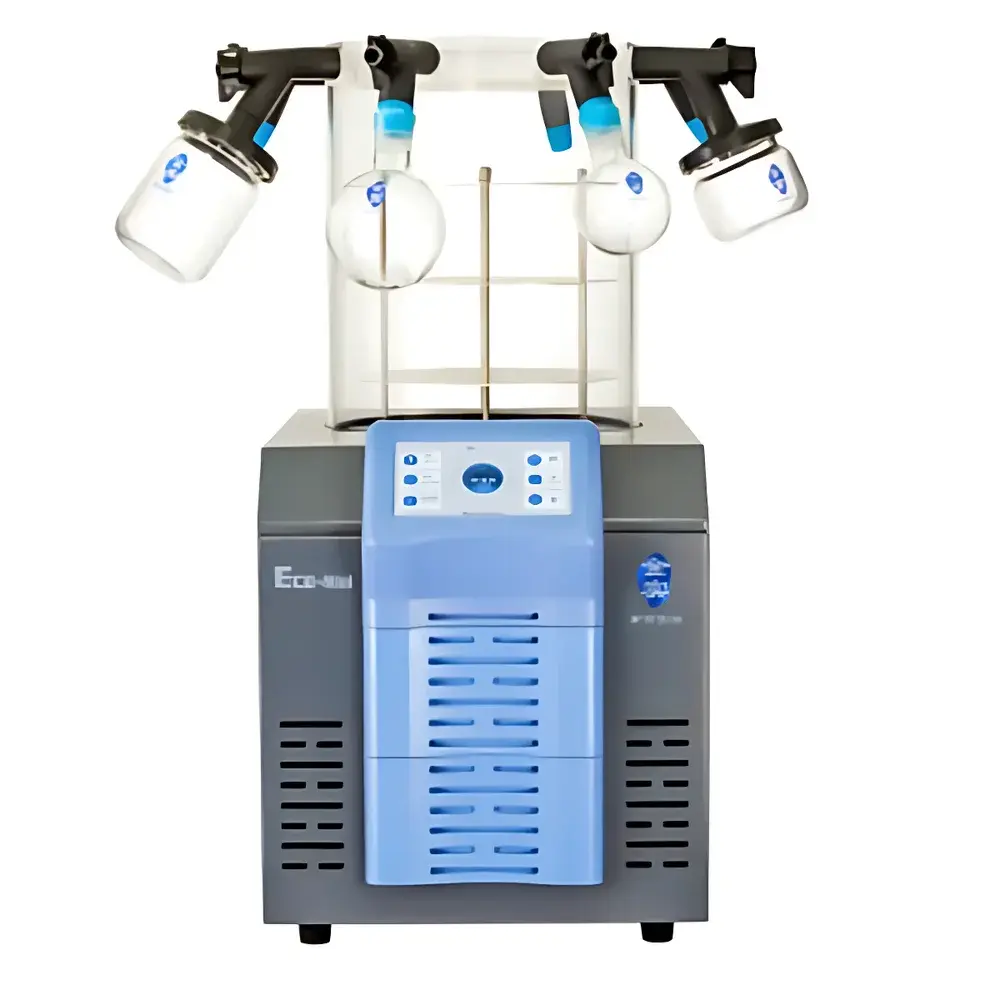
Goldstar Instruments ECO mini Freeze Dryer
| Brand | Goldstar Instruments |
|---|---|
| Origin | Jiangsu, China |
| Manufacturer Type | Authorized Distributor |
| Country of Origin | China |
| Model | ECO mini |
| Instrument Type | Manifold-Style Freeze Dryer |
| Application | Laboratory-Scale Lyophilization |
| Shelf Area | 0.16 m² |
| Ultimate Vacuum | 0.1 Pa |
| Condensate Capacity (24 h) | 4 kg |
| Cold Trap Temperature | −60 °C |
| Dimensions (W×D×H) | 420 mm × 550 mm × 440 mm |
| Display | 7-inch LCD Touchscreen |
| Shelf Diameter | 260 mm |
| Number of Shelves | 3 |
| Manifold Ports | 8 |
| Defrost Method | Natural Thawing |
| Power Consumption | 0.75 kW |
| Net Weight | 47 kg |
Overview
The Goldstar Instruments ECO mini Freeze Dryer is a compact, benchtop manifold-style lyophilization system engineered for precision, reproducibility, and operational simplicity in academic, pharmaceutical, and analytical laboratories. It operates on the fundamental principle of sublimation—removing water from frozen samples under deep vacuum while maintaining product integrity, structural stability, and biological activity. Designed for small-batch processing, the ECO mini integrates a high-efficiency −60 °C cold trap, a robust vacuum system capable of achieving ≤0.1 Pa ultimate pressure, and thermally optimized stainless-steel shelves with uniform temperature distribution. Its 0.16 m² total shelf area—achieved via three 260 mm-diameter aluminum shelves—provides 70% greater surface area than conventional 200 mm configurations, significantly improving throughput without compromising thermal homogeneity or process control.
Key Features
- Three independently heated/cooled shelves (Ø260 mm), each precisely temperature-controlled to ensure consistent freezing and primary drying profiles across all layers.
- Eight universal manifold ports compatible with standard 15-mm, 24-mm, and 29-mm neck freeze-drying flasks, as well as custom adapters for serum vials, wide-mouth bottles, and 15-port ampoule racks.
- 7-inch high-resolution capacitive touchscreen interface with intuitive navigation, real-time graphical display of vacuum pressure, cold trap temperature, shelf temperature, and elapsed time.
- Integrated vacuum monitoring and automatic pressure regulation via a dual-stage rotary vane pump (not included) — supports optional vacuum gauge calibration per ISO 27874 and ASTM F2338 standards.
- Stainless-steel condenser chamber with optimized fin geometry and direct-coupled refrigeration circuit for rapid ice capture and minimal thermal lag.
- Energy-efficient design compliant with IEC 61000-3-2 harmonic emission limits; power input stabilized at 0.75 kW for continuous 24-hour operation.
Sample Compatibility & Compliance
The ECO mini accommodates diverse sample formats—including aqueous solutions, protein formulations, microbial cultures, botanical extracts, and diagnostic reagents—across volumes ranging from 5 mL to 500 mL per flask. Its manifold architecture enables simultaneous drying of heterogeneous sample types without cross-contamination. The system meets essential safety and performance benchmarks for laboratory-grade freeze dryers: EN 61010-1 (electrical safety), EN 61326-1 (EMC), and ISO 13485-aligned documentation support for QMS integration. While not certified for GMP manufacturing, its data logging capability, user-accessible calibration logs, and audit-ready parameter history make it suitable for GLP-compliant research, method development, and pre-formulation studies subject to FDA 21 CFR Part 11 readiness when paired with validated software.
Software & Data Management
Data acquisition is performed via embedded firmware with timestamped storage of all critical process variables (vacuum level, shelf temp, trap temp, runtime) onto internal flash memory (≥10,000-cycle endurance). Export is supported via USB 2.0 to CSV format for post-processing in Excel, MATLAB, or statistical analysis platforms. Optional PC-based Goldstar Control Suite (v3.2+) provides remote monitoring, multi-unit fleet management, alarm notification via SMTP/email, and electronic signature-enabled batch record generation aligned with ALCOA+ principles. All stored data retain immutable timestamps and operator ID tagging where enabled—facilitating traceability during internal audits or regulatory inspections.
Applications
- Stabilization of heat-labile biologics (e.g., monoclonal antibodies, enzymes, vaccines) prior to long-term storage or transport.
- Routine dehydration of bacterial and fungal cultures for strain preservation in microbiology and fermentation labs.
- Preparation of reference standards and calibration materials for HPLC, GC-MS, and elemental analysis workflows.
- Processing of natural product extracts (e.g., polyphenols, terpenoids) where solvent removal must avoid thermal degradation.
- Development of lyophilized assay kits, lateral flow reagents, and point-of-care diagnostics requiring shelf-stable solid-phase components.
- Teaching laboratories: ideal for demonstrating phase diagrams, mass transfer kinetics, and critical formulation parameters such as collapse temperature (Tc) and eutectic melting point (Te).
FAQ
What vacuum pump is recommended for optimal performance?
A two-stage oil-sealed rotary vane pump rated ≥4 m³/h at 50 Hz, equipped with a gas ballast valve and cold trap filter, is recommended to achieve and sustain ≤0.1 Pa.
Can the ECO mini be used for sterile processing?
No—it lacks ISO Class 5 cleanroom-rated construction, HEPA filtration, or SIP/CIP functionality. Sterile applications require additional containment (e.g., laminar flow hood integration) and validation per ISO 14644.
Is shelf temperature programmable during primary and secondary drying?
Yes—users can define up to six ramp/soak segments per cycle, with resolution of ±0.1 °C and ramp rates adjustable between 0.1–5.0 °C/min.
Does the system support external temperature probes for product monitoring?
Yes—two PT100 inputs are provided for real-time product temperature tracking using calibrated thermocouples or resistance probes placed directly in vials.
What maintenance intervals are specified for the refrigeration system?
Compressor oil and refrigerant charge require verification every 24 months; cold trap O-rings and vacuum seal gaskets should be inspected and replaced annually per preventive maintenance log.



