
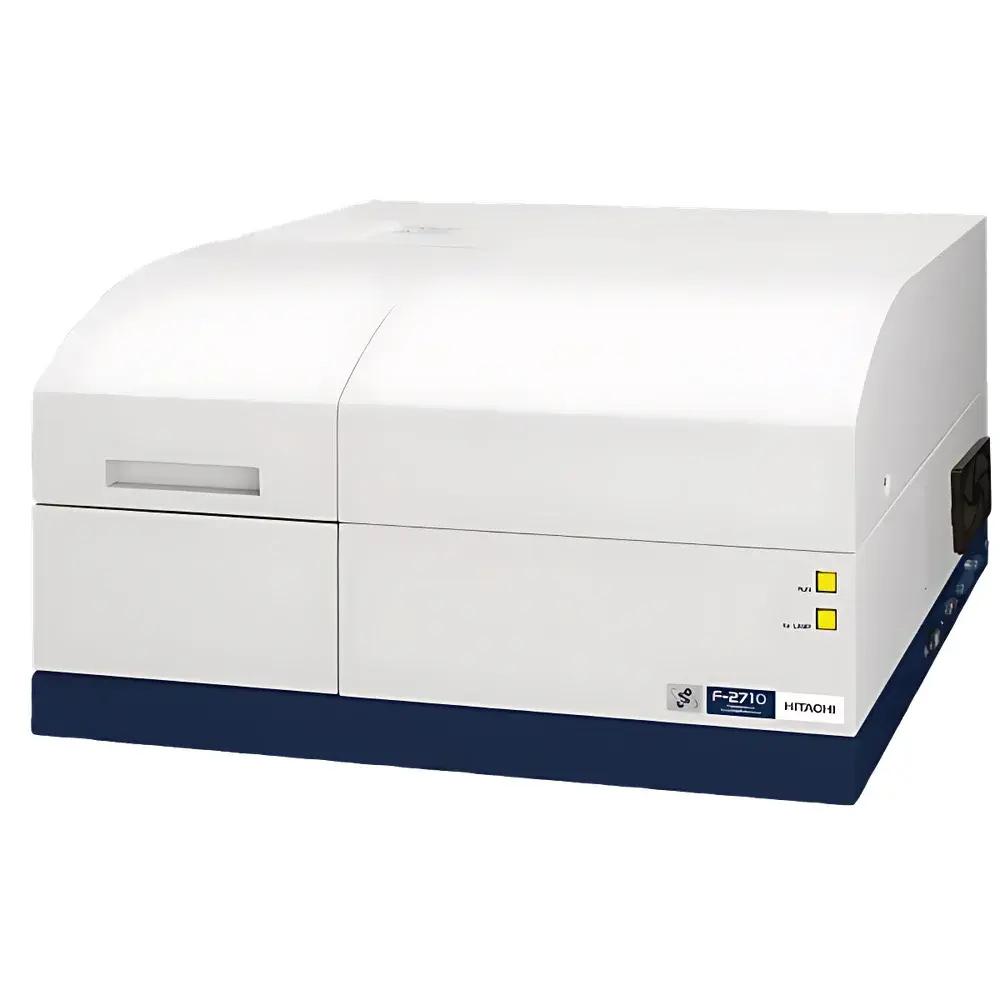
Hitachi F-2710 Fluorescence Spectrophotometer
| Brand | Hitachi |
|---|---|
| Origin | Japan |
| Manufacturer Type | Original Equipment Manufacturer (OEM) |
| Instrument Type | Steady-State Fluorescence Spectrometer |
| Excitation Source | Xenon Arc Lamp |
| Monochromator | Grating-Based |
| Slit Width (Spectral Bandpass) | 2.5–20 nm |
| Sensitivity (S/N Ratio, RMS) | ≥1000:1 |
| Lamp Lifetime | 2500 h |
| Dynamic Range | ~6 decades |
| Accessories | >30 optional modules including solid-sample holders, temperature-controlled cuvette holders, polarization kits, and quantum yield accessories |
Overview
The Hitachi F-2710 Fluorescence Spectrophotometer is a high-performance steady-state molecular fluorescence spectrometer engineered for precision quantitative and qualitative analysis of fluorescent species across research, quality control, and regulatory environments. Based on the principle of photoluminescence excitation and emission detection, the instrument employs a high-intensity, pulsed xenon arc lamp as its excitation source—delivering broad spectral coverage (typically 200–900 nm) with stable output and minimal thermal drift. Light is dispersed via precision blazed gratings in both excitation and emission monochromators, enabling accurate wavelength selection and high spectral resolution. The optical path incorporates optimized signal-to-noise architecture—including low-noise PMT detection, digital lock-in amplification, and real-time background subtraction—ensuring robust performance even at trace analyte concentrations. Designed for reproducibility and long-term stability, the F-2710 meets foundational requirements for method validation under ISO/IEC 17025 and supports alignment with USP , ICH Q2(R2), and ASTM E2882–22 guidelines for fluorescence-based assays.
Key Features
- Enhanced sensitivity: Signal-to-noise ratio (RMS) ≥1000:1, representing a 1.2× improvement over the predecessor F-2700 model; peak-to-peak S/N ≥300 under standardized quinine sulfate conditions.
- Extended lamp lifetime: Integrated long-life xenon lamp rated for 2500 hours of operational use—five times the service life of the F-2700’s lamp—reducing downtime and recalibration frequency.
- Adjustable spectral resolution: Slit width continuously variable from 2.5 nm to 20 nm, permitting optimization between sensitivity and spectral fidelity based on sample matrix and analytical objective.
- Modular optical design: Front-panel accessible monochromators, interchangeable detectors (e.g., red-sensitive PMT), and standardized optical interfaces facilitate field upgrades and maintenance.
- Thermal and mechanical stability: Precision-machined aluminum optical bench with passive temperature compensation minimizes wavelength drift (<0.05 nm/h at 25 °C ambient).
Sample Compatibility & Compliance
The F-2710 accommodates standard 10-mm quartz cuvettes, micro-volume cells (down to 50 µL), solid samples (via reflectance or front-face geometry), and temperature-controlled configurations (−10 to +80 °C with Peltier accessory). It supports compliance-critical workflows through audit-trail-enabled software (optional), electronic signature capability, and configurable user access levels aligned with FDA 21 CFR Part 11 and EU Annex 11 expectations. All measurement protocols adhere to ISO 17025 traceability requirements when operated with NIST-traceable reference standards (e.g., quinine sulfate in 0.1 M H2SO4). Routine verification includes wavelength accuracy (±0.5 nm), photometric linearity (R² > 0.9999 over 0–1000 mAU), and repeatability (RSD < 0.5% for intensity, n = 10).
Software & Data Management
Controlled via Hitachi’s FL Solutions v3.x platform, the system provides intuitive method setup, real-time spectral preview, kinetic acquisition (up to 100 spectra/sec), and multi-dimensional data processing (e.g., synchronous scanning, excitation-emission matrix (EEM) mapping). Raw data are stored in vendor-neutral .CSV and .JWS formats; spectral libraries support user-defined compound identification. Software modules include Quantum Yield Calculator (with integrating sphere compatibility), Polarization Ratio Analyzer, and Time-Zero Correction for kinetic studies. Data integrity safeguards include automatic timestamping, operator ID logging, and immutable audit trails exportable as PDF or XML for GLP/GMP review.
Applications
- Materials Science: Quantitative determination of photoluminescence quantum yield (PLQY) for LED phosphors, perovskite nanocrystals, and OLED emitters; spectral deconvolution of overlapping emission bands using multivariate curve resolution (MCR).
- Life Sciences: Ligand-binding affinity assessment via fluorescence anisotropy; conformational dynamics monitoring of proteins and nucleic acids using intrinsic tryptophan fluorescence; high-throughput screening of enzyme activity using fluorogenic substrates.
- Environmental Analysis: Detection and speciation of polycyclic aromatic hydrocarbons (PAHs), humic substances, and pharmaceutical residues in aqueous matrices at sub-nanomolar levels; dissolved organic matter (DOM) characterization via EEM-PARAFAC modeling.
- Food & Agriculture: Vitamin B2 (riboflavin), vitamin C (indirectly via derivatization), aflatoxin B1, and melamine quantification; authenticity verification of honey and olive oil using native fluorophore fingerprinting.
FAQ
What is the recommended calibration frequency for the F-2710?
We recommend wavelength and photometric calibration every 3 months using certified reference standards, or prior to critical regulatory submissions.
Can the F-2710 perform time-resolved fluorescence measurements?
No—the F-2710 is a steady-state instrument; time-resolved capabilities require the Hitachi F-7100 or F-8100 series with TCSPC modules.
Is quantum yield measurement supported out-of-the-box?
Yes—when paired with the optional integrating sphere accessory (Model ISR-280) and FL Solutions QY module, absolute quantum yield is calculated per ASTM E2620–20.
Does the system comply with 21 CFR Part 11 requirements?
Full compliance is achievable with the optional FL Solutions Secure Edition, which includes role-based access control, electronic signatures, and encrypted audit trail generation.
What maintenance is required for the xenon lamp?
Lamp alignment verification is advised after 500 h; full replacement is recommended at 2500 h or upon observed intensity drop >20% at 280 nm.



