
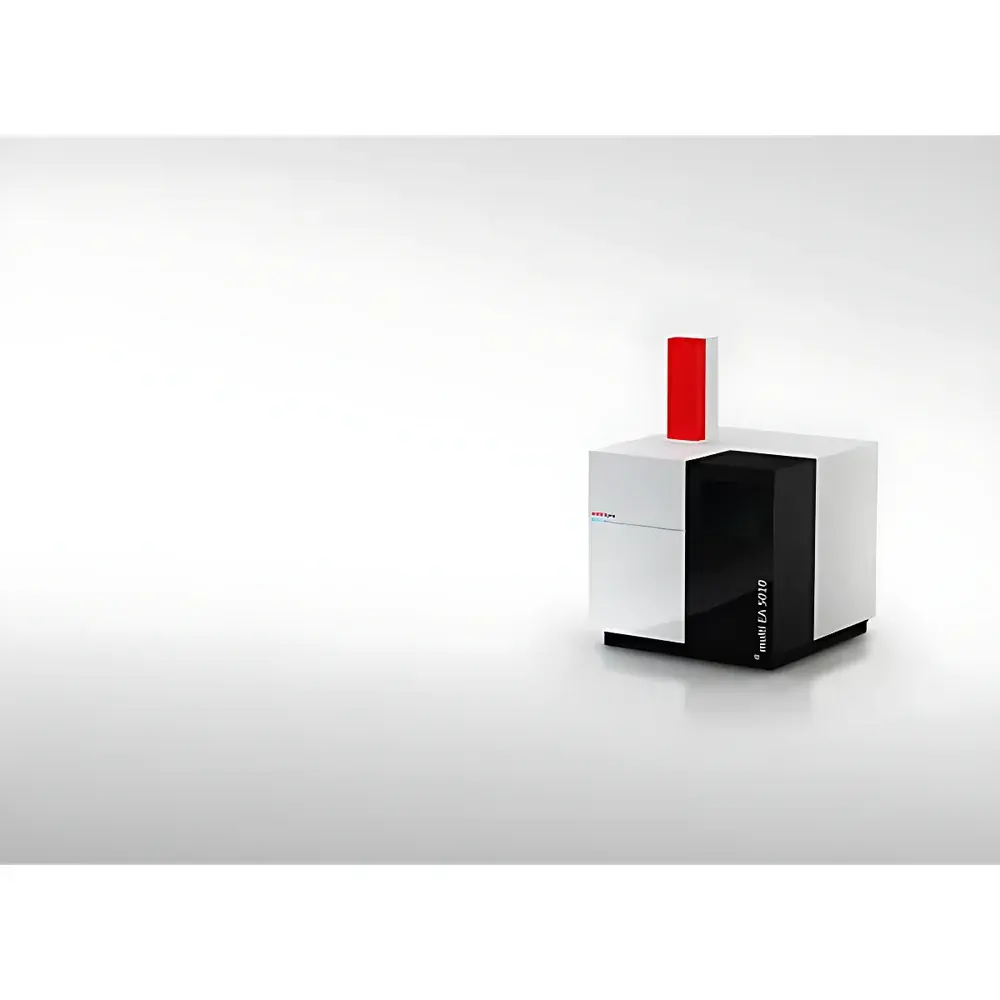
Analytik Jena multi EA 5010 SPMO Carbon, Sulfur, Nitrogen and Chlorine Elemental Analyzer
| Brand | Analytik Jena |
|---|---|
| Origin | Germany |
| Model | multi EA 5010 SPMO |
| Detection Principle | High-Temperature Combustion Coupled with UV-Fluorescence (S), Chemiluminescence (N), IR Absorption (C), and Microcoulometric Titration (Cl) |
| Detection Limits | <0.02 mg/kg (S), <0.05 mg/kg (N), <0.1 mg/kg (C), <0.05 mg/kg (Cl) |
| Sample Forms | Liquids, Gases, Liquefied Petroleum Gas (LPG), Liquefied Natural Gas (LNG), Solids (with optional solid module) |
| Analysis Time | 2–5 min per sample |
| Throughput | Up to 120 samples/day (unattended) |
| Linear Dynamic Range | 4–6 orders of magnitude |
| Compliance | ASTM D5453, D7183, D7039, ISO 20846, ISO 20884, UOP 975, IP 542, EN ISO 14596, USP <233>, FDA 21 CFR Part 11 (with optional audit trail & electronic signature) |
Overview
The Analytik Jena multi EA 5010 SPMO is a fully automated, high-temperature combustion-based elemental analyzer engineered for the simultaneous or independent quantification of carbon (C), sulfur (S), nitrogen (N), and chlorine (Cl) in liquid, gaseous, and liquefied hydrocarbon matrices—including gasoline, diesel, jet fuel, crude oil, LPG, LNG, and refinery process streams. Its core measurement architecture integrates orthogonal detection technologies: ultraviolet fluorescence (UVF) for sulfur, chemiluminescence (CLD) for nitrogen, non-dispersive infrared (NDIR) absorption for carbon, and microcoulometric titration for chlorine—each optimized for trace-level sensitivity and long-term stability. Designed for continuous 24/7 operation in regulated industrial and contract testing laboratories, the system delivers sub-ppb detection capability (e.g., <0.02 mg/kg S in gasoline per ASTM D5453), robust reproducibility (<1.5% RSD at 1 ppm level), and full compliance with global fuel specification standards.
Key Features
- Modular high-temperature combustion furnace (up to 1,150 °C) with ceramic reaction tube and oxygen-controlled oxidation environment for complete sample mineralization
- HiPerSens optical detection modules featuring thermoelectrically cooled photomultiplier tubes and optimized gas-phase reaction cells for enhanced signal-to-noise ratio
- Integrated carrier gas management with automatic pressure regulation, flow monitoring, and leak detection
- 7-inch capacitive touchscreen HMI with intuitive workflow navigation, real-time parameter visualization, and context-sensitive help
- Self-diagnostic system continuously monitors critical parameters—including furnace temperature uniformity, detector baseline drift, gas purity, and reagent consumption—and initiates corrective actions or alerts
- Compact footprint (<0.3 m²) with front-access service design, enabling installation in space-constrained analytical labs or mobile testing units
- Optional solid sample introduction module (multi EA Solid Kit) for catalysts, polymers, and petrochemical solids via controlled pyrolysis and oxygen flash combustion
Sample Compatibility & Compliance
The multi EA 5010 SPMO accommodates a broad range of sample types without matrix-specific hardware modification: volatile liquids (via programmable syringe injection), pressurized gases (using certified gas sampling valves and regulator-integrated manifolds), and cryogenic LNG/LPG (with heated transfer lines and vaporization control). All operational sequences adhere to internationally recognized test methods—including ASTM D5453 (S in light hydrocarbons), ASTM D7183 (N in aromatic hydrocarbons), ASTM D7039 (Cl in middle distillates), ISO 20846 (S in automotive fuels), and UOP 975 (total N in naphthas). System validation protocols support GLP and GMP environments; when configured with optional software modules, it meets FDA 21 CFR Part 11 requirements for electronic records and signatures, including full audit trail, user access control, and data integrity logging.
Software & Data Management
Control and data acquisition are managed through the EA Control Center v4.x software suite—a Windows-based platform compliant with IEC 62443-3-3 for industrial cybersecurity. The software provides method editor functionality for custom calibration curves (linear, quadratic, or multi-point weighted), automatic dilution factor application, and QC flagging based on system suitability criteria (e.g., blank response, recovery standard deviation, peak symmetry). Raw chromatographic and detector signals are stored in vendor-neutral .csv and .xml formats. Integrated LIMS connectivity (via ASTM E1384 or HL7-compliant API) enables bidirectional sample queue synchronization and automated result reporting. Remote diagnostics and firmware updates are supported over secure TLS 1.2 connections, permitting off-site technical support without physical access.
Applications
- Refinery quality assurance: Real-time monitoring of sulfur and nitrogen content in FCC feedstocks, hydrotreated naphthas, and finished transportation fuels
- Environmental compliance testing: Quantification of total organic chlorine in wastewater effluents and soil extracts per EPA Method 9096A
- Petrochemical R&D: Catalyst poisoning studies via low-level Cl and S accumulation analysis in zeolites and metal oxides
- Aviation fuel certification: Verification of ASTM D1655 Annex A1 specifications for total sulfur and thermal stability-related nitrogen compounds
- Contract laboratories: High-throughput screening of biodiesel blends (EN 14214) for residual catalyst metals and halogen contaminants
FAQ
What sample introduction methods are supported for gaseous matrices?
The system uses a precision-machined gas sampling valve with integrated pressure regulation and temperature-controlled transfer lines, compatible with cylinder pressures up to 20 bar and flow rates from 10–100 mL/min.
Can the instrument be validated for ISO/IEC 17025 accreditation?
Yes—the hardware architecture, software validation package (IQ/OQ/PQ documentation), and traceable calibration standards (NIST-traceable SRMs for S, N, and Cl) are designed to fulfill ISO/IEC 17025:2017 clause 5.5 and 5.9 requirements.
Is method transfer possible from legacy multi EA platforms?
All method files (.mth) from multi EA 4000 and 4500 series are backward-compatible; migration tools automatically convert legacy detector gain settings and combustion parameters to SPMO-equivalent configurations.
How is carryover minimized during high-concentration sample analysis?
The system employs dual-stage quartz trap purification, post-combustion scrubbing with Mg(ClO4)2 and Ascarite®, and programmable high-purity oxygen purge cycles between injections—validated to achieve <0.1% carryover at 100 ppm S level.
What maintenance intervals are recommended for routine operation?
Furnace tube inspection every 6 months; UVF lamp replacement every 12 months; CLD ozone generator servicing every 9 months; full system performance verification (SPV) quarterly using certified reference materials.






