
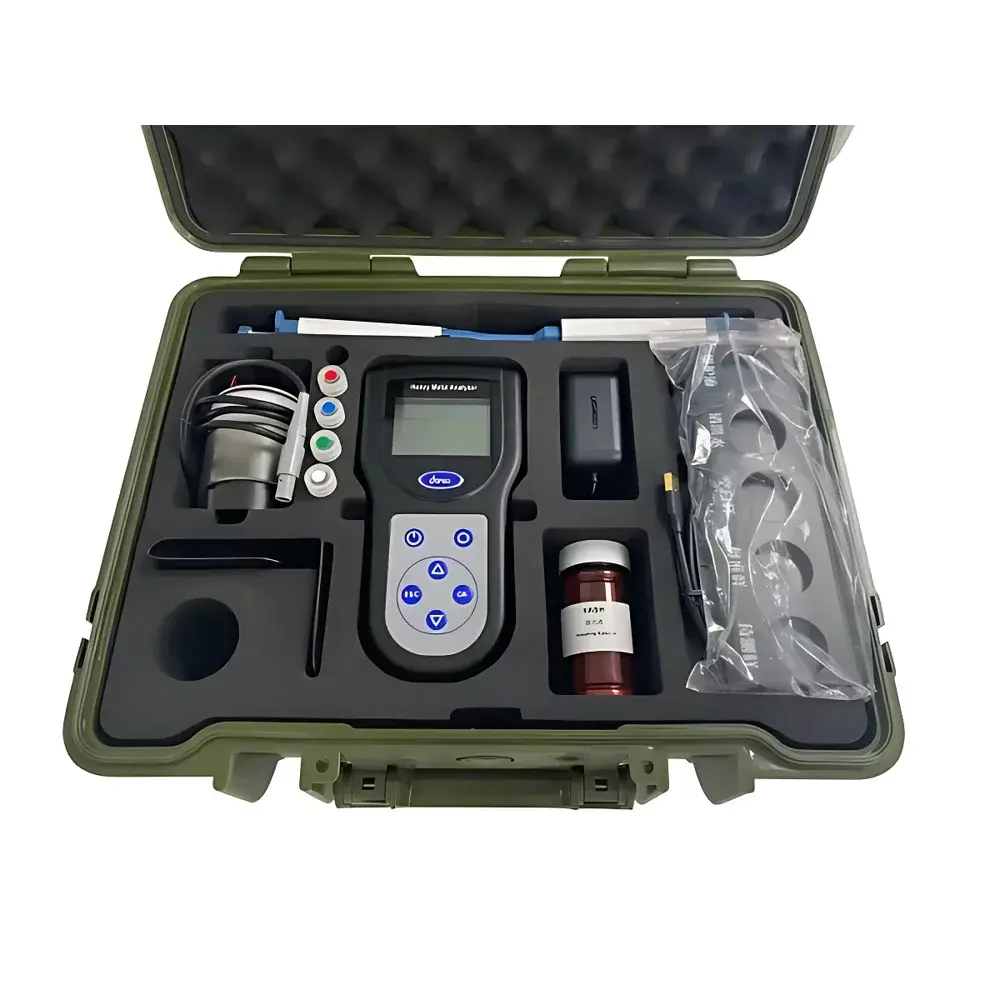
ZYKX PTB-200M Portable Heavy Metals Analyzer for Water Quality
| Brand | ZYKX |
|---|---|
| Origin | Beijing, China |
| Model | PTB-200M |
| Instrument Type | Portable |
| Detection Principle | Anodic Stripping Voltammetry (ASV) + Colorimetry |
| Target Elements | Cu, Cd, Pb, Zn, As, Hg, Mn, Sb, Ni (expandable) |
| Detection Time | ≤5 min per sample |
| Accuracy | RSD ≤2% (at Cd 50 µg/L) |
| Resolution | 1 ppb |
| Detection Limits | ≤0.5 µg/L (ASV mode) |
| Measurement Range (ASV) | 0.1 µg/L – tens of mg/L |
| Measurement Range (Colorimetry) | 0.01–5 mg/L (for Cr(VI), Ni, Mn, Cu, Cr, Pb, Zn, Fe, Co, etc.) |
| Compliance | Aligns with EPA Method 7063, ISO 8692, GB/T 5750.6–2023, and ASTM D3559 |
Overview
The ZYKX PTB-200M Portable Heavy Metals Analyzer is an integrated electrochemical and optical field-deployable instrument engineered for rapid, on-site quantification of toxic heavy metals in diverse aqueous matrices. It combines dual analytical modalities—Anodic Stripping Voltammetry (ASV) for trace-level metal ion detection and standardized colorimetric analysis for redox-active species such as hexavalent chromium (Cr(VI))—within a single, ruggedized platform. ASV leverages controlled electrodeposition and subsequent oxidative stripping to achieve sub-ppb sensitivity for electroactive metals including cadmium, lead, copper, zinc, mercury, arsenic, manganese, antimony, and nickel. The colorimetric module employs validated reagent-based reactions compliant with ISO 6685 (for Cr(VI)) and GB/T 5750.6–2023 (for Ni, Mn, Cu), enabling reliable quantification across regulatory-relevant concentration ranges. Designed for environmental emergency response and routine surveillance, the PTB-200M eliminates the need for centralized lab infrastructure while maintaining metrological integrity suitable for data reporting under national water quality monitoring programs.
Key Features
- Field-ready portable architecture: Weighing under 3.2 kg with integrated rechargeable Li-ion battery (≥8 h operation), enabling full autonomy during remote or mobile deployments.
- Dual-mode detection engine: Simultaneous ASV and colorimetric measurement capability—no hardware swapping required; method selection is software-controlled.
- Low detection limits: ≤0.5 µg/L for Cd, Pb, and Hg via ASV; ≤10 µg/L for Cr(VI) via colorimetry—meeting WHO guideline values and Chinese Class III surface water standards (GB 3838–2002).
- High reproducibility: RSD ≤2% at 50 µg/L Cd standard, verified across 10 consecutive measurements under ambient field conditions (20–30°C, 40–70% RH).
- Minimal sample preparation: Direct analysis of filtered (0.45 µm) water samples; no digestion, dilution, or matrix-matching required for most freshwater and wastewater matrices.
- Pre-calibrated multi-element method library: Factory-loaded ASV waveforms and colorimetric calibration curves for 10+ elements; user-customizable methods supported via firmware update.
Sample Compatibility & Compliance
The PTB-200M is validated for use with surface water, groundwater, seawater (with salinity correction), drinking water, industrial effluents, and stormwater runoff. It accommodates total dissolved metal analysis per EPA Method 1669 and supports speciation workflows—for example, Cr(VI) quantification without interference from Cr(III) due to selective colorimetric chemistry. Instrument performance meets requirements of China’s “Technical Specifications for Monitoring of Heavy Metals in Surface Water” (HJ 493–2019) and aligns with ISO/IEC 17025:2017 principles for field instrumentation. Data output includes audit-trail metadata (operator ID, GPS coordinates, timestamp, temperature, pH if external probe connected), supporting GLP-compliant documentation for regulatory submissions.
Software & Data Management
The embedded Android-based interface provides intuitive touchscreen control, real-time voltammogram visualization, and automatic peak integration using Savitzky-Golay smoothing and derivative-based baseline correction. All measurement data—including raw current-time traces, calibration logs, and QC records—are stored locally in encrypted SQLite format and exportable via USB or Wi-Fi to CSV, PDF, or XML formats compatible with LIMS systems. Firmware supports over-the-air updates and integrates with ZYKX Cloud Platform for centralized fleet management, remote diagnostics, and cross-site method harmonization—essential for multi-laboratory monitoring networks operating under unified QA/QC protocols.
Applications
- Emergency response: Rapid assessment following industrial spills, mining tailings breaches, or flood-related contamination events—results within 5 minutes support immediate risk classification and remediation triage.
- Regulatory compliance monitoring: Routine screening at municipal water intakes, wastewater treatment plant outfalls, and ecological reserve boundaries per national discharge standards (e.g., GB 8978–1996, GB 18918–2002).
- Research & education: Field-based environmental science curricula and graduate-level electroanalytical method development, particularly for ASV optimization in complex matrices.
- Industrial hygiene: On-site verification of effluent pretreatment efficacy in electroplating, battery manufacturing, and pigment production facilities.
- Public health surveillance: Deployment by CDC-affiliated laboratories for drinking water safety audits in rural and peri-urban communities lacking fixed lab access.
FAQ
What sample volume is required for ASV analysis?
Typically 10–20 mL of pre-filtered (0.45 µm) sample; micro-cell configuration supports as little as 5 mL when sample volume is constrained.
Does the instrument require daily recalibration?
No—factory calibration remains stable for ≥30 days under normal field use; daily verification with 10 µg/L Cd/Pb standard is recommended per QA/QC protocols.
Can the PTB-200M distinguish between Cr(III) and Cr(VI)?
Yes—the colorimetric module uses diphenylcarbazide reagent under acidic conditions, which reacts selectively with Cr(VI); Cr(III) shows negligible interference up to 10 mg/L.
Is method validation documentation available for regulatory submission?
Yes—ZYKX provides a full Validation Report (per ISO/IEC 17025 Annex B) including LOD/LOQ, linearity (R² ≥0.999), recovery (96–106%), and inter-instrument precision data.
How is electrode maintenance performed in the field?
The disposable screen-printed carbon electrodes (ASV) are replaced per sample batch; the colorimetric cuvettes are reusable and cleaned with 10% nitric acid followed by DI water rinse.







