
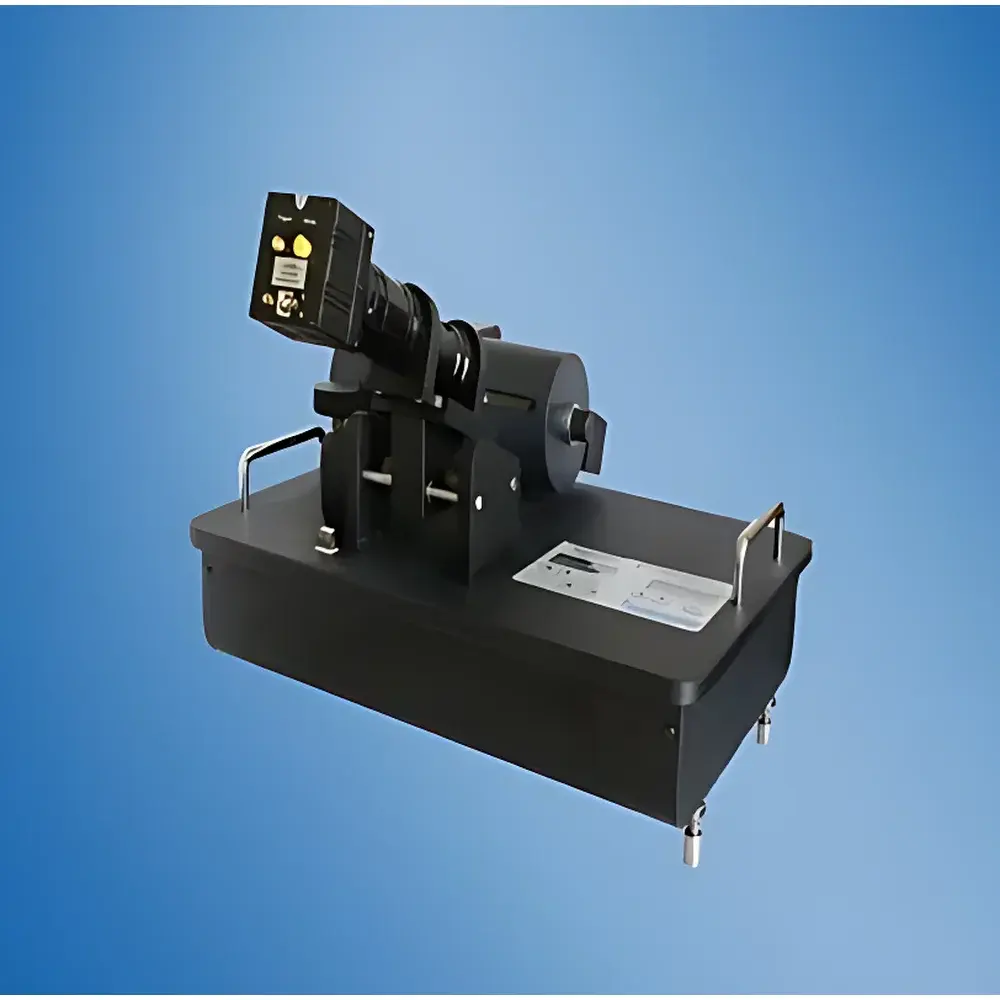
TX-500C Rotating Drop Interfacial Tensiometer
| Origin | Beijing, China |
|---|---|
| Manufacturer Type | Authorized Distributor |
| Origin Category | Domestic (China-assembled) |
| Model | TX-500C |
| Price Range | USD 14,000 – 28,500 |
| Surface/Interfacial Tension Range | 1×10⁻⁶ – 100 mN/m |
| Measurement Resolution | 0.001 mm |
| Measurement Accuracy | ±0.1% of reading |
| Temperature Control Range | 0–100 °C |
| Temperature Accuracy | ±0.1 °C |
| Measurement Method | Rotating Drop |
Overview
The TX-500C Rotating Drop Interfacial Tensiometer is a precision-engineered instrument designed for the quantitative determination of ultra-low interfacial tension (IFT) and surface tension (ST) in liquid–liquid and liquid–air systems. It operates on the rotating drop principle—a well-established hydrodynamic method grounded in Laplace’s equation—where a denser droplet of one liquid is suspended within a less dense continuous phase inside a horizontally rotating quartz capillary tube. Under centrifugal force, the droplet deforms into a prolate spheroid; its shape is captured via high-speed video imaging and analyzed to compute interfacial tension with high reproducibility. Unlike pendant drop or Wilhelmy plate methods, the rotating drop technique enables reliable measurement down to 10−6 mN/m—critical for evaluating enhanced oil recovery (EOR) surfactants, microemulsion formation, and nanoscale colloidal stabilization. The system integrates real-time temperature control, motorized rotation speed regulation, and digital image acquisition, making it suitable for both routine QC labs and advanced R&D environments requiring trace-level IFT quantification.
Key Features
- Full PC-based control architecture with embedded single-board microcontroller for synchronized operation of rotation, heating, and imaging subsystems
- High-resolution video detection system (752 × 480 pixels) at 60 fps frame rate, enabling precise edge detection of sub-micron droplets
- Adjustable magnification optics supporting pixel-level resolution down to 0.001 mm—optimized for resolving droplet deformation at ultra-low IFT regimes
- Motor-driven rotational stage with speed range 1,000–10,000 rpm and ±0.1% speed stability, ensuring consistent centrifugal field generation
- Integrated Peltier-assisted heating system (RT+5 °C to 90 °C) with external bath compatibility for extended temperature flexibility up to 100 °C
- Standard quartz capillaries (2 mm and 4 mm inner diameter) certified for optical clarity and chemical inertness across organic solvents and aqueous formulations
- Native Windows GUI software with BMP export capability, timestamped data logging, and batch analysis mode for multi-sample throughput
Sample Compatibility & Compliance
The TX-500C accommodates a broad spectrum of sample chemistries—including anionic, nonionic, and zwitterionic surfactants; polymer-stabilized emulsions; crude oil–brine systems; and functionalized nanofluids—without requiring calibration standards for each matrix. Its sealed capillary configuration minimizes evaporation and contamination risks during prolonged measurements. All hardware and firmware comply with CE electromagnetic compatibility (EMC) directives. Data acquisition workflows support audit-ready documentation per GLP and GMP requirements, including user-defined metadata tagging, electronic signature fields, and exportable CSV/Excel reports compatible with LIMS integration. While not FDA 21 CFR Part 11–certified out-of-the-box, the software architecture permits implementation of supplementary access controls and change logs required for regulated environments upon customer specification.
Software & Data Management
The proprietary Windows-native application provides real-time visualization of droplet morphology, automated contour fitting using edge-detection algorithms, and iterative calculation of interfacial tension based on Young–Laplace curve-fitting models. Users can define custom protocols—including ramped temperature profiles, stepwise rotational acceleration, and timed image capture sequences—for method standardization. All raw video frames (BMP), processed shape parameters (e.g., axial ratio, droplet length/diameter), and final tension values are stored in a hierarchical folder structure with ISO 8601 timestamps. Export options include tab-delimited text, Microsoft Excel (.xlsx), and PDF summary reports containing annotated images and statistical summaries (mean, SD, CV%). USB 2.0 and RS-232 interfaces ensure seamless connectivity to laboratory networks and peripheral devices such as thermal printers or external data loggers.
Applications
- Enhanced oil recovery (EOR): Screening and optimization of surfactant–cosurfactant–oil–brine systems for ultra-low IFT targeting <10−3 mN/m
- Formulation science: Stability assessment of pharmaceutical microemulsions, agrochemical adjuvants, and cosmetic nano-dispersions
- Coating & ink development: Interfacial compatibility analysis between pigment dispersions and resin matrices
- Fuel and lubricant additives: Evaluation of interfacial activity at fuel–water or lubricant–coolant boundaries
- Materials science: Wettability characterization of functionalized membranes and porous substrates via contact angle derivation from rotating drop geometry
- Academic research: Fundamental studies of micellization kinetics, critical aggregation concentration (CAC), and interfacial rheology under dynamic shear
FAQ
What is the minimum detectable interfacial tension value achievable with the TX-500C?
The instrument achieves a lower limit of 1×10⁻⁶ mN/m under optimal conditions—requiring high-purity quartz capillaries, vibration-isolated mounting, and stable ambient temperature control.
Can the TX-500C measure solid–liquid contact angles?
Yes—by analyzing the shape of a rotating sessile droplet on a vertically oriented hydrophobic/hydrophilic substrate mounted inside the capillary, contact angle can be derived from axisymmetric profile fitting.
Is external temperature control (e.g., circulating bath) supported?
Yes—the system features dual-mode thermal management: integrated Peltier heating (0–90 °C) and auxiliary port for connection to external thermostatic baths covering 0–100 °C.
What file formats are supported for image and data export?
Video frames are saved as uncompressed BMP; measurement results export to CSV, XLSX, and PDF formats with embedded figures and metadata.
Does the system meet ASTM D971 or ISO 6295 standards?
While not pre-certified to these specific standards, the rotating drop methodology aligns with the physical principles outlined in ASTM D971 Annex A3 and ISO 6295 Clause 6.3 for ultra-low IFT determination; users may validate against reference materials per their internal SOPs.



