
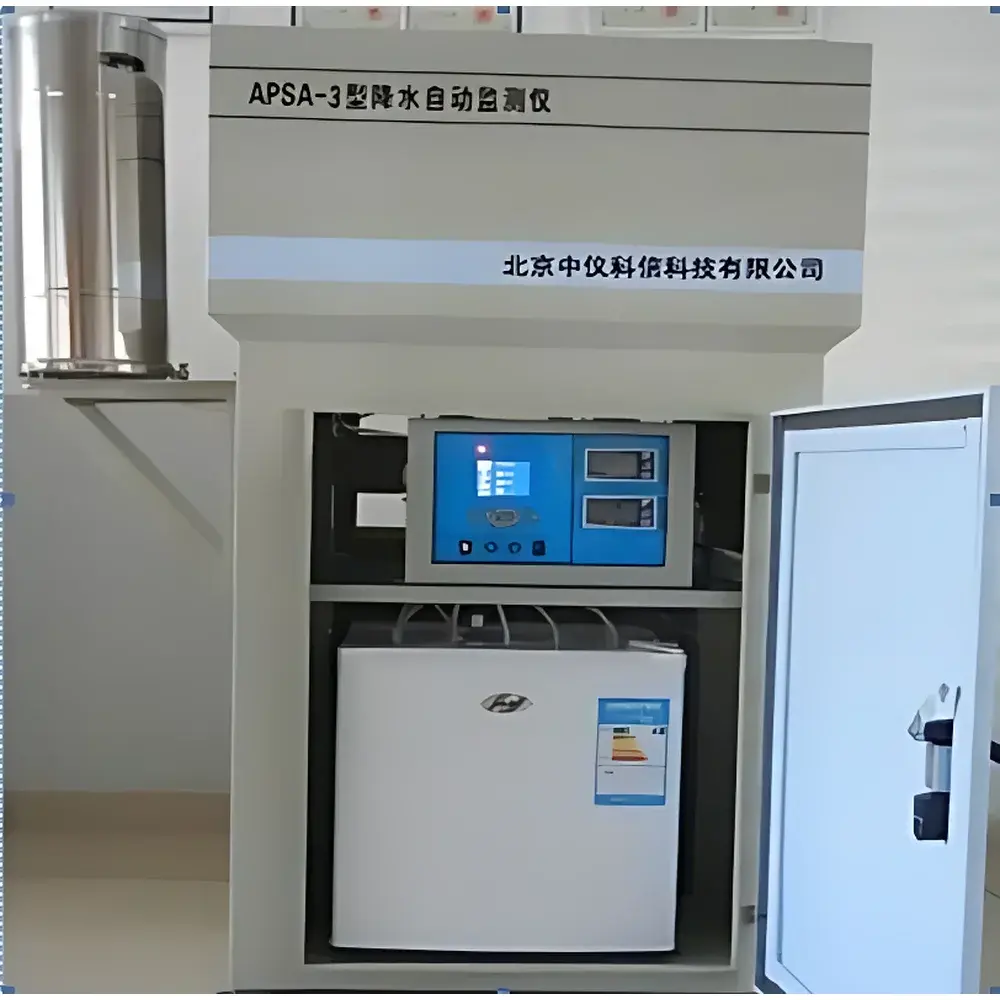
APSA Automated Precipitation Sampler and Monitoring System
| Origin | Beijing, China |
|---|---|
| Manufacturer Type | Distributor |
| Origin Category | Domestic |
| Model | APSA |
| Pricing | Upon Request |
| Instrument Type | Laboratory-Grade Automated Precipitation Sampler |
Overview
The APSA Automated Precipitation Sampler and Monitoring System is a field-deployable, laboratory-grade environmental monitoring instrument engineered for long-term, unattended collection and real-time physicochemical characterization of atmospheric precipitation. It operates on a dual-function principle: automated event-triggered sampling combined with continuous in-situ measurement of key rainwater quality parameters—pH, electrical conductivity (EC), and cumulative rainfall volume—using integrated electrochemical sensors and a calibrated tipping-bucket rain gauge. Designed for compliance with national and international ambient air and precipitation monitoring protocols—including China’s HJ/T 174–2005 and aligned with ISO 9060:2018 (rain gauge classification) and ASTM D5128–19 (electrochemical measurement of acidic deposition)—the APSA system supports both discrete event-based sampling and high-temporal-resolution monitoring modes. Its robust mechanical architecture, embedded temperature-controlled storage, and fault-tolerant control logic ensure data integrity across seasonal extremes—from sub-zero frost conditions to high-humidity monsoonal environments.
Key Features
- Wet comb-type rain sensor with four-step adjustable sensitivity (0.02, 0.04, 0.1, and 0.2 mm/h thresholds), integrated heating element to prevent false triggering from dew, frost, or fog condensation
- Three programmable operational modes: (1) Event-integrated sampling—single composite analysis per rainfall event + refrigerated bulk collection (7-day capacity); (2) Event-segregated sampling—eight independent 1-L sample vials indexed by chronological order; (3) High-frequency monitoring—pH and EC measured every 2 minutes during active rainfall (>0.5 mm cumulative), with automatic daily rainfall aggregation
- Stainless steel powder-coated chassis and UV-stabilized polyethylene rain collector (Φ300 mm, mounted at 1.4 m above ground level) with embedded linear translation cover mechanism (≤10 s open/close cycle)
- Integrated 3–5 °C refrigerated storage compartment with eight 1000 mL sample bottles; power consumption ≤100 W for cooling subsystem
- Onboard microprocessor with non-volatile memory retaining ≥10 years of timestamped precipitation metadata (start/end time, duration, intensity, pH, EC, volume) and sensor diagnostics
- Multi-protocol communication suite: RS232 (9-pin male), RS485 (up to 1200 m daisy-chain), PSTN modem, and GSM/GPRS SMS telemetry—enabling centralized networked deployment and remote parameter reconfiguration
- Self-diagnostic firmware with motor timeout protection, electrode auto-cleaning cycles, measurement cell purge sequences, and battery-backed data retention during mains failure
Sample Compatibility & Compliance
The APSA system is validated for collection and short-term stabilization of unpreserved rainwater samples under ambient and low-temperature conditions. Sample integrity is maintained via inert polyethylene wet-path materials, stainless-steel-free fluidic pathways, and temperature-controlled storage (3–5 °C), minimizing microbial activity and volatile compound loss per EPA Method 160.1 and ISO 5667-4:2023 guidelines. All electrochemical measurements conform to GLP principles: pH electrodes feature automatic temperature compensation (0–50 °C, ±0.1 pH accuracy); EC measurements include linear temperature correction (0–50 °C, ±2% FS error). The external standard tipping-bucket rain gauge meets ISO 9060 Class B specifications (200 mm orifice, 0.1 mm resolution, ±4% error above 10 mm). System-level electromagnetic compatibility includes integrated surge protection per IEC 61000-4-5 (Level 3), suitable for outdoor installation in lightning-prone regions.
Software & Data Management
Field-collected data are stored in structured ASCII or CSV format with UTC timestamps, event identifiers, and sensor status flags. USB 2.0 interface enables direct retrieval using industry-standard flash drives—no proprietary drivers required. Desktop software (Windows-compatible) provides automated generation of regulatory-compliant reports: daily/weekly/monthly precipitation summaries, pH-EC correlation scatter plots, event frequency histograms, and time-series trend charts. Audit trails record all configuration changes, calibration events, and manual interventions—supporting traceability requirements under ISO/IEC 17025 and FDA 21 CFR Part 11 (when deployed in GxP-aligned environmental monitoring programs). Networked installations support Modbus RTU over RS485 for integration into SCADA or LIMS platforms.
Applications
- Long-term acid deposition monitoring networks (e.g., NADP/NTN, EMEP, CMA’s National Acid Rain Monitoring Program)
- Urban atmospheric chemistry studies assessing sulfate/nitrate ion loading and neutralization capacity
- Calibration and validation of satellite-based precipitation products (e.g., GPM IMERG)
- Baseline characterization for environmental impact assessments near industrial zones or thermal power plants
- Climate research requiring high-fidelity rainwater composition datasets correlated with meteorological variables
- Regulatory compliance reporting for local ecological monitoring agencies and provincial environmental bureaus
FAQ
What is the minimum detectable rainfall threshold for triggering sampling?
The wet comb sensor can be configured to initiate sampling at rainfall intensities as low as 0.02 mm/h (L1 sensitivity setting), with a default event trigger threshold of 0.5 mm cumulative rainfall.
How is electrode drift mitigated during extended field deployment?
The system executes scheduled automatic cleaning cycles using deionized water flushes prior to each measurement sequence; pH and EC electrodes also undergo periodic zero-point verification against factory-calibrated reference solutions.
Can the APSA operate autonomously during extended power outages?
Yes—the controller retains full functionality for up to 72 hours on internal backup battery; refrigeration pauses during outage but resumes automatically upon power restoration without compromising sample integrity.
Is the system compatible with third-party weather stations?
Yes—RS485 and Modbus RTU support enables synchronization with external anemometers, hygrometers, and solar radiation sensors for multivariate atmospheric analysis.
What maintenance intervals are recommended for routine operation?
Bi-weekly visual inspection of the rain collector and sensor surface; quarterly electrode recalibration; annual replacement of the rain gauge tipping bucket magnet and O-ring seals.
Related Products







