
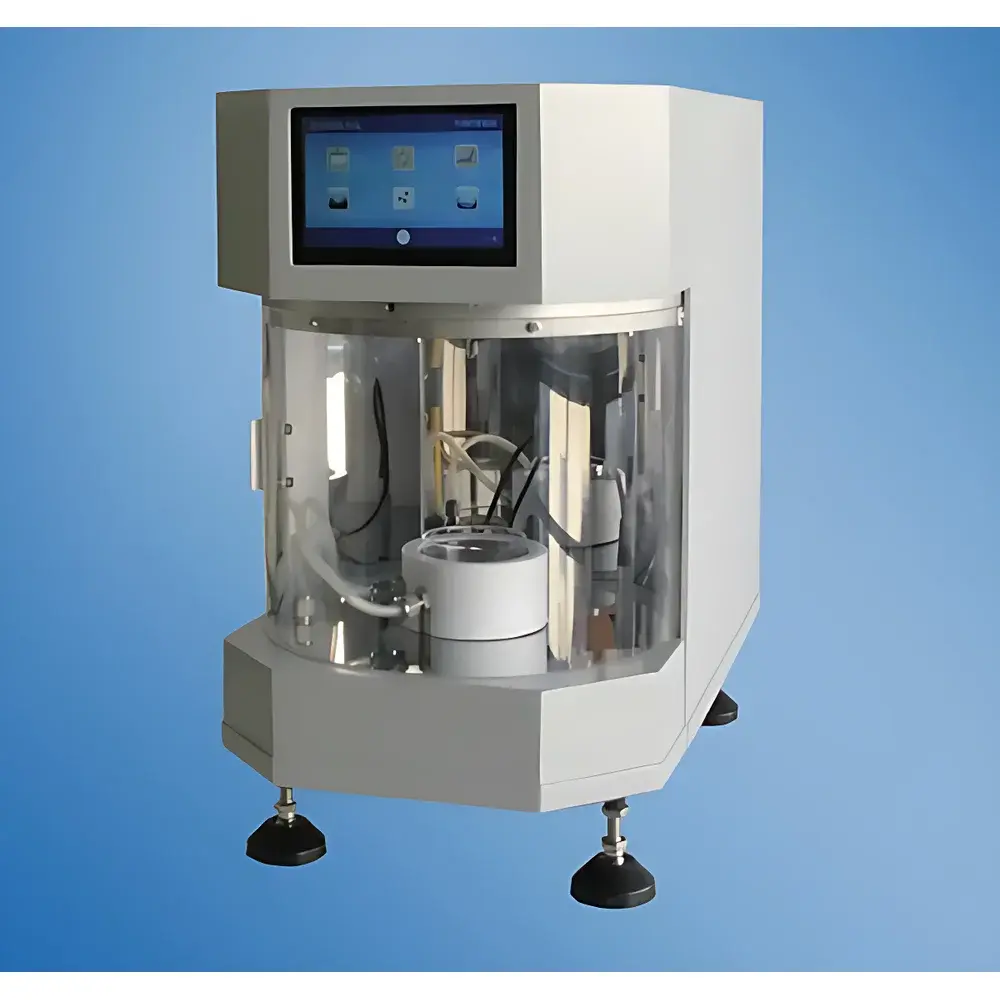
ZYKX JK99M Advanced Automated Surface & Interfacial Tensiometer
| Brand | ZYKX |
|---|---|
| Origin | Beijing, China |
| Model | JK99M Series |
| Measurement Range | 0–1999.999 mN/m |
| Resolution & Sensitivity | 0.001 mN/m |
| Accuracy | ±0.001 mN/m |
| Primary Methods | Du Noüy Ring Method & Wilhelmy Plate Method |
| Sampling Interval | 1–5 s (plate), 20–150 s (ring) |
| Vertical Travel | 0–50 mm (standard), up to 110 mm (optional) |
| Positioning Precision | 0.1 µm |
| Data Acquisition Rate | 0.1 Hz (0.02 Hz optional) |
| Mass Measurement Range | 0–210 g (0.1 mg standard, 0.01 mg optional) |
| Temperature Sensing Accuracy | ±0.01 °C |
| Power Supply | AC 220 V ±5%, <150 W |
| Operating Humidity | 30–85% RH |
| Compliance | SY/T 5370–1999 |
Overview
The ZYKX JK99M Advanced Automated Surface & Interfacial Tensiometer is a precision laboratory instrument engineered for high-reproducibility measurement of surface tension (liquid–air) and interfacial tension (liquid–liquid) using two internationally standardized physical methods: the Wilhelmy plate method and the Du Noüy ring method. Based on the principles of force balance in capillary systems, the instrument quantifies the vertical force exerted by the liquid interface on a calibrated platinum probe—either a vertically immersed plate or a horizontally suspended ring—as it interacts with the test fluid. This force is transduced via a high-stability electromagnetic balance (METTLER Toledo 0.001 mN resolution sensor) and converted into surface or interfacial tension values in millinewtons per meter (mN/m). Designed for rigorous R&D and QC environments, the JK99M supports dynamic measurements over time, enabling kinetic analysis of surfactant adsorption, aging effects, and critical micelle concentration (CMC) determination—essential for formulation development in enhanced oil recovery, coatings, agrochemicals, and pharmaceutical emulsions.
Key Features
- Robust all-metal chassis with precision-machined stainless-steel components and vibration-damped optical platform for long-term mechanical stability.
- High-resolution vertical translation stage driven by a servo-controlled stepper motor; travel range 0–50 mm (extendable to 110 mm), positioning accuracy ±0.1 µm, speed adjustable from 0.1 to 500 mm/min.
- Dual-method capability: simultaneous hardware and software support for both Wilhelmy plate (fast sampling: 1–5 s) and Du Noüy ring (equilibrium-based: 20–150 s) protocols—each validated per SY/T 5370–1999 and aligned with ASTM D971 and ISO 6295 standards.
- Integrated temperature monitoring system with ±0.01 °C resolution; compatible with external thermostatic baths (e.g., Julabo or Huber units) via standardized mounting interface and real-time thermal feedback loop.
- Onboard magnetic stirrer (speed-adjustable) ensures homogeneous sample conditions during CMC or dynamic surface tension assays.
- Embedded 7-inch capacitive touchscreen display and thermal mini-printer enable standalone operation—no PC required for routine measurements, data logging, or report generation.
- Hardware and software dual-zeroing functions—including programmable interval auto-zero—to compensate for thermal drift and mechanical hysteresis.
- Calibration traceability supported by certified calibration weights and built-in correction algorithms for buoyancy, meniscus geometry, and wire deformation (ring method).
Sample Compatibility & Compliance
The JK99M accommodates a broad spectrum of Newtonian and non-Newtonian liquids—from low-viscosity solvents (e.g., ethanol, hexane) to highly viscous formulations (paints, bitumen emulsions, polymer melts). Both platinum plate and ring probes are chemically inert and autoclavable, ensuring compatibility with aggressive media including strong acids, bases, and organic solvents. For interfacial tension applications, the system reliably measures immiscible liquid pairs such as water–crude oil, silicone oil–aqueous surfactant solutions, and fluorocarbon–hydrocarbon interfaces. Regulatory alignment includes full documentation support for GLP-compliant workflows: audit-trail-enabled software logs operator ID, timestamp, method parameters, raw force data, and calibration events—meeting essential requirements for FDA 21 CFR Part 11 readiness when deployed with networked PCs and electronic signature modules. All measurements conform to SY/T 5370–1999 (China petroleum industry standard), while method implementation satisfies the theoretical foundations of ISO 1409 (plastics), ASTM D1331 (coatings), and USP (pharmaceutical surfactants).
Software & Data Management
The proprietary ZYKX TensiSoft v5.2 software operates natively on Windows 10/11 (64-bit) and supports real-time plotting of force vs. time, tension vs. concentration, and dynamic surface age profiles. Data export is available in CSV, TXT, and XLSX formats, with metadata embedding (sample ID, operator, ambient T/RH, method version). Advanced features include automated CMC calculation using first-derivative inflection detection, density-corrected interfacial tension modeling, and batch processing for multi-sample comparative studies. The software architecture supports optional 21 CFR Part 11 compliance packages—including role-based access control, electronic signatures, and immutable audit trails—when integrated into validated laboratory IT infrastructures. Local storage retains ≥10,000 measurement records; USB and RS-232 interfaces enable seamless integration with LIMS platforms.
Applications
- Enhanced Oil Recovery (EOR): Quantification of ultra-low interfacial tension (<0.01 mN/m) between surfactant-polymer flood formulations and reservoir crude oils—critical for screening chemical flooding candidates per API RP 42 guidelines.
- Colloid & Interface Science: Time-resolved adsorption kinetics of amphiphiles at air–water and oil–water interfaces; evaluation of micellization thermodynamics and Krafft point behavior.
- Coatings & Inks: Stability assessment of pigment dispersions via wetting tension analysis; optimization of leveling agents and defoamers through dynamic surface tension profiling.
- Pharmaceutical & Cosmetic Formulations: CMC determination for nonionic and zwitterionic surfactants; interfacial rheology screening of microemulsion precursors.
- Agrochemical Development: Wetting efficiency testing of adjuvants on hydrophobic leaf surfaces using fiber contact angle add-ons (optional).
- Materials Characterization: Solid surface energy estimation via Owens–Wendt–Rabel–Kaelble (OWRK) model when combined with optional contact angle modules.
FAQ
Does the JK99M comply with international standards for surface tension measurement?
Yes—the instrument implements methodologies fully consistent with ASTM D971 (ring method), ISO 6295 (plate method), and SY/T 5370–1999. Calibration procedures follow ISO/IEC 17025 traceability pathways when used with certified reference materials.
Can the JK99M measure interfacial tension between two immiscible liquids?
Yes—both platinum plate and platinum ring configurations are validated for liquid–liquid interfacial tension measurement across a wide dynamic range (0.1–1999.999 mN/m), including ultra-low regimes relevant to EOR applications.
Is temperature control integrated or external?
The base unit includes a stainless-steel thermostatic jacket with embedded Pt100 sensor (±0.01 °C accuracy); full temperature regulation requires connection to an external recirculating chiller or Peltier-based bath (not included).
What data security and regulatory features are available for GxP environments?
With optional Part 11 compliance software, the system provides electronic signatures, user-level permissions, immutable audit trails, and data integrity validation—enabling deployment in FDA- and EMA-regulated laboratories under GLP/GMP frameworks.
How is sensor calibration performed?
Calibration uses NIST-traceable stainless-steel weights (included) and automated sequence-driven routines within TensiSoft; zero-point verification can be executed manually or scheduled at user-defined intervals.



