
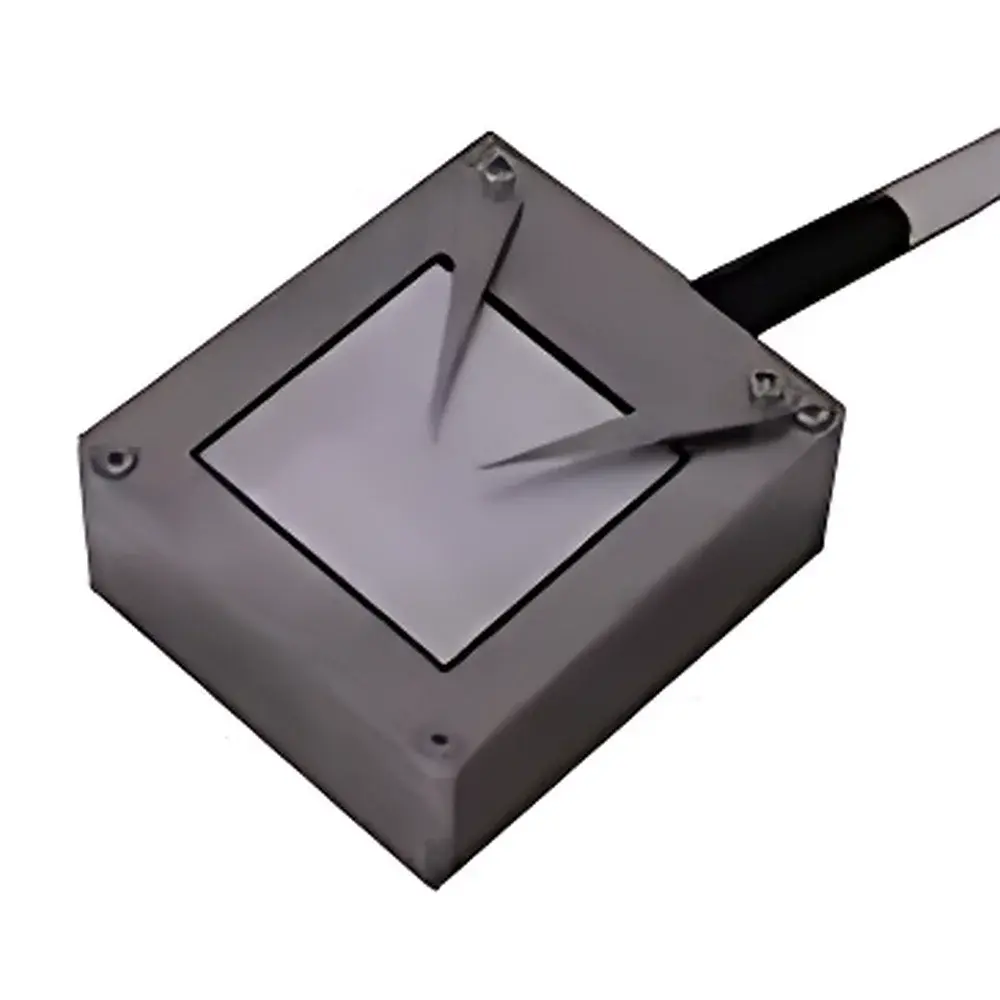
MicrOptik MHS300 High-Temperature Heating Stage
| Brand | MicrOptik |
|---|---|
| Origin | Poland |
| Model | MHS300 |
| Temperature Range | Ambient to 300 °C |
| Temperature Resolution | 0.1 °C |
| Control Method | Dual-Mode PID/PID-Switching |
| Sensor Type | RTD (Pt100) |
| Sample Area | 40 mm × 40 mm (customizable) |
| Mounting | Horizontal & Vertical Configurations Supported |
| Environmental Operation | Ambient Atmosphere |
Overview
The MicrOptik MHS300 High-Temperature Heating Stage is a precision-engineered thermal platform designed for integration into optical microscopy, spectroscopy, X-ray diffraction (XRD), and synchrotron beamline systems. Based on resistive heating architecture with closed-loop feedback control, the MHS300 enables stable, repeatable thermal conditioning of samples under ambient atmospheric conditions—without requiring vacuum or inert gas enclosures. Its core functionality centers on delivering high spatial and thermal uniformity across the sample zone while maintaining mechanical stability compatible with sub-micron optical alignment requirements. The stage operates within a calibrated temperature range from ambient to +300 °C, supporting both static thermal hold and dynamic ramp/soak protocols essential for phase transition analysis, in situ crystallization studies, thermal expansion coefficient measurement, and real-time structural evolution monitoring.
Key Features
- Wide operational temperature range: ambient to +300 °C, with ±0.3 °C thermal stability at setpoint (typical, over 30 min)
- High-resolution temperature control: 0.1 °C resolution with dual-mode PID/PID-switching algorithm for optimized response during heating, holding, and cooling phases
- Integrated Pt100 RTD sensor embedded beneath the sample surface for direct, low-drift temperature measurement and feedback
- Open-access sample configuration: unobstructed top access allows full optical path compatibility with upright/inverted microscopes, Raman spectrometers, and X-ray optics
- Modular mechanical design supports horizontal mounting (standard) and vertical orientation (optional adapter kit), enabling integration into custom optical benches and multi-axis goniometers
- Thermally isolated baseplate minimizes heat conduction to adjacent instrumentation, preserving system-level thermal integrity
- Low thermal mass construction ensures rapid heating rates up to 10 °C/min (dependent on load and ambient conditions)
Sample Compatibility & Compliance
The MHS300 accommodates diverse sample geometries—including semiconductor wafers (up to 50 mm diameter), geological thin sections, fluid inclusion mounts, photovoltaic test cells, and biological substrates such as glass-bottom Petri dishes. Its 40 mm × 40 mm standard sample area is available with optional extensions (e.g., 60 mm × 60 mm) or recessed configurations for specialized holders. All materials in contact with samples conform to ISO 80000-5:2019 (quantities and units – thermodynamics) and are non-magnetic, non-outgassing, and compatible with cleanroom Class 1000 environments. The stage meets CE marking requirements for electromagnetic compatibility (EMC Directive 2014/30/EU) and low-voltage safety (LVD Directive 2014/35/EU). It is routinely deployed in laboratories adhering to ASTM E1113 (Standard Guide for In Situ Microscopy of Materials at Elevated Temperatures) and supports GLP-compliant workflows when paired with validated software control modules.
Software & Data Management
The MHS300 is supplied with MicrOptik’s StageControl Pro v3.x software suite, offering native support for Windows 10/11 and Linux (via API). The application provides full programmability of temperature profiles—including multi-segment ramps, dwell times, and conditional triggers—and logs timestamped temperature, power output, and sensor status at user-defined intervals (100 ms to 10 s resolution). A documented TCP/IP-based SCPI command set enables seamless integration with LabVIEW, Python (PyVISA), MATLAB, and third-party DAQ platforms. Audit-trail functionality complies with FDA 21 CFR Part 11 requirements when used with electronic signature-enabled deployment; raw data exports are generated in CSV and HDF5 formats for traceable post-processing and archival per ISO/IEC 17025:2017 clause 7.5.2.
Applications
- In situ optical microscopy of mineral phase transitions (e.g., quartz α–β inversion, carbonate decomposition)
- Real-time Raman/FTIR spectroscopic analysis of polymer thermal degradation kinetics
- Hot-stage XRD for lattice parameter tracking during annealing of perovskite thin films
- Thermal stress testing of MEMS devices and optoelectronic packaging interfaces
- Cell viability assessment under controlled hyperthermic conditions (in collaboration with IR-transparent window variants)
- Calibration reference staging for thermographic camera validation across extended ranges
FAQ
Can the MHS300 operate under vacuum or inert gas?
No—the standard MHS300 is rated for ambient atmosphere only. Vacuum-compatible versions (MHS300-VAC) and purged-chamber variants (MHS300-GAS) are available upon request with modified heater/sensor encapsulation.
Is the temperature sensor calibrated traceable to NIST standards?
Yes—each unit ships with a factory calibration certificate referencing PTB-traceable standards; optional on-site recalibration services are offered annually.
What is the maximum recommended sample weight?
For optimal thermal uniformity and response time, the recommended maximum is 250 g. Heavier loads may extend stabilization time and reduce effective resolution without compromising safety.
Does the stage generate electromagnetic interference that could affect sensitive detectors?
EMI emissions are below CISPR 11 Group 1 limits; ferrite-clad cabling and optional shielding kits are available for ultra-low-noise applications such as single-photon counting or lock-in amplifier setups.
Can I retrofit an existing microscope with the MHS300 without mechanical modification?
Yes—the stage includes standardized kinematic mounting holes (M4 and 1/4″-20) compatible with Thorlabs, Newport, and Standa optical rails; height-adjustable feet ensure co-planarity with most objective nosepiece clearances.




