
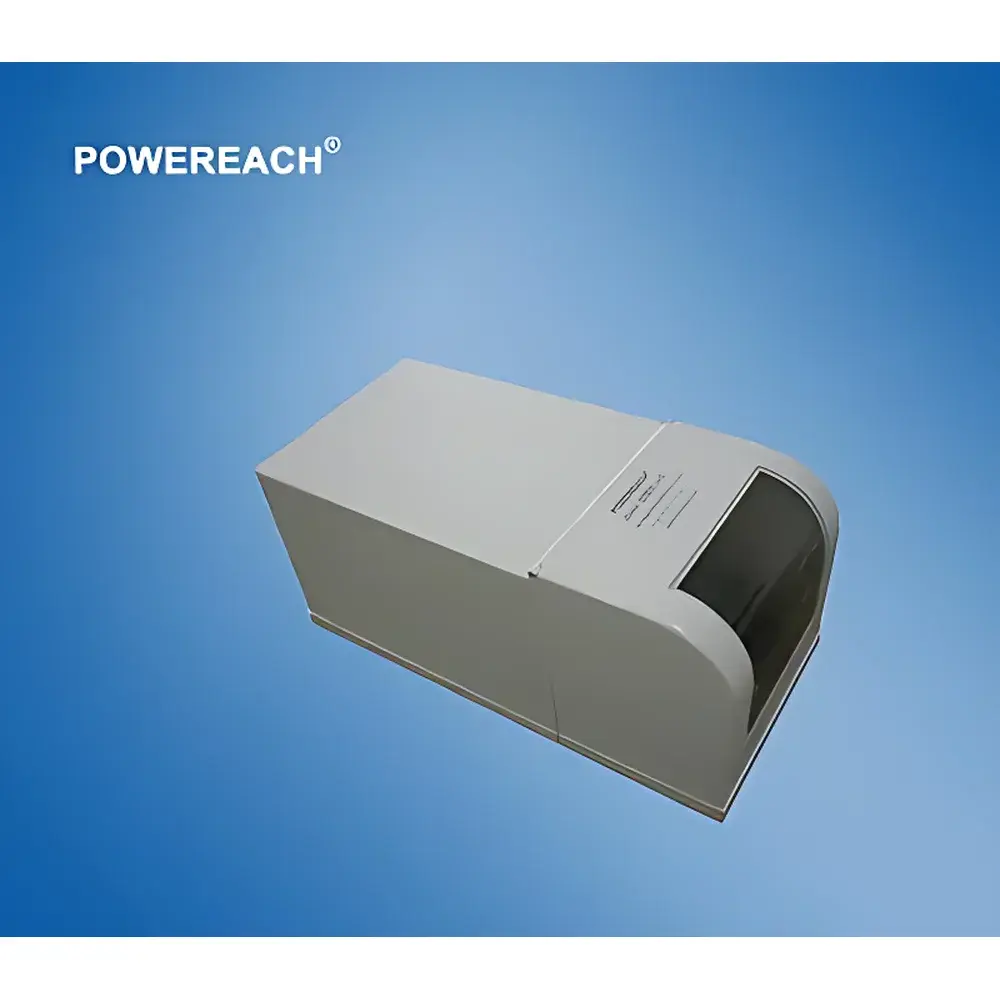
JS94KM Zeta Potential Analyzer (Microelectrophoresis Instrument)
| Origin | Beijing, China |
|---|---|
| Manufacturer Type | Distributor |
| Origin Category | Domestic |
| Model | JS94KM |
| Price Range | USD 7,000–14,000 |
| Zeta Potential Range | ±3000 mV |
| pH Range | 2.0–12.0 (extended range: 1.6–13.0) |
| Operating Temperature | 5–35 °C |
| pH Resolution | 0.1 |
| Temperature Resolution | 0.1 °C |
| Accuracy | ≤5% |
| Repeatability | ≤5% |
| Particle Size Range | 0.2–50 µm (aqueous dispersions) |
| Optical Magnification | Up to 1200× |
| Voltage Polarity Switching Time | 0.30–1.20 s (adjustable) |
| Sampling Time | 3–10 s |
| Power Supply | 220 V, 50 Hz |
| Power Consumption | 150 W |
Overview
The JS94KM Zeta Potential Analyzer is a precision microelectrophoresis instrument engineered for direct measurement of electrophoretic mobility and subsequent calculation of zeta potential in colloidal and dispersed systems. It operates on the principle of laser-assisted video microscopy combined with constant-voltage electrophoretic migration under controlled hydrodynamic conditions. By tracking individual particle displacement under applied electric field using high-magnification (up to 1200×), near-field optical imaging—employing low-power blue/green semiconductor illumination—the system quantifies velocity vectors with sub-pixel resolution. This enables robust determination of zeta potential across aqueous suspensions, emulsions, and nanoparticle dispersions without reliance on bulk conductivity or indirect electroacoustic assumptions. The instrument is particularly suited for academic research, QC laboratories, and formulation development where surface charge characterization informs stability prediction, flocculation behavior, and interfacial reactivity.
Key Features
- Patented open-cup electrophoresis cell with integrated Ag/Platinum/Titanium electrodes—0.5 cm thick borosilicate glass construction, optimized via microfluidic simulation to minimize edge effects and eliminate stagnant layer artifacts.
- Real-time temperature compensation via embedded thermistor probe; continuous ambient temperature sampling feeds dynamic correction into zeta potential calculation algorithms.
- Adjustable polarity reversal timing (0.30–1.20 s) with programmable DC voltage output, mitigating electrode polarization while enabling rapid acquisition (3–10 s per measurement cycle).
- High-fidelity optical train featuring continuous zoom optics, dual-wavelength (blue + green) illumination, and ultra-low thermal load (<50 µW), ensuring minimal photothermal disturbance during prolonged observation.
- Computer-controlled automated image capture synchronized to electrophoretic pulse timing; four simultaneous grayscale frames (bidirectional analysis) processed via centroid-tracking algorithm for enhanced statistical confidence.
- Calibration-integrated workflow: proprietary cross-hair reticle mounted on XYZ translation stage ensures precise focal plane alignment and eliminates parallax-induced magnification drift; mandatory real-time magnification calibration before each run.
Sample Compatibility & Compliance
The JS94KM supports aqueous colloidal systems within the 0.2–50 µm particle size range, including polymeric nanoparticles, liposomes, silica sols, clay suspensions, and protein aggregates. Its pH operability from 1.6 to 13.0 (standard range 2.0–12.0, resolution 0.1) accommodates acidic catalyst slurries and alkaline cementitious suspensions alike. Temperature control (5–35 °C, resolution 0.1 °C) allows isothermal studies under physiologically or industrially relevant conditions. While not certified to ISO 13099 or ASTM D7826, the instrument’s architecture aligns with core metrological principles outlined in those standards—including traceable electrode geometry, defined field uniformity, and documented thermal management. Data acquisition and processing workflows are compatible with GLP-compliant documentation practices when paired with validated laboratory information management systems (LIMS).
Software & Data Management
The native software suite provides full control over voltage parameters, frame rate, polarity switching, and thermal compensation settings. All raw image sequences, velocity time-series, and calculated zeta distributions are stored in timestamped, metadata-embedded HDF5 files. Export options include CSV (for statistical post-processing in MATLAB or Python), PDF reports with embedded uncertainty metrics (±5% accuracy bound per IUPAC-recommended error propagation), and PNG overlays showing particle trajectories. Audit trail functionality logs user actions, calibration events, and environmental parameter deviations—supporting alignment with FDA 21 CFR Part 11 requirements when deployed in regulated environments with supplementary electronic signature validation.
Applications
- Determination of isoelectric point (IEP) for proteins, peptides, and functionalized nanomaterials in biopharmaceutical development.
- Stability assessment of cosmetic emulsions and pigment dispersions by monitoring zeta potential shifts upon surfactant titration or ionic strength variation.
- Optimization of mineral flotation reagents in mining applications through surface charge mapping of ore particles across pH gradients.
- Evaluation of coating adhesion mechanisms in papermaking and ceramic processing via interfacial charge reversal analysis.
- Teaching laboratory use for hands-on instruction in colloid science, interfacial electrochemistry, and soft matter physics—fully compliant with undergraduate and graduate curricula in materials science and chemical engineering departments.
FAQ
What sample volume is required per measurement?
Each analysis consumes only 0.5 mL of dispersion, minimizing reagent cost and enabling high-throughput screening of formulation variants.
Is the instrument suitable for non-aqueous media?
The JS94KM is optimized for aqueous systems; organic solvent compatibility is limited due to electrode material constraints and refractive index mismatch in the optical path.
How is calibration performed?
A dedicated precision reticle is used to calibrate pixel-to-micron scaling prior to every session; no external reference particles are required for routine operation.
Can the system operate unattended overnight?
Yes—programmable sequence mode supports up to 99 consecutive runs with automatic temperature logging, file naming, and error flagging for outlier detection.
Does it support batch-mode data export for statistical analysis?
All datasets export natively to CSV with column headers conforming to ASTM E2412 conventions, facilitating direct import into JMP, Minitab, or R-based analysis pipelines.



