
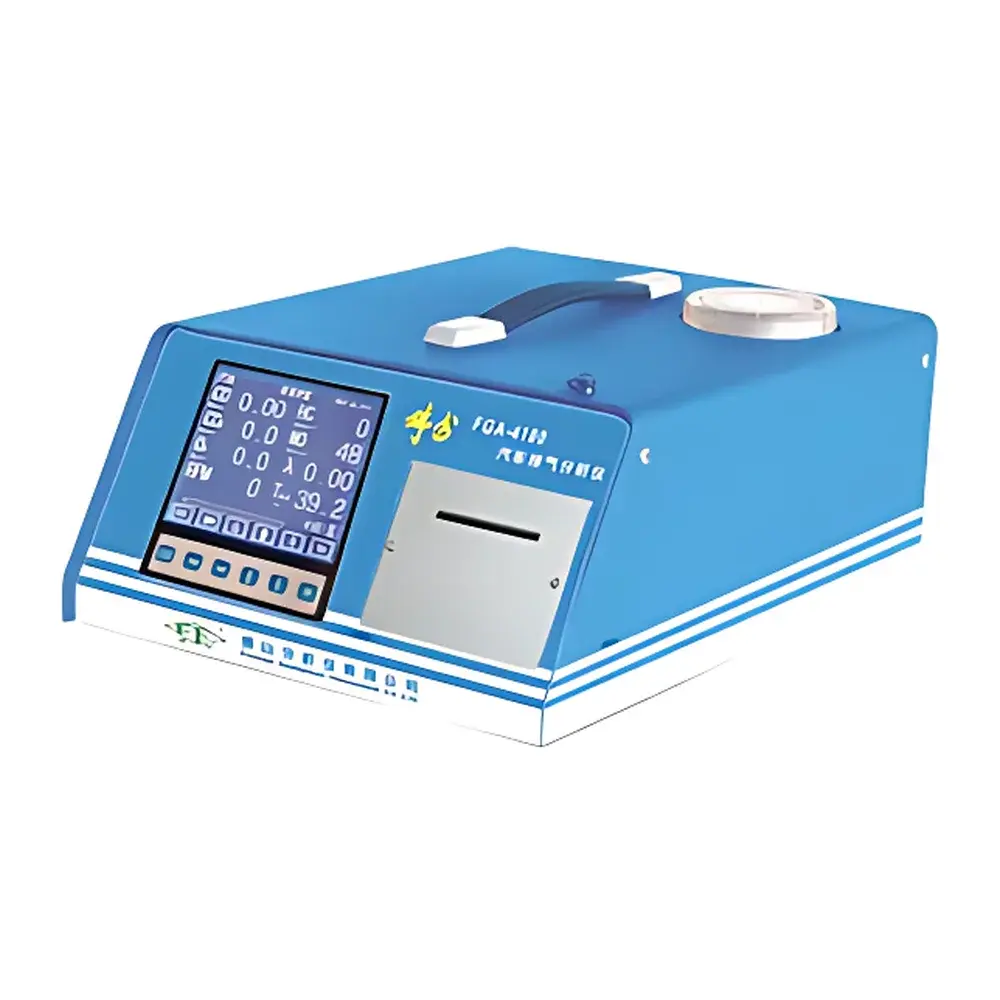
FGA-4100A Dual-Fuel Automotive Exhaust Emission Analyzer (Gas + Opacity)
| Origin | Guangdong, China |
|---|---|
| Manufacturer Type | Authorized Distributor |
| Regional Origin | Domestic (PRC) |
| Model | FGA-4100A |
| Pricing | Upon Request |
| Gas Measurement | HC (0–9999 ppm), CO (0–9.99%), CO₂ (0–20%), O₂ (0–25%), NO (0–5000 ppm), λ (0.5–3.0), Oil Temperature (0–150 °C), RPM (250–10000 rpm) |
| Opacity Measurement | N (0–99.9%), k (0–16 m⁻¹) |
| Resolution | HC (1 ppm), CO (0.01% / 0.001%), CO₂ (0.1% / 0.01%), O₂ (0.1% / 0.01%), NO (1 ppm), λ (0.001), Oil Temp (0.1 °C), RPM (1 rpm), N (0.1%), k (0.001 m⁻¹) |
| Accuracy | HC (±12 ppm or ±5%), CO (±0.06% or ±5%), CO₂ (±0.5% or ±5%), O₂ (±0.1% or ±5%), NO (±25 ppm or ±4%), N (±2%) |
| Response Time | HC/CO/CO₂ ≤10 s |
| Warm-up Time | 15 min |
| Power Supply | AC 220 V ±10%, 50 Hz ±1%, 10 A |
| Power Consumption | ~50 W |
| Weight | Main Unit 9 kg (Control Unit 3 kg + Measurement Unit 4.5 kg) |
| Operating Environment | 5–40 °C, RH 0–95% non-condensing |
| Interfaces | RS-232C, RS-485 |
| Data Storage | 300 test records with timestamp, real-time clock, curve logging, optional EOB-D diagnostics, programmable firmware update via serial port |
Overview
The FGA-4100A Dual-Fuel Automotive Exhaust Emission Analyzer is an integrated, regulatory-compliant instrument engineered for simultaneous gaseous pollutant analysis and diesel particulate opacity measurement. It operates on two distinct physical principles: nondispersive infrared (NDIR) absorption spectroscopy for hydrocarbon (HC), carbon monoxide (CO), carbon dioxide (CO₂), and oxygen (O₂); electrochemical detection for nitrogen oxides (NO); and dual-beam optical attenuation measurement for smoke opacity (N) and light absorption coefficient (k). Designed to meet the metrological and functional requirements of GB 18285–2005 (spark-ignition vehicle emissions) and GB 3847–2005 (compression-ignition vehicle opacity), the analyzer supports standardized test protocols including idle, dual-idle, transient cycle, and free-acceleration modes. Its architecture enables traceable, repeatable measurements under field-deployable environmental conditions (5–40 °C, up to 95% RH), making it suitable for regulatory inspection, vehicle maintenance certification, OEM quality assurance, and applied research in combustion efficiency and aftertreatment performance.
Key Features
- Modular gas configuration: Supports 2-gas (HC, CO), 4-gas (HC, CO, CO₂, O₂), or 5-gas (HC, CO, CO₂, O₂, NO) analysis—field-upgradable via firmware.
- Dual-mode opacity module compliant with ISO 11614 and GB 3847–2005, featuring automatic zero calibration, pressure/temperature compensation, and reverse-purge filtration to maintain optical path integrity.
- Triple-stage gas filtration system with quick-release cartridges and programmable backflush sequence to minimize sensor contamination and extend service intervals.
- Real-time stoichiometric ratio (λ) calculation using measured O₂ and fuel-specific air/fuel coefficients, enabling combustion efficiency assessment without external inputs.
- CO dilution correction algorithm per ISO 8765:1991, reporting true volumetric concentration even in high-dilution exhaust streams.
- Embedded real-time clock with non-volatile memory retains time/date stamp across power cycles; stores 300 full test records with vehicle ID, operator code, and measurement curves.
- RS-232C and RS-485 interfaces support bidirectional communication with PCs or central data acquisition systems; firmware updates and parameter configuration performed remotely.
- Self-diagnostic subsystem continuously monitors sensor health, flow integrity, optical alignment, and thermal stability—alerts operators prior to out-of-spec operation.
Sample Compatibility & Compliance
The FGA-4100A is validated for use with gasoline, LPG, CNG, and diesel-powered light- and heavy-duty vehicles. It accommodates standard sampling probes (1.5 m heated or unheated), flexible hose assemblies, and optional EOBD (European On-Board Diagnostics) interface modules for SAE J1978–compliant fault code retrieval and live PID streaming. All gas sensors are factory-calibrated against NIST-traceable reference standards and conform to ISO 15059:2021 for exhaust gas analyzers. Opacity measurement adheres to the beam geometry, wavelength (550 ± 30 nm), and photometric linearity requirements specified in GB 3847–2005 Annex B and ISO 11614 Clause 6. The instrument’s software architecture supports audit trails, user-level access control, and electronic signature capability—enabling alignment with GLP and ISO/IEC 17025 documentation requirements when deployed in accredited laboratories.
Software & Data Management
The embedded firmware includes a multilingual GUI (English/Chinese selectable), intuitive menu navigation, and contextual help prompts. Data export is supported via ASCII text files compatible with Excel, LabVIEW, or custom LIMS platforms. Optional PC-based software provides graphical trend analysis, statistical summaries (mean, SD, CV%), pass/fail flagging per limit thresholds (e.g., Euro 4–6, China 6), and PDF report generation with embedded calibration certificates. All stored records include metadata: test mode (idle/free-acceleration/transient), ambient T/P, probe insertion depth, and operator ID. Firmware versioning, calibration history, and diagnostic logs are accessible via serial query—ensuring full traceability for regulatory audits per CNAS-CL01:2018 or EPA 40 CFR Part 1065 compliance frameworks.
Applications
- Regulatory enforcement: Routine roadside inspections, I/M (Inspection and Maintenance) program verification, and type-approval testing per GB 18352.x series.
- OEM and Tier-1 supplier QA: Pre-delivery emission screening, aftertreatment durability validation, and cold-start behavior characterization.
- Aftermarket service centers: Diagnostic support for catalytic converter efficiency, EGR valve function, and DPF regeneration monitoring.
- Academic and government research: Correlation studies between λ, NOx, and particulate number (PN) under variable load conditions; evaluation of alternative fuels (bio-diesel, hydrogen blends).
- Training institutions: Hands-on instruction in exhaust chemistry, combustion stoichiometry, and regulatory test protocol execution.
FAQ
Does the FGA-4100A comply with current Chinese national standards for motor vehicle emissions?
Yes—it meets all technical, metrological, and operational requirements defined in GB 18285–2005 (gasoline vehicles) and GB 3847–2005 (diesel opacity), including accuracy tolerances, response times, and environmental operating limits.
Can the instrument measure both gaseous emissions and smoke opacity simultaneously?
No—measurements are sequential but fully integrated within one platform: gas analysis occurs during idle/dual-idle/transient cycles; opacity is measured independently during free-acceleration tests per GB 3847–2005 Annex D.
Is EOBD diagnostics functionality built-in or optional?
EOBD support is an optional hardware module (FGA-EOBD-KIT) that connects via ISO 15765-4 CAN interface; firmware activation requires separate license key.
What is the recommended calibration frequency for field use?
Zero and span calibration using certified gases (NIST-traceable) is required before each daily shift; full multi-point verification recommended every 30 days or after 100 tests—documented in internal calibration log.
How is data integrity ensured during power interruption?
The real-time clock and 300-record memory are powered by a rechargeable backup battery; all test data written to flash memory prior to shutdown remains intact and recoverable.
Related Products







