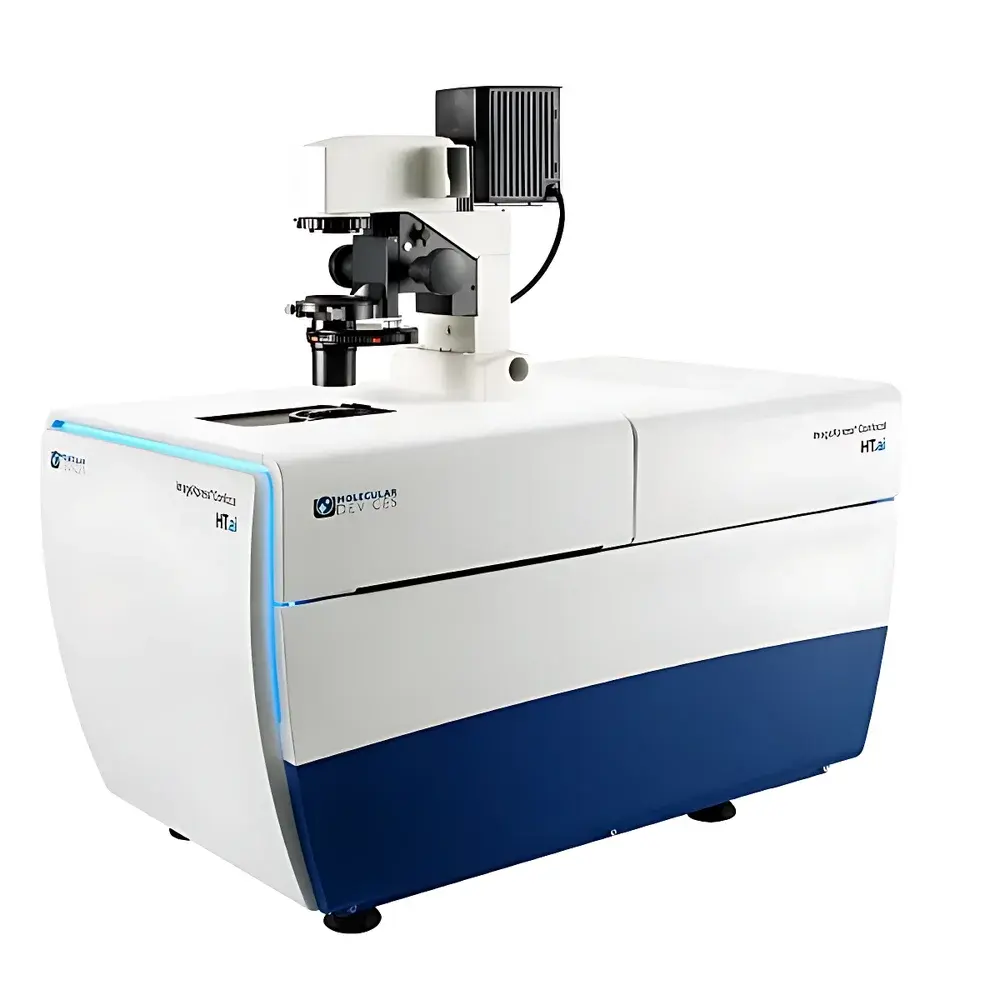
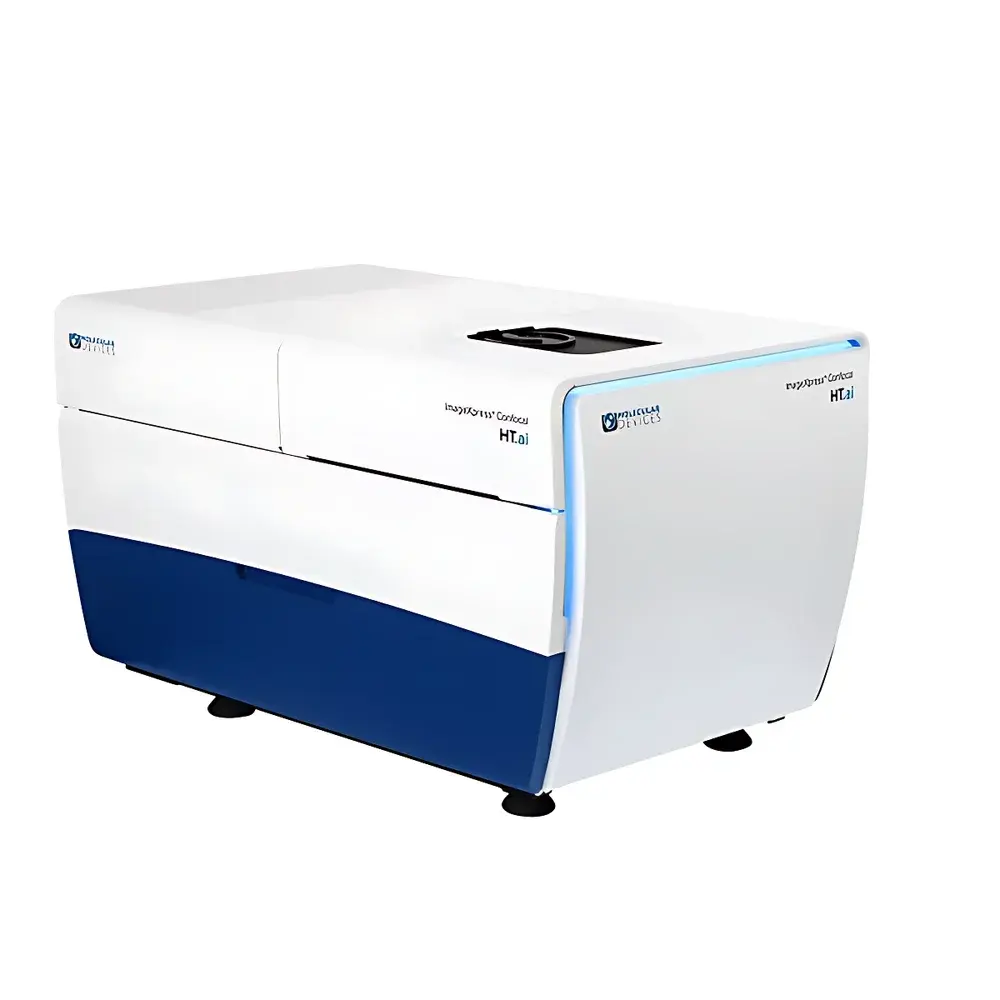
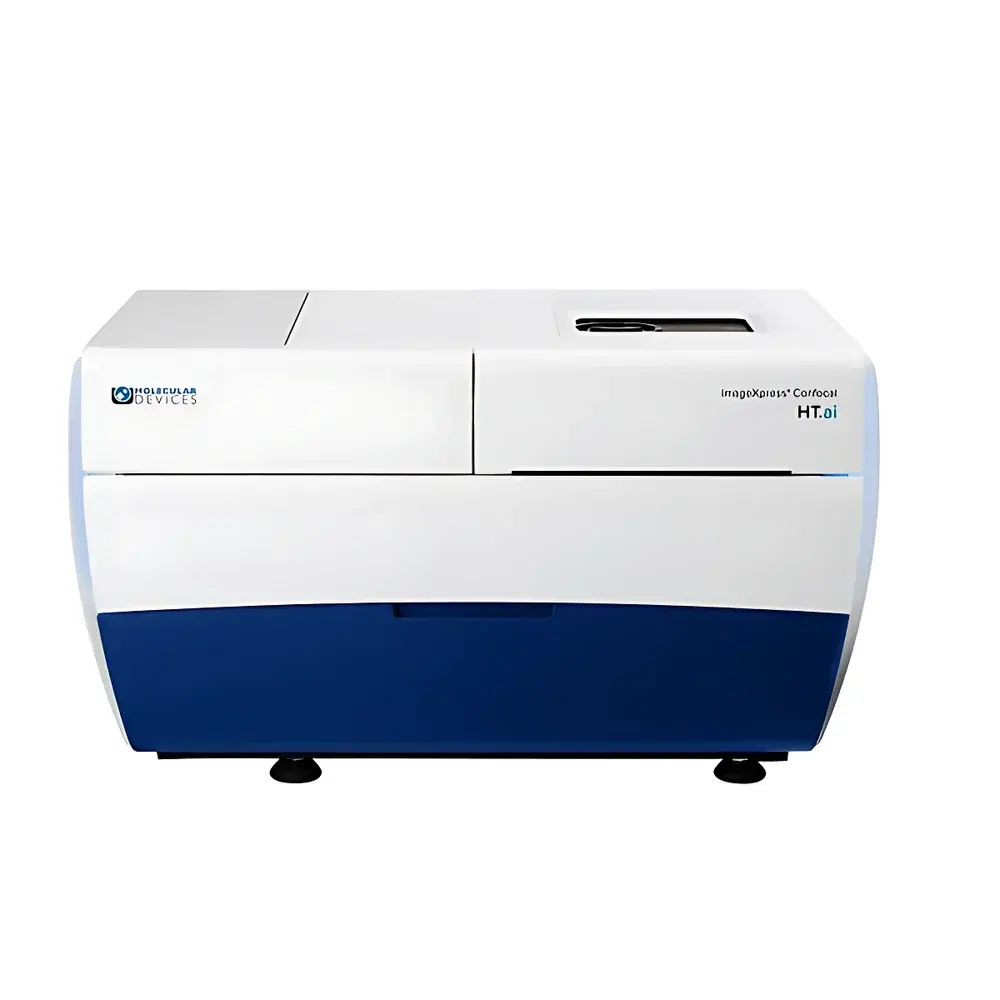
Molecular Devices ImageXpress Confocal HT.ai Intelligent High-Content Confocal Imaging System
| Brand | Molecular Devices |
|---|---|
| Origin | USA |
| Manufacturer Type | Original Equipment Manufacturer (OEM) |
| Product Origin | Imported |
| Model | ImageXpress Confocal HT.ai |
| Temperature Control | 30–40 °C ± 0.5 °C |
| Humidity Control | Relative Humidity (RH) |
| Cell Analysis Throughput | Not Specified |
Overview
The Molecular Devices ImageXpress Confocal HT.ai is an intelligent, high-content confocal imaging system engineered for quantitative, multi-parametric analysis of complex 3D biological models—including organoids, spheroids, thick tissue sections, and whole-organism specimens (e.g., zebrafish embryos, C. elegans). It operates on the principle of spinning-disk confocal microscopy, leveraging AgileOptix™ optical architecture to eliminate out-of-focus light, enhance axial resolution, and enable deep-tissue optical sectioning with minimal phototoxicity. Integrated water-immersion objectives (NA up to 1.2) correct spherical aberration in aqueous or hydrogel-embedded samples—critical for maintaining fidelity in Matrigel-based 3D cultures. The system supports simultaneous acquisition across eight fluorescence channels (DAPI, CFP, FITC, YFP, TRITC, Texas Red, Cy5, Cy7) using a seven-laser excitation source, delivering higher signal intensity and improved signal-to-noise ratio compared to LED-based illumination. Coupled with back-illuminated sCMOS detectors, it achieves high sensitivity without compromising acquisition speed—enabling robust time-lapse imaging over hours to days under tightly regulated environmental conditions (temperature, humidity, CO2).
Key Features
- AgileOptix™ spinning-disk confocal platform with interchangeable pinhole disks and seven laser lines (405–785 nm), enabling flexible configuration for diverse experimental requirements.
- Eight-channel fluorescence detection with spectral separation optimized for standard fluorophores and tandem dyes—supporting subcellular, cellular, and tissue-level phenotypic quantification.
- Automated water-immersion optics (20×, 40×, 60×; NA = 1.2) providing up to 4× signal enhancement and superior resolution in thick, refractive-index-mismatched samples.
- QuickID™ intelligent targeting module: performs low-magnification survey scanning to identify rare events or regions of interest, then automatically re-acquires high-resolution Z-stacks at user-defined magnifications and channel combinations.
- Environmental control unit maintaining temperature (30–40 °C ± 0.5 °C), relative humidity, and CO2 levels—validated for long-term live-cell and 3D model assays lasting from minutes to >72 hours.
- Comprehensive objective library (>25 options): air objectives (NA 0.05–0.95; 1×–100×), oil immersion (NA 1.4), and water immersion (NA 1.2)—ensuring optimal optical matching across sample types and thicknesses.
Sample Compatibility & Compliance
The ImageXpress Confocal HT.ai is validated for use with adherent and suspension cultures, 3D extracellular matrix–embedded models (e.g., Matrigel, collagen I), tissue slices up to 200 µm thick, microfluidic devices, and whole-mount specimens. Its optical design complies with ISO 19037:2019 (microscopy—specifications for fluorescence imaging systems) and supports GLP/GMP-aligned workflows through audit-trail-enabled software modules. MetaXpress and IN Carta software are designed to meet FDA 21 CFR Part 11 requirements for electronic records and signatures when deployed with appropriate IT infrastructure and validation protocols. The system accommodates standard microplate formats (6–384-well), including U-bottom spheroid plates and glass-bottom dishes.
Software & Data Management
Dual-software architecture enables seamless transition from acquisition to advanced analysis: MetaXpress software provides full instrument control—including laser power modulation, Z-stack acquisition, autofocus (laser-assisted and image-based), and real-time focus maintenance—and includes over 100 pre-validated analysis modules for cell counting, morphology, intensity profiling, and co-localization. All parameters are exportable as XML-based protocols for reproducibility. IN Carta software introduces machine learning–guided phenotypic classification, eliminating manual threshold tuning via adaptive segmentation and unsupervised feature clustering. Its workflow-driven interface supports batch processing of 2D, 3D, and time-lapse datasets, with built-in visualization tools (scatter plots, heatmaps, 3D volume rendering) and export to CSV, TIFF, OME-TIFF, or HDF5 for downstream statistical modeling. Both applications support secure network deployment, role-based access control, and integration with LIMS and ELN systems via RESTful APIs.
Applications
- High-content screening of compound libraries against 3D tumor spheroids or patient-derived organoids—quantifying viability, proliferation, apoptosis, and spatial drug distribution.
- Longitudinal tracking of cellular dynamics: migration, mitosis, organelle translocation (e.g., NF-κB nuclear translocation), viral entry, and bacterial internalization.
- Morphometric phenotyping of neurospheres, intestinal organoids, or cardiac microtissues—measuring lumen formation, epithelial polarization, and contractile activity.
- Multi-parametric toxicity assessment per OECD TG 499 and ICH S7B guidelines, combining membrane integrity, mitochondrial potential, and cytoskeletal organization metrics.
- Developmental biology studies in zebrafish or C. elegans—capturing embryonic patterning, neural crest migration, and axon guidance with subcellular resolution.
- Label-free and homogeneous assay compatibility—including phase contrast, DIC, and transmitted-light-based confluence analysis—reducing reagent costs and assay complexity.
FAQ
What confocal technology does the ImageXpress Confocal HT.ai employ?
It uses a spinning-disk confocal architecture with AgileOptix™ optics, enabling rapid optical sectioning with reduced photobleaching and high signal fidelity in thick specimens.
Can the system perform true 3D volumetric reconstruction and analysis?
Yes—MetaXpress supports Z-stack acquisition, deconvolution, maximum-intensity projection, and voxel-based 3D object segmentation with quantitative outputs including volume, surface area, sphericity, and inter-object distances.
Is environmental control integrated into the hardware or added as an external module?
Temperature, humidity, and CO2 regulation are provided by a fully integrated chamber housed within the instrument base—no external incubators or gas mixers required.
How does IN Carta differ from traditional high-content analysis software?
IN Carta applies supervised and unsupervised machine learning to automate feature extraction and phenotypic classification without requiring prior algorithm training or expert image analysis knowledge.
Does the system support multi-user, multi-project data management with audit trails?
Yes—both MetaXpress and IN Carta support user authentication, session logging, parameter versioning, and electronic signature capture compliant with 21 CFR Part 11 when configured per organizational validation standards.