
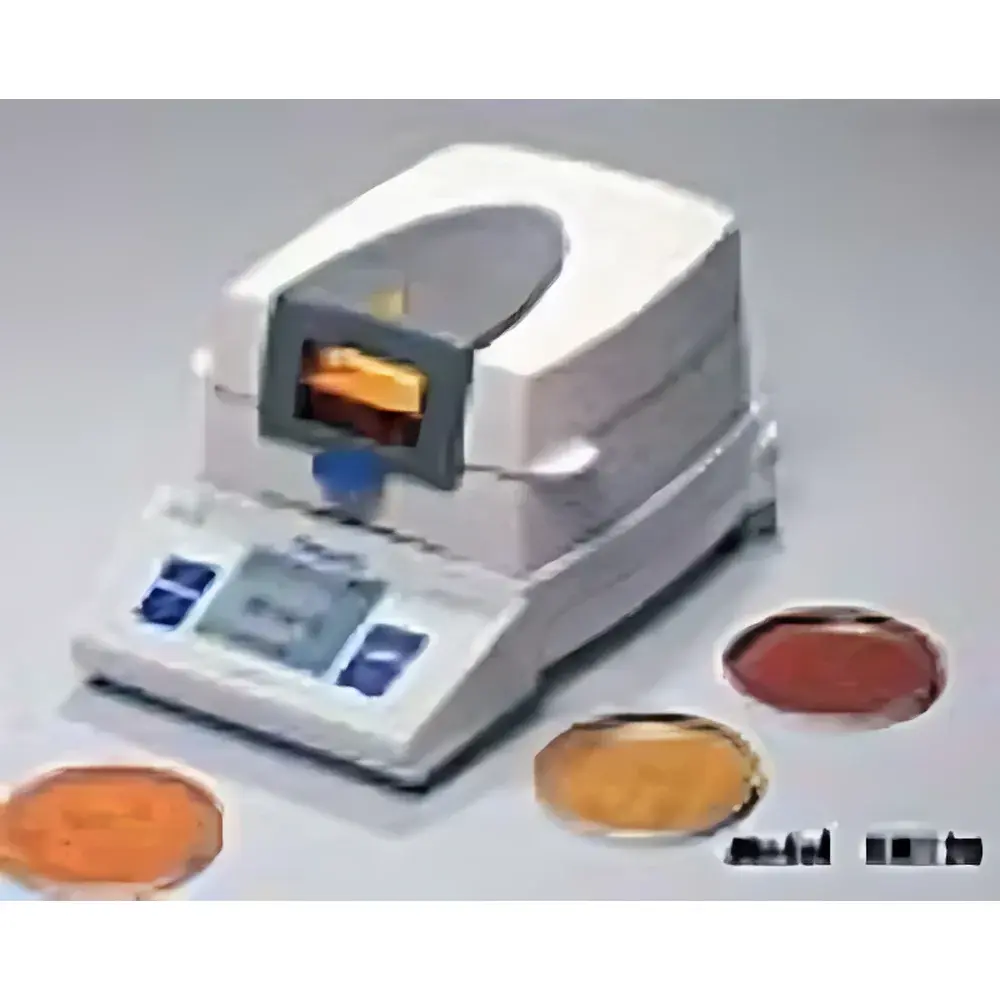
Precisa XM120 Infrared Moisture Analyzer
| Brand | Precisa |
|---|---|
| Origin | Switzerland |
| Model | XM120 |
| Maximum Capacity | 124 g |
| Minimum Readability | 0.001 g |
| Moisture Resolution | 0.01% |
| Pan Diameter | 90 mm |
| Repeatability | ±0.2% (1 g sample), ±0.02% (10 g sample) |
| Heating Source | Halogen Lamp |
| Temperature Range | 30–230 °C |
| Temperature Increment | 1 °C |
| Drying Time Range | 0.1–99.9 min |
| Termination Modes | Automatic, Semi-Automatic (Δdigit/sec or Δ%/sec), Fixed-Time |
| Data Output Interval | 0.1–10.0 min |
| Password Protection | Yes |
| Statistical Functions | Count, Mean, Max, Min, Standard Error |
| Interface | RS232 |
| Memory | 50 Method Programs, 999 Test Records |
| Preheating | 30–100 °C |
| Multi-Stage Heating | 3 programmable segments (temp + time per stage) |
| Boost Mode | 140% target temp for first 3 min |
| Firmware Update | Remote via network |
Overview
The Precisa XM120 Infrared Moisture Analyzer is a high-precision, halogen-heated thermogravimetric instrument engineered for rapid, reproducible moisture content determination in solid and semi-solid samples across pharmaceutical, food, chemical, and materials quality control laboratories. It operates on the principle of loss-on-drying (LOD): sample mass is continuously monitored during controlled thermal drying, and moisture content is calculated as the percentage mass loss relative to the initial dry weight. Unlike conventional oven methods requiring hours, the XM120 achieves typical analysis times under 5 minutes—enabled by its focused halogen lamp heating system, which delivers uniform radiant energy with minimal thermal inertia and precise surface temperature control. Designed and manufactured in Switzerland, the instrument complies with fundamental metrological requirements outlined in ISO 8573-8, ASTM D4442, and USP <921>, and supports audit-ready workflows essential for GLP and GMP environments.
Key Features
- Halogen lamp heating system with fast thermal response and stable output—enabling consistent drying kinetics and reduced inter-sample variability.
- High-resolution weighing unit with 0.001 g readability and 124 g maximum capacity, calibrated internally with traceable standards.
- Backlit capacitive touchscreen interface with intuitive navigation, real-time mass curve visualization, and dynamic parameter adjustment during active runs.
- Ergonomic pan handle design—thermally insulated to prevent operator contact with heated surfaces during loading/unloading.
- Three-stage programmable heating profile: independent temperature and duration settings for preheat, main drying, and gentle finish phases—optimized for heat-sensitive or heterogeneous matrices.
- Boost mode: automatically elevates heater output to 140% of setpoint for the first 3 minutes to accelerate initial water evaporation without compromising sample integrity.
- Multi-criteria termination logic—including automatic endpoint detection (mass change threshold), time-based stop, and user-defined rate-of-loss thresholds (g/sec or %/sec).
- Comprehensive data security: password-protected method editing, dual-level access control, and physical lock mechanism for instrument immobilization.
Sample Compatibility & Compliance
The XM120 accommodates a broad range of sample types—including powders, granules, pellets, pastes, films, and filter cakes—with no requirement for solvent extraction or chemical reagents. Its 90 mm diameter stainless-steel pan ensures even heat distribution and accommodates representative sample masses from 0.5 g to 120 g. All operational parameters—including calibration logs, method configurations, and raw test records—are timestamped, user-annotated, and stored with immutable metadata (sample ID, batch number, operator, date/time). The instrument supports GLP-compliant reporting via integrated thermal printer, allowing customizable printouts that include mass curves, statistical summaries, and regulatory headers. Data export via RS232 enables seamless integration into LIMS or ELN platforms, and firmware architecture supports future alignment with FDA 21 CFR Part 11 requirements through configurable electronic signature and audit trail modules.
Software & Data Management
The XM120 stores up to 50 fully customizable drying protocols and retains complete records of 999 analyses—including initial mass, final mass, elapsed time, ambient conditions (if externally logged), and derivative metrics (moisture %, dry matter %, weight loss rate). Each record is indexed with unique identifiers and searchable by date range, sample ID, or operator code. Statistical functions compute mean, standard deviation, max/min values, and coefficient of variation across batches—critical for SPC implementation. Firmware updates are delivered remotely over Ethernet or USB, ensuring continuous compliance with evolving analytical standards without onsite service intervention. Exported CSV files contain structured columns compatible with Excel, Minitab, and JMP for advanced trend analysis and validation documentation.
Applications
- Pharmaceutical QC: verification of residual solvents and hygroscopicity in APIs and excipients per ICH Q5C guidelines.
- Food industry: moisture specification testing for flour, dairy powders, coffee beans, and pet food to ensure shelf-life stability and microbial safety.
- Chemical manufacturing: monitoring hydration state of catalysts, silica gels, and desiccants prior to packaging.
- Plastics & polymers: quantifying moisture in PET, nylon, and polycarbonate resins before extrusion to prevent hydrolytic degradation.
- Academic research: kinetic modeling of drying behavior using time-resolved mass loss datasets.
FAQ
What calibration standards are recommended for routine verification?
Certified weight standards traceable to NIST or PTB (e.g., 10 g and 100 g Class E2) should be used weekly; moisture reference standards (e.g., sodium tartrate dihydrate) are advised for performance qualification.
Can the XM120 comply with 21 CFR Part 11 requirements?
Out-of-the-box, it provides foundational elements (audit trail, user authentication, data integrity); full compliance requires documented SOPs, IT validation, and optional third-party e-signature add-ons.
Is method transfer between XM120 units straightforward?
Yes—method programs and calibration data can be exported/imported via USB or network, enabling identical test conditions across multiple instruments in multi-site operations.
How does halogen heating differ from infrared quartz or microwave methods?
Halogen lamps emit broadband near-infrared radiation (700–1400 nm) with superior penetration depth and lower peak surface temperatures than quartz IR, minimizing charring risks in organic samples.
What maintenance intervals are specified for optimal long-term accuracy?
Daily cleaning of the pan and chamber; annual recalibration of load cell and temperature sensor by an authorized Precisa service center—certified to ISO/IEC 17025.





