
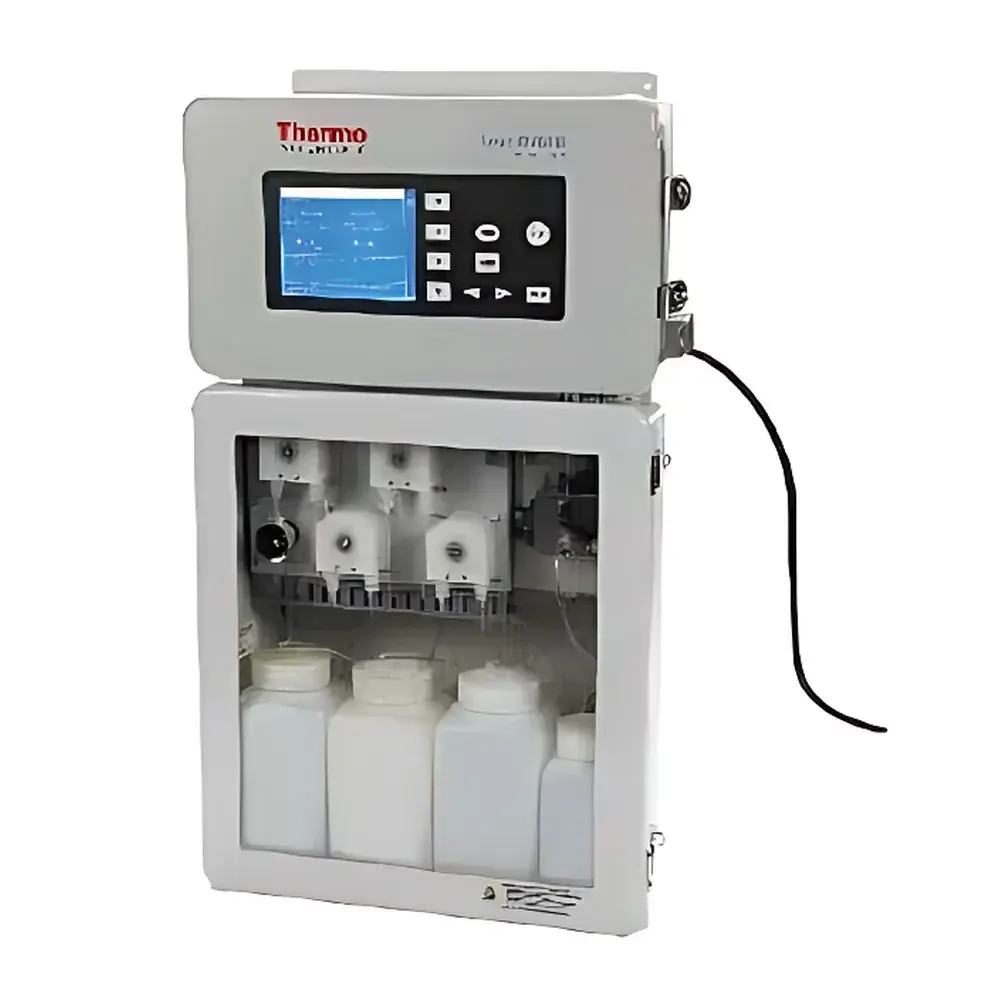
Thermo Scientific Orion 2210AM Online Ammonia Nitrogen Analyzer
| Brand | Thermo Fisher Scientific |
|---|---|
| Origin | USA |
| Manufacturer Type | Original Equipment Manufacturer (OEM) |
| Product Origin | Imported |
| Model | Thermo Scientific Orion 2210AM |
| Instrument Type | Online Analyzer |
| Measurement Principle | Colorimetric Method (Indophenol Blue Reaction) |
| Measurement Ranges | 0.01–2 mg/L, 0.05–10 mg/L, 0.5–50 mg/L, 5–500 mg/L (as N) |
| Accuracy | ±5% or ±0.01 mg/L (whichever is greater) within 0.01–50 mg/L |
| Detection Limit | 0.01 mg/L (as N) |
| Analysis Time | ≤30 minutes per cycle |
| Sample Throughput | Continuous online operation (no batch processing) |
Overview
The Thermo Scientific Orion 2210AM Online Ammonia Nitrogen Analyzer is an industrial-grade, fully automated water quality monitoring system engineered for continuous, real-time quantification of ammonia nitrogen (NH₃–N) in aqueous matrices. It operates on the standardized indophenol blue colorimetric method—compliant with ISO 7150-1, ASTM D1426, and EPA Method 350.1—where free ammonia reacts with hypochlorite and phenol under alkaline conditions to form a stable blue chromophore, measured photometrically at 630 nm. Designed for unattended deployment in municipal drinking water treatment plants, wastewater influent/effluent streams, surface water monitoring stations, and industrial process loops, the 2210AM delivers high reproducibility across four user-selectable measurement ranges without hardware modification. Its robust architecture supports long-term stability in variable ambient environments, minimizing drift and operator intervention while maintaining traceability to NIST-traceable calibration standards.
Key Features
- Four auto-switchable measurement ranges: Seamlessly configurable from 0.01–2 mg/L to 5–500 mg/L (as N), enabling single-instrument deployment across source water, distribution systems, biological nutrient removal (BNR) basins, and industrial discharge points.
- Software-defined range switching: Range transitions require only parameter reconfiguration via the embedded HMI or remote SCADA interface—no reagent kit replacement, pump recalibration, or optical path adjustment needed.
- Temperature-controlled reaction chamber: Integrated Peltier-heated cuvette block maintains precise 37 °C reaction temperature during color development, eliminating thermal variance as a source of inter-sample bias.
- Micro-dosing fluidics: Optimized peristaltic and syringe pump architecture delivers sub-milliliter reagent volumes per analysis, reducing chemical consumption by >40% versus conventional analyzers and lowering hazardous waste generation per 1,000 measurements.
- Self-diagnostic system: Real-time monitoring of LED intensity, photodiode response, reagent depletion status, and flow integrity—with automated fault logging and event-triggered alerts via Modbus TCP or 4–20 mA outputs.
Sample Compatibility & Compliance
The 2210AM accepts raw, filtered, or clarified liquid samples with turbidity ≤100 NTU and suspended solids <50 mg/L. It accommodates pH 6.0–9.0 without pre-adjustment and tolerates chloride concentrations up to 2,000 mg/L (as Cl⁻) without interference. All wetted components—including sample tubing, reaction coil, and flow cell—are constructed from chemically inert PTFE, FEP, and borosilicate glass to prevent adsorption or catalytic degradation of ammonia species. The analyzer complies with IEC 61326-1 (EMC), UL 61010-1 (safety), and meets the functional requirements of ISO/IEC 17025 for in-field calibration verification. Data integrity adheres to FDA 21 CFR Part 11 principles through audit-trail-enabled firmware, electronic signature support, and secure user role management (Admin, Operator, Viewer).
Software & Data Management
Embedded firmware v3.2+ provides local configuration via 7-inch capacitive touchscreen HMI or remote access through HTTPS-secured web interface. All measurement data—including raw absorbance values, temperature logs, reagent expiration timestamps, and diagnostic codes—are time-stamped with UTC synchronization and stored onboard for ≥90 days. Native integration with industry-standard protocols (Modbus RTU/TCP, OPC UA, MQTT) enables seamless ingestion into PI System, Ignition SCADA, or cloud-based platforms such as AWS IoT Core. Optional Orion Connect™ software adds automated report generation (PDF/CSV), trend visualization with statistical process control (SPC) limits, and alarm escalation via email/SMS based on configurable thresholds and duration logic.
Applications
- Drinking water treatment: Monitoring ammonia breakthrough post-chlorination, optimizing chloramine formation, and verifying compliance with WHO (0.2 mg/L) and US EPA (1.0 mg/L) guidance values.
- Wastewater process control: Feedback control of nitrification/denitrification tanks, early detection of ammonium loading surges, and effluent compliance reporting against NPDES permit limits.
- Surface and groundwater surveillance: Long-term trend analysis in river basins, reservoirs, and aquifer recharge zones impacted by agricultural runoff or septic leachate.
- Industrial process monitoring: Ammonia concentration control in semiconductor rinse water, pharmaceutical buffer preparation, and food & beverage cooling tower chemistry management.
FAQ
Does the 2210AM require daily manual calibration?
No. The analyzer performs automatic zero and span verification every 24 hours using factory-certified standard solutions; manual calibration is required only after maintenance events or when QA/QC protocols mandate it per GLP guidelines.
Can it operate in outdoor enclosures with temperature fluctuations?
Yes. With optional thermostatically controlled cabinet (–10 °C to +50 °C ambient rating), the unit maintains internal thermal stability and meets IP66 ingress protection for rain, dust, and hose-directed water exposure.
Is method validation documentation available?
Yes. Thermo Fisher provides a complete Method Validation Package including precision/recovery studies, interference testing reports (e.g., Ca²⁺, Mg²⁺, Fe³⁺, NO₂⁻), and third-party verification data aligned with ISO/IEC 17025 scope.
What reagents are consumed during operation?
Sodium hypochlorite (NaOCl), sodium salicylate, and sodium nitroprusside—supplied in stabilized, pre-measured cartridges with barcoded lot tracking and shelf-life monitoring integrated into the firmware.
Related Products







