
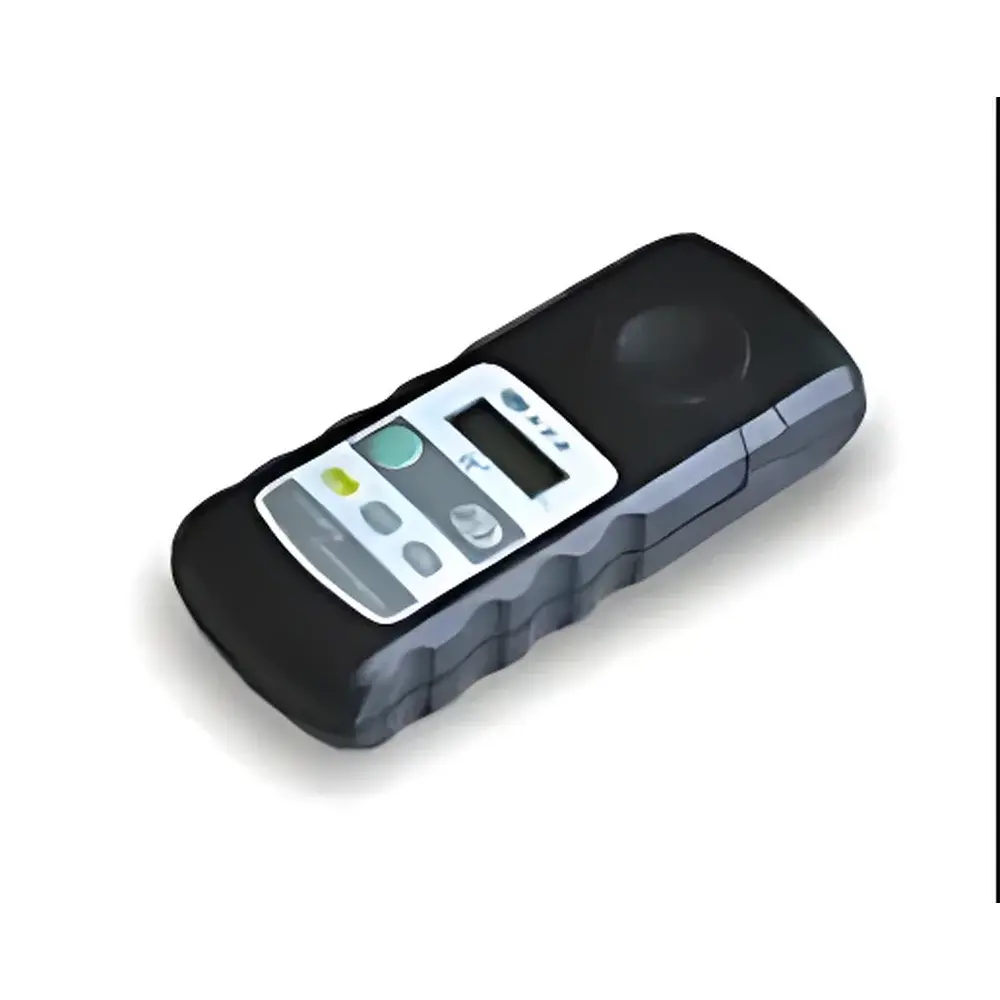
Beifen Sanpu Q-CL501C Portable Free Chlorine Analyzer
| Brand | Beifen Sanpu |
|---|---|
| Origin | Beijing, China |
| Manufacturer Type | Direct Manufacturer |
| Country of Origin | China |
| Model | Q-CL501C |
| Instrument Type | Portable/HANDHELD Water Quality Analyzer |
| Analyte | Free Chlorine (as Cl₂) |
| Detection Method | Iodometric Photometric Method |
| Measurement Time | ≤60 s |
| Range (Low) | 5–500 mg/L Cl₂ |
| Range (High) | 0.05–15.0% w/w Cl₂ (500–150,000 mg/L) |
| Resolution (Low) | 1 mg/L |
| Resolution (High) | 0.01% |
| Accuracy (Low) | ±10 mg/L at 200 mg/L Cl₂ |
| Accuracy (High) | ±0.25% at 5% Cl₂ |
| Dimensions | 160 × 62 × 30 mm |
| Weight | 0.15 kg |
| Power Supply | 2 × AA alkaline batteries |
Overview
The Beifen Sanpu Q-CL501C Portable Free Chlorine Analyzer is a field-deployable photometric instrument engineered for rapid, on-site quantification of free chlorine concentration in high-chlorine disinfection applications. It operates on the iodometric photometric principle: free chlorine oxidizes iodide (I⁻) to iodine (I₂) under acidic conditions; the liberated iodine forms a yellow-brown complex with starch or reacts stoichiometrically with a chromogenic reagent, generating absorbance proportional to chlorine concentration. This method conforms to foundational principles outlined in Standard Methods for the Examination of Water and Wastewater (2017, Method 4500-Cl G) and ISO 7393-2:2018 (Water quality — Determination of free chlorine and total chlorine — Part 2: Colorimetric method). Designed for robustness in non-laboratory environments—including wastewater treatment outfalls, aquaculture ponds, hospital sterilization units, and food processing rinse lines—the Q-CL501C integrates optical stability, environmental sealing, and battery-powered autonomy to deliver reproducible results without external calibration hardware or PC connectivity.
Key Features
- Field-optimized photometric detection with dual-range capability: low-range (5–500 mg/L) for precise monitoring of residual disinfectant levels and high-range (0.05–15.0% w/w) for concentrated bleach solutions, sodium hypochlorite stock tanks, and chlorinated lime suspensions.
- Integrated optical path sealed against dust, moisture, and chemical vapor ingress—validated per IP65-equivalent enclosure integrity for operation in humid, saline, or fume-rich environments (e.g., chlorination contact chambers, hatchery water intakes).
- Pre-formulated, single-use reagent sachets eliminate pipetting, dilution errors, and cross-contamination risks; no auxiliary glassware or volumetric equipment required.
- Stable LED light source and precision photodiode detector ensure long-term signal repeatability; temperature-compensated algorithm minimizes drift across 5–40 °C ambient operating range.
- Compact form factor (160 × 62 × 30 mm) and ultra-light mass (150 g) enable one-handed operation and extended field use on belt clips or in glove compartments.
Sample Compatibility & Compliance
The Q-CL501C is validated for direct analysis of aqueous samples containing sodium hypochlorite (NaOCl), calcium hypochlorite (Ca(OCl)₂), dichloroisocyanuric acid (NaDCC), chlorinated lime, and commercial bleach formulations. It accommodates turbid or colored matrices up to 50 NTU without filtration, provided sample pH remains between 3.5 and 7.0 during reaction. The iodometric method inherently excludes interference from monochloramine (NH₂Cl) and dichloramine (NHCl₂), making it selective for free (uncombined) chlorine species. While not certified to ISO/IEC 17025 for accredited testing, the instrument supports GLP-aligned documentation when used with traceable reference standards (e.g., NIST-traceable potassium iodate solutions) and operator logbooks. Its measurement protocol aligns with US EPA guidance for field verification of disinfectant dosing in emergency response and routine infrastructure maintenance.
Software & Data Management
The Q-CL501C operates as a standalone, firmware-controlled system with no embedded software stack, cloud interface, or data export capability. All calculations—including range switching, blank subtraction, and unit conversion (mg/L ↔ %)—are performed in real time by onboard microcontroller logic. Results are displayed as numeric readouts only (no graphical plots or trend storage). For regulatory traceability, users must manually record measurements alongside time/date, sample ID, lot number of reagent sachet, and environmental notes in bound laboratory notebooks or LIMS-integrated paper forms. No firmware updates or cybersecurity patches are issued; device lifecycle management follows industrial handheld instrument conventions (typical service life >5 years with proper battery replacement and optical window cleaning).
Applications
- Verification of sodium hypochlorite concentration in municipal water treatment plant feed tanks prior to dosing.
- Routine monitoring of free chlorine residuals in recirculating aquaculture systems (RAS) to prevent fish gill damage while maintaining pathogen control.
- On-the-spot validation of disinfectant strength in hospital endoscope reprocessing workflows per AAMI ST58 requirements.
- Quality assurance of bleach-based sanitizers in food manufacturing CIP (clean-in-place) cycles, aligned with FDA Food Code §3-301.12.
- Emergency response assessment of chlorine demand in flood-affected wells or temporary field hospitals using liquid chlorine donors.
- Validation of dechlorination efficiency in wastewater effluent prior to aquatic discharge, supporting compliance with local NPDES permit limits.
FAQ
What chlorine species does the Q-CL501C measure?
It measures free chlorine (hypochlorous acid HOCl and hypochlorite ion OCl⁻) exclusively, not combined chlorine (chloramines) or total chlorine.
Can the instrument be calibrated with NIST-traceable standards?
Yes—users may perform manual two-point calibration using certified potassium iodate (KIO₃) standard solutions prepared per ASTM D1253-22 Annex A1.
Is the device suitable for seawater or brine applications?
Yes, provided sample turbidity remains below 50 NTU and chloride ion concentration does not exceed 10,000 mg/L; high salinity may require matrix-matched calibration.
How often must the optical path be cleaned?
The sealed cuvette chamber requires cleaning only if visible residue accumulates after ≥200 tests; use lint-free swabs moistened with deionized water.
Does the analyzer meet FDA 21 CFR Part 11 requirements?
No—it lacks electronic audit trails, user authentication, or electronic signature functionality; it is intended for non-GxP field screening, not regulated release testing.







